
School Open House Follow-Up: Converting Campus Tours Into Enrollment Applications
The Gap Between Campus Tour and Submitted Application
A family that visits your campus has already done something remarkable. They researched your school, found a tour date, coordinated their schedules, loaded their children into the car, and spent 90 minutes walking your hallways. That is genuine, demonstrated interest — far more committed than a website visit or a downloaded brochure. And yet, most private schools convert fewer than half of campus tour families into submitted applications.
The failure is almost never about the tour itself. School directors routinely report that tour families leave enthusiastic, ask thoughtful questions, and express genuine excitement. The gap happens in the days and weeks after the tour ends, when families return to their busy lives, competing priorities accumulate, and the school that inspired genuine excitement during the visit fades from active consideration simply because the follow-up was too slow, too generic, or too infrequent.
This article covers the design and implementation of automated follow-up sequences specifically for school campus tours and open houses — a fundamentally different challenge from real estate open house follow-up, which our guide to open house follow-up automation for real estate addresses in depth. Education admissions follow-up is distinguished by longer decision timelines, multi-stakeholder family decisions, grade-level-specific program information, financial aid complexity, and the ongoing relationship that makes aggressive sales tactics counterproductive.
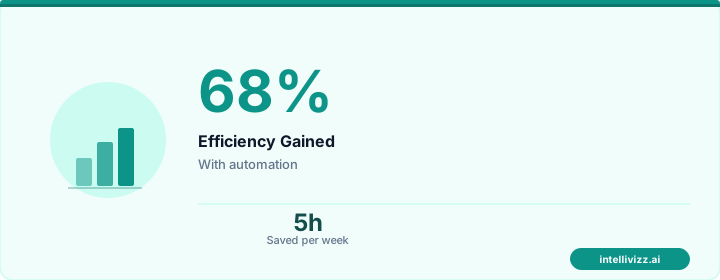
🏫 From Campus Tour to Completed Application
Personalized follow-up sequences that convert tour families into enrolled students
Why Generic Follow-Up Fails Admissions
The most common school follow-up approach after a campus tour is a single thank-you email sent within 24 hours, followed by silence until the application deadline approaches. This approach fails for several overlapping reasons:
- Timing mismatch: Families rarely make school enrollment decisions within 48 hours of a tour. The actual decision process unfolds over weeks, often while the family is simultaneously touring competing schools. A single follow-up email sent immediately after the tour does nothing to maintain presence during the active comparison phase.
- Generic content: A thank-you email that references "our program" without acknowledging the specific grade level, interests, or questions the family raised during the tour signals that the school is not paying close attention — precisely the opposite of the personal attention private schools promise.
- Missing the second parent: Many campus tours are attended by one parent, with the other parent making the final decision after reviewing information at home. Follow-up sequences that address only the attending parent miss the decision-maker entirely.
- No clear next step: Without a specific, low-friction next action — scheduling a shadow day, requesting a financial aid meeting, submitting a preliminary interest form — families who are genuinely interested have no obvious path forward and default to inaction.
Segmenting Tour Families for Personalized Follow-Up
Effective school open house follow-up begins with capturing structured information at registration, not just a name and email address. A tour registration system should collect — at minimum — the grade level(s) of interest, the anticipated enrollment year, whether the family has other children who might also enroll, and whether financial aid information is needed. These data points drive the personalization that makes the difference between a follow-up that feels genuinely helpful and one that feels like a mass email blast.
Segmentation Variables That Matter in Education Admissions
| Variable | Why It Matters | How It Shapes Follow-Up |
|---|---|---|
| Grade level of interest | Program information, class size, teaching approach, and transition concerns differ dramatically by level | Different content tracks for Lower School (K-5), Middle School (6-8), and Upper School (9-12) |
| Enrollment year | A family enrolling next fall has a different urgency and timeline than a family planning for two years out | Deadline-driven urgency for near-term enrollment; nurture sequence for future-year families |
| Multi-child family | Families with multiple children in different grade levels have compounded logistics and financial considerations | Dedicated multi-child messaging addressing sibling enrollment coordination and tuition considerations |
| Financial aid interest | Financial aid families have additional steps, earlier deadlines, and specific anxiety about affordability | Early financial aid deadline reminders, affordability messaging, net price calculator links |
| Referral source | A family referred by a current parent has a warm relationship to leverage; a cold organic inquiry does not | Activate referral parent for testimonial outreach; direct connection offer between referred and referring family |
The Post-Tour Follow-Up Sequence Architecture
The sequence below represents a high-performing framework for private school admissions follow-up after a campus tour. It is designed to maintain meaningful presence over a 6–8 week window without overwhelming families or triggering the unsubscribe that ends the relationship.
Day 1: The Personalized Thank-You
Sent within 2–4 hours of the tour's end, this message references specifics: the grade level, the name of the admissions director or guide who led the tour, and — if captured during registration or the tour itself — specific interests mentioned by the family ("We noticed you asked about our robotics program. Here is a link to our STEM showcase from last spring"). The message includes a direct link to the application portal and a calendar link for scheduling a follow-up call with the admissions director.
Day 3: Grade-Level Program Deep Dive
A content piece specific to the grade level of interest. For Lower School families, this might be a letter from the division head about the early literacy approach and classroom culture. For Upper School families, a breakdown of college placement results and AP/IB program offerings. This message positions the school as a genuine source of education expertise, not just a promotional entity. It is the message most likely to be forwarded to the second parent who did not attend the tour.
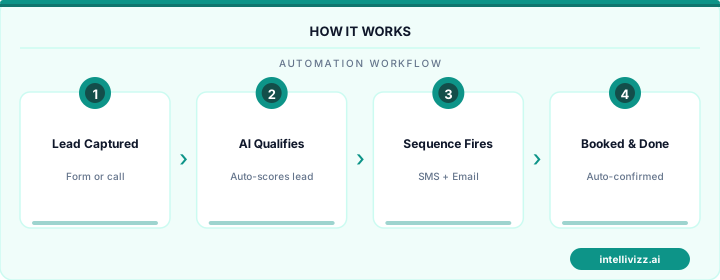
📬 Six Weeks of Purposeful Follow-Up
Each message serves a specific role in the admissions decision process
Day 7: Student Shadow Day Invitation
A shadow day — where a prospective student spends a morning attending classes alongside a current student in their grade — is the single highest-converting activity in private school admissions. Families who complete a shadow day apply at dramatically higher rates than those who only attended a group tour. The Day 7 message offers available shadow day dates and a single-click registration link. For Middle and Upper School prospects, it can include a student testimonial video or a letter from a current student ambassador.
Day 14: Financial Aid Information (Segmented)
For families who indicated financial aid interest at registration, this message provides the financial aid calendar, the net price calculator link, and an invitation to a financial aid information session. Affordability concerns are the most common reason qualified, interested families do not submit applications — often because they assume the answer is "no" before they have asked the question. Proactive financial aid communication reduces this self-elimination and ensures the school is selecting from its full pool of qualified families rather than only those who assumed they could afford full tuition.
For families who did not indicate financial aid interest, the Day 14 message covers a different angle: community, extracurricular programs, or an upcoming school event to which the family can be invited as guests.
Day 21: Re-Engagement Check-In
A brief, warm message that acknowledges the family's busy schedule and offers a direct line to the admissions director for any questions. This message includes a simple response option — "Still interested / Exploring options / No longer considering" — that helps the admissions team prioritize personal outreach. Families who respond "Exploring options" receive a personalized call from admissions. Families who respond "Still interested" receive an application deadline reminder. This behavioral data is valuable for pipeline management and for private school admissions CRM reporting.
Day 35: Application Deadline Urgency
With the application deadline in view, this message provides the specific deadline, the exact steps required to complete the application, and direct links to each required component (application form, teacher recommendation request, transcript release, application fee). For multi-child families, this message explicitly addresses the logistics of submitting applications for multiple children simultaneously.
Day 42–50: Final Outreach and Waitlist Invitation
For families who have not yet applied, a final message that acknowledges the decision timeline, offers a direct call with the admissions director, and — if appropriate for the school's admissions philosophy — mentions that waitlist consideration is available for families who are still evaluating. This message should feel human and warm rather than a final sales push, preserving the relationship for future consideration even if the family chooses not to apply in the current cycle.
Handling Multi-Child Families
Families with multiple children simultaneously entering different grade levels present unique follow-up complexity. The standard segmented sequence — built around a single grade level — fails when a family is evaluating your school for a third grader and a seventh grader at the same time. Multi-child family follow-up requires: Related: learn how campus tour no-show recovery systems can re-engage families who missed their scheduled visit.
- Consolidated communications: Two separate single-grade email sequences sent to the same parent inbox create confusion and signal that the school does not recognize the family as a unit. The follow-up system should detect multi-child families and deliver coordinated, consolidated messaging.
- Combined program information: A single message that addresses both grade level program content, with explicit acknowledgment of the family's complete situation ("We loved meeting you and both of your children during Tuesday's tour").
- Sibling enrollment logistics: Many private schools offer sibling discounts on tuition or application fees. Proactively communicating these benefits in early follow-up messaging is highly effective at converting multi-child families who might otherwise hesitate at the combined financial commitment.
- Coordinated shadow day scheduling: Offering both children shadow day experiences on the same day, so parents do not have to make multiple trips to campus, removes a practical barrier to the highest-converting admissions activity.
Re-Engaging Families Who Toured But Did Not Apply
Every school's admissions pipeline includes families who attended a tour, engaged with follow-up communication, and then went silent — neither applying nor formally withdrawing. These families represent a recoverable segment that standard admissions practice leaves entirely on the table.
A structured re-engagement campaign for non-applicants, launched after the application deadline passes, can recover a meaningful percentage of these families for the following year's admission cycle or for mid-year enrollment if spots open. This campaign is distinct from the active follow-up sequence and operates on a much longer timeline: a warm check-in at three months post-tour, a program update at six months, and a new open house invitation the following fall. The school enrollment funnel automation guide covers the broader pipeline architecture, including these long-cycle re-engagement workflows.
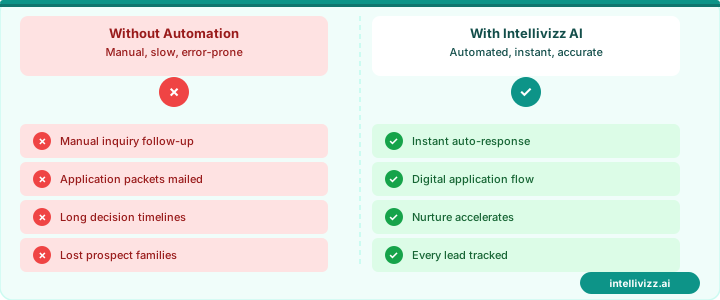
🔄 Never Lose a Warm Prospect Permanently
Re-engagement sequences recover families who toured but didn't apply
Measuring Open House Follow-Up Performance
School admissions directors managing follow-up automation should track a specific set of conversion metrics to evaluate sequence effectiveness and identify optimization opportunities:
| Metric | Typical Manual Result | Automated Target |
|---|---|---|
| Tour-to-application conversion rate | 25–40% | 50–65% |
| Shadow day scheduling rate (post-tour) | 10–20% | 30–45% |
| Shadow day-to-application conversion | 65–75% | 75–85% |
| Financial aid inquiry rate (FA-flagged families) | 30–50% | 60–75% |
| Multi-child family application rate | 20–35% | 40–55% |
| Follow-up email open rate | N/A (manual) | 45–60% |
For schools building out a complete admissions automation infrastructure — from inquiry capture through tour booking, follow-up sequences, application processing, and enrollment confirmation — the complete guide to automating the school enrollment process provides the end-to-end architecture. And for schools managing the post-application experience — accepted student communication, deposit collection, and enrollment completion — our guide to school enrollment automation covers the full pipeline from acceptance through first day of school.
The families who walk out of your campus tour are your highest-quality prospects. Building a follow-up system sophisticated enough to match the quality of that initial experience — personalized, timely, attentive, and sustained over the actual decision timeline — is the most direct investment a private school admissions office can make in improving enrollment outcomes.
Ready to modernize your school's operations? Explore our education automation solutions, or read our guide to Automated Enrollment Follow-Up for Private Schools:....
Relevant AI Automations
AI Review Management
All-in-one review management: automated review requests, AI-powered responses, and review repurposing for web & social — 3 engines in 1.
Missed Call Text-Back
Instantly respond to missed calls from prospective parents with AI-powered SMS, capturing enrollment leads 24/7
AI Voice Agent - Inbound
AI answers calls 24/7, handles FAQs about programs, tuition, availability, and books tours