
Private School Enrollment Software in Washington DC: Navigating the DMV's Competitive Admissions Landscape
The DC Metro Private School Admissions Landscape
The Washington DC metropolitan area — encompassing the District of Columbia, Montgomery and Prince George's Counties in Maryland, and Arlington, Fairfax, Alexandria, and Loudoun Counties in Virginia — is home to one of the most competitive private school markets in the United States. Families in the DMV have access to an exceptionally deep bench of independent school options: elite day schools in Northwest DC and Georgetown, progressive independent schools in Chevy Chase and Bethesda, classical and faith-based schools throughout Northern Virginia, and a tier of highly regarded regional independent schools from Rockville to Reston to McLean.
The competitive dynamics of DMV private school admissions are distinctive. First, the applicant pool is extraordinarily credentialed — DC draws high-achieving families through federal government employment, international organizations (World Bank, IMF, embassies), law firms and lobbying groups, and a tech sector that rivals the coasts. These families approach school selection with the same rigor they apply to their professional work: extensive research, multiple school visits, and simultaneous applications to five to eight schools. Second, the DMV's geographic diversity creates unusual enrollment patterns — families in McLean and families in Capitol Hill are both private school families but are accessing completely different school networks, and schools in each sub-market face different competitive pressures. Third, the diplomatic and international community creates a unique enrollment complexity: families who arrive mid-year from abroad, who may not have complete academic records in English, and who have enrollment timelines that do not align with standard September admission cycles.
What Private School Enrollment Software Must Handle in the DMV Market
Generic enrollment management software designed for average markets often falls short for DMV private schools. The specific requirements of this market include:
- Multi-round application management: Many DC-area private schools run rolling admissions with multiple rounds (Early Action in October-November, Regular Decision in January-February, Late Round in March-April). Each round requires different communication sequences, decision timelines, and deposit deadlines.
- Sibling priority and legacy tracking: Established families with siblings already enrolled or legacy connections to the school expect priority treatment in the admissions process. Enrollment software must flag these relationships and route their applications appropriately.
- Financial aid integration: DC-area private schools range from $20,000 to $60,000+ in annual tuition. A substantial portion of enrolled families receive some form of financial aid, often processed through NAIS-affiliated systems (FACTS, SSS by Blackbaud). Enrollment software must integrate with financial aid processing platforms and manage the aid award communication sequence alongside the admissions decision sequence.
- Re-enrollment campaign management: Current families re-enrolling for the following year are as important to manage as new applicants. In a competitive market, families who feel undervalued or uncommunicated-with during re-enrollment will explore alternatives — and in the DMV, there are always alternatives.
- International and diplomatic family workflows: Applications from foreign service families, diplomatic personnel, and international organization employees require specialized handling: evaluation of foreign transcripts and credentials, accommodating non-standard English language proficiency testing, and managing enrollment timelines that may span multiple school years.
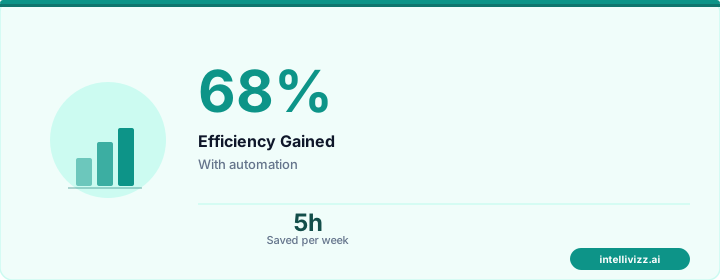
🏫 Built for the DMV's Competitive Admissions Environment
Enrollment management software that handles multi-round admissions, financial aid integration, and re-enrollment campaigns
Enrollment Management Software Platforms for Private Schools
The independent school market is served by several purpose-built enrollment management platforms that address the specific workflow requirements of private school admissions — from inquiry tracking through enrollment confirmation and re-enrollment.
Blackbaud Enrollment Management (formerly Enrollment Management Online)
Blackbaud's suite is the incumbent platform for many established independent schools, particularly those that are also Blackbaud Raiser's Edge users for development and alumni relations. The platform covers the full admissions workflow: online inquiry forms, application management, interviewing and visit scheduling, decision communication, contract execution, and re-enrollment. Financial aid integration through SSS (School and Student Services) is seamless within the Blackbaud ecosystem. The platform's depth is its strength — and its complexity is its limitation, particularly for schools that lack dedicated enrollment software administrators.
Ravenna / TADS
Ravenna is the dominant application platform in many competitive urban markets, including DC. Families applying to multiple schools prefer Ravenna because it allows them to manage applications to multiple schools through a single parent portal — reducing the administrative burden of applying to eight schools simultaneously. For schools in markets where Ravenna family adoption is high (and DC is one), being on the Ravenna platform means meeting families where they are rather than asking them to manage a separate login and workflow for your school. TADS (formerly tuition management, now a comprehensive enrollment and financial aid platform) integrates with Ravenna for schools that want a unified system.
Finalsite Enrollment (formerly Enrollment Rx)
Finalsite's enrollment module integrates with its website CMS, making it an attractive option for schools that manage their marketing and enrollment through a unified platform. The integration between marketing automation (tracking which pages a prospective family visits on the school website, what events they register for, what content they download) and admissions CRM (linking that digital behavior to the family's inquiry and application record) is a genuine competitive advantage for admissions teams that want insight into a family's engagement level before the application is submitted.
Veracross
Veracross is an enterprise-grade school information system used by larger independent schools that want a single platform covering admissions, enrollment, student information, learning management, development, and finance. For schools with 500+ students and complex organizational requirements, Veracross's integrated architecture eliminates the data synchronization problems that plague schools using separate point solutions for each function. The DC area has significant Veracross adoption among larger independent schools in Maryland and Northern Virginia.
Automating the Inquiry-to-Application Pipeline
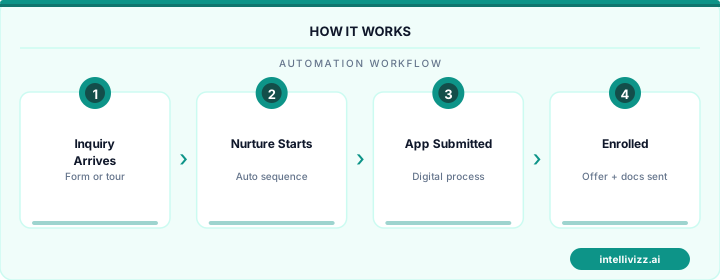
The first critical automation for any private school admissions office is the inquiry-to-application pipeline — the sequence of interactions that moves a family from initial interest to submitted application. In the DMV market, where families are researching multiple schools simultaneously, speed and personalization of response are competitive differentiators.
Automated Inquiry Response Sequence
- Immediate inquiry acknowledgment (T+0): An automated response sent the moment an inquiry form is submitted — thanking the family, confirming receipt, and providing specific next steps (schedule a tour, access the online viewbook, learn about application requirements). This response should be personalized based on the grade level of interest and the inquiry source (website, open house, word of mouth).
- Admissions team follow-up (T+24–48 hours): A triggered task for an admissions counselor to make personal contact — phone call or email — with families who have not scheduled a tour or requested application materials within 24 hours of the initial inquiry. In DC's competitive market, families who do not hear from your school within 48 hours of an inquiry often complete their research and begin applications at other schools before your admissions team calls.
- Information packet and application invitation (T+3–5 days): For families who have engaged with the acknowledgment but have not yet applied, a curated information packet — grade-specific programming information, the school's unique value proposition, faculty and student profiles, financial aid overview — sent with an invitation to begin the application.
- Application deadline reminders (ongoing): For families who have started but not completed an application, automated reminders at 30, 14, 7, and 3 days before each round's application deadline. These reminders should include a direct link to the incomplete application in the parent portal and a contact number for admissions office assistance.
For a more detailed treatment of the general school enrollment automation framework, our guides on how to automate the school enrollment process and school enrollment funnel automation cover the pipeline design in depth. The DC-specific application of these frameworks adds the competitive market dynamics and multi-school application behavior that are distinctive to this geography.
Open House and Campus Tour Automation
The campus visit is the highest-converting engagement event in a private school's admissions pipeline. Families who complete a campus tour enroll at rates 3–5 times higher than families who do not visit. In the DMV market, where families are often scheduling visits to four to six schools in a compressed window (typically October–January), managing open house and tour registration efficiently is both an operational challenge and a competitive opportunity.
Open House Management Workflow
- Registration and confirmation automation: Automated registration confirmation with calendar invitation, pre-visit information packet (parking, arrival instructions, event agenda), and a short video or photo series introducing the campus and key faculty.
- Pre-event engagement sequence: A 3-email sequence in the 10 days before the open house, delivering curated content about the school's programs, philosophy, and student life. Families who have engaged with these emails before arriving at the campus have higher-quality visit conversations because they arrive with specific questions rather than general curiosity.
- Post-visit follow-up (T+24 hours): A personalized follow-up from the admissions counselor who met the family at the visit, with resources specific to the grade level of interest and a direct invitation to schedule an individual family interview.
- No-show recovery (T+1 day): For registered families who did not attend the open house, an automated "we missed you" message with an invitation to schedule an individual campus tour. Families who registered but did not attend are not disinterested — they are often simply dealing with schedule conflicts and need a second invitation.
🎓 Every Campus Visit Leads to the Next Step
Automated pre-visit sequences and post-visit follow-up increase open house to application conversion by 35–50%
Re-Enrollment Campaign Automation
Re-enrollment — the process of securing commitments from currently enrolled families for the following academic year — is often treated as an administrative formality at private schools. In competitive markets like DC, it is a retention campaign that deserves the same strategic attention as new student recruitment.
DC-area private school families are regularly recruited by peer institutions. A family whose child has had a difficult year socially, or who has encountered a budget challenge with tuition, or who has simply received a call from a competing school's admissions director, may quietly explore alternatives during the re-enrollment window. Proactive re-enrollment automation addresses this risk by:
- Celebrating the current year: Sending current families curated highlights of their child's year — classroom milestones, co-curricular achievements, community moments — before the re-enrollment communication arrives. Families who feel recognized and celebrated re-enroll at higher rates than families who only hear from the school when a contract or payment is due.
- Early re-enrollment incentives: An early commitment discount or priority scheduling benefit (preferred lottery position for high-demand electives, priority course selection, early summer program registration) for families who complete re-enrollment before a specified deadline. These incentives reward committed families and help the school forecast enrollment for budgeting purposes earlier in the year.
- Financial aid renewal automation: For families receiving financial aid, the re-enrollment process includes a financial aid renewal application. Automated reminders of financial aid renewal deadlines, with direct links to the renewal application, prevent families from missing deadlines and then feeling uncertain about their ability to re-enroll — which creates churn risk.
- Non-re-enrollment follow-up: For families who have not submitted re-enrollment contracts by the stated deadline, a personal outreach from the Head of School or Division Director — not the business office — asking whether there is anything the school can address to support the family's continued enrollment. This personal touch often surfaces concerns that are addressable (financial strain, social challenges, curriculum fit) before the family makes a final decision.
For schools that have implemented the re-enrollment campaign and are looking at the payment collection side — collecting tuition deposits and installment payments from newly re-enrolled families — our guide to tuition payment automation for private schools in the DMV covers the payment system integration, and school payment automation addresses the broader payment workflow. Related: learn how to increase private school enrollment with a complete growth strategy.
Financial Aid System Integration
Financial aid is central to the enrollment management strategy of virtually every DC-area private school that wants to maintain economic diversity in its student body. The financial aid workflow — application, needs assessment, award determination, award communication, and annual renewal — is a major source of administrative complexity and, if mismanaged, a significant source of family frustration and enrollment loss.
Automated financial aid communication should handle: acknowledgment of the financial aid application submission, status updates as the application moves through the review process, award notification with a clear explanation of the components (grant, loan, work-study if applicable), instructions for accepting or appealing the award, and the link between the financial aid acceptance and the enrollment contract completion. Families who experience delays, confusion, or impersonal communication during the financial aid process are more likely to choose a competing school — even one with a less generous award — because the operational experience signals how the school will treat them as a long-term family.
FACTS Financial Aid and SSS by Blackbaud are the dominant needs assessment platforms in the DC independent school market. Both produce standardized assessments that admissions committees use to determine award amounts. Integration between the needs assessment platform and the school's enrollment management software should automate the hand-off between needs determination and award letter generation, eliminating the manual data transfer that creates errors and delays.
Communication Automation for the DMV's International Community
Washington DC's international community creates a unique enrollment complexity: families arriving from abroad who may have non-standard enrollment timelines or academic records in foreign languages. Enrollment software supporting multilingual communication templates, rolling mid-year admissions, and credential evaluation integration is a meaningful differentiator for schools recruiting from diplomatic and international communities.
For broader context on enrollment automation across educational settings, the frameworks in school enrollment automation and school communication automation in Maryland provide applicable models that extend naturally to the DC and Virginia portions of the DMV market.
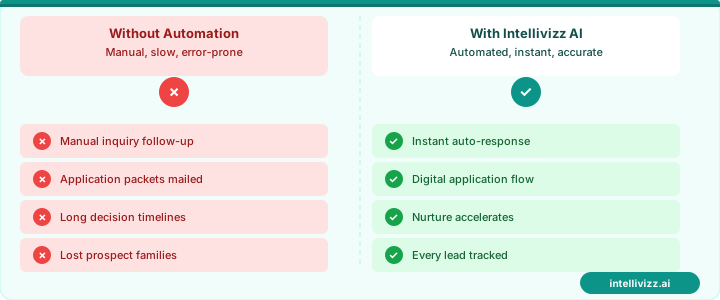
📋 Re-Enrollment That Retains and Renews
Proactive re-enrollment campaigns with financial aid integration protect tuition revenue year over year
Selecting Enrollment Software for Your DMV Private School
The right enrollment management platform depends on your school's size, existing technology stack, and admissions team capacity. Schools with strong Blackbaud relationships will find the most seamless implementation within that ecosystem. Schools in markets with high Ravenna family adoption — which DC increasingly is — benefit from meeting families on the platform they are already using. Schools that prioritize marketing-to-admissions integration should evaluate Finalsite Enrollment seriously.
The most important evaluation criteria: Does the platform integrate with your financial aid system? Does it support multi-round admissions cycles? Does it produce the communication sequences the DMV's sophisticated applicant families expect? And can your admissions team use it without a dedicated administrator during the high-volume January–March decision season? For implementation of automated communication sequences, our guide to school enrollment automation provides a practical workflow framework applicable across platforms.
Ready to modernize your school's operations? Explore our education automation solutions, or read our guide to Private School Admissions CRM: Managing the....
Relevant AI Automations
AI Review Management
All-in-one review management: automated review requests, AI-powered responses, and review repurposing for web & social — 3 engines in 1.
Missed Call Text-Back
Instantly respond to missed calls from prospective parents with AI-powered SMS, capturing enrollment leads 24/7
AI Voice Agent - Inbound
AI answers calls 24/7, handles FAQs about programs, tuition, availability, and books tours