
School Enrollment Automation: Streamlining the Administrative Pipeline from Application to First Day
The Enrollment Administrative Burden That Consumes Your Staff
Private school admissions teams operate under a paradox. The process that generates enrollment revenue — bringing new families from inquiry through committed enrollment — is also the process most likely to frustrate families, consume staff time, and introduce errors. A typical school managing 150–300 new inquiries per enrollment cycle will process thousands of individual interactions: application forms, document submissions, email follow-ups, deadline reminders, deposit collections, and onboarding packets. Much of this is handled through a combination of email, spreadsheets, and institutional memory.
This article focuses specifically on the operational and administrative side of school enrollment — the forms, documents, deadlines, deposits, and onboarding sequences that must be managed after a family has expressed interest. This is distinct from the enrollment marketing funnel (inquiry generation, tour scheduling, and family conversion sequences), which is covered separately in our guide to school enrollment funnel automation. The funnel gets families to apply; the operational pipeline gets them enrolled and through the door on the first day of school.
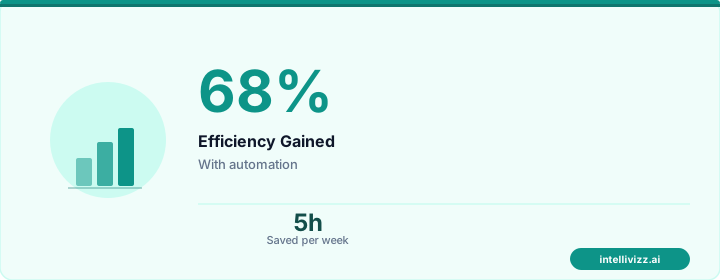
📋 From Application to First Day — Automated
Handle documents, deposits, and onboarding without adding administrative headcount
The Full Operational Enrollment Pipeline
The administrative enrollment pipeline for a private school or independent educational institution typically encompasses the following stages, each generating specific data requirements and staff touchpoints:
- Application submission and acknowledgment
- Application completeness review and document requests
- Document collection (immunization records, transcripts, recommendations)
- Admissions committee review and decision
- Acceptance notification and enrollment packet delivery
- Enrollment deposit collection and processing
- Enrollment contract execution
- Sibling enrollment linking and family account creation
- New family onboarding sequence (forms, orientation, portal access)
- First-day readiness confirmation
Each stage involves communication with families, document management, deadline tracking, and status updates across a school's enrollment management system. Without automation, each of these stages is a potential bottleneck — and in a competitive enrollment market, delays or friction at any point increase the probability that a family chooses a competing school.
Digital Application Processing: The Foundation
The digital application is the entry point for enrollment automation. A well-designed digital application does more than collect information — it validates data in real time, routes incomplete submissions to a follow-up sequence, and populates your enrollment management system (EMS) without manual data entry.
Application Platform Integration
Most private and independent schools use purpose-built enrollment management systems rather than generic CRMs. Key platforms in the independent school market include:
| Platform | Core Strengths | Best For |
|---|---|---|
| Veracross | Full school ERP with enrollment, SIS, billing, and parent portal in one platform | Mid-to-large independent schools wanting unified data |
| Blackbaud | Enrollment management integrated with fundraising and school operations | Large independent and parochial schools with complex development needs |
| TADS | Financial aid, enrollment, and tuition management with strong parent portal | Schools with complex financial aid processes |
| Smart Tuition | Tuition management with enrollment features; strong payment processing | Schools prioritizing tuition collection automation |
| SchoolAdmin | Admissions-focused with inquiry tracking, application management, and event registration | Schools wanting a dedicated admissions CRM |
The automation layer sits above these platforms, orchestrating communication sequences and document collection workflows based on status changes in the EMS. When a family completes an application in Veracross and their status changes to "Application Received," the automation layer triggers the acknowledgment sequence and begins the document collection workflow automatically.
Document Collection Automation
Document collection is the most administratively intensive phase of the enrollment pipeline. A typical private school enrollment package requires:
- Immunization records (state-mandated, with specific vaccine requirements by grade level)
- Previous school transcripts or report cards (multiple years for upper school applicants)
- Teacher and administrator recommendation letters
- Standardized test scores (SSAT, ISEE, or school-specific assessments)
- Physical examination documentation
- Learning support documentation (IEPs, 504 plans, psychological evaluations) where applicable
- Birth certificate and proof of residency
- Emergency contact and medical information forms
Manually tracking document receipt for 200 applicants means monitoring dozens of pending items per applicant, sending reminder emails when documents are overdue, and updating status records when items arrive. This work consumes enormous administrative capacity during the January–April enrollment peak when staff attention is also needed for family visits, committee meetings, and acceptance notifications.
Automated Document Collection Sequence
An automated document collection system assigns each required document to a family's checklist at application submission, based on the applicant's grade level and program. Families receive a personalized document portal link showing exactly which items are outstanding. The automated sequence then runs on a configurable schedule:
- Day 1 post-application: Welcome message with complete document checklist and portal link. Documents that can be submitted digitally have direct upload links.
- Day 7: Status summary email listing outstanding documents. For immunization records specifically, a note about state requirements and accepted formats reduces submission errors.
- Day 14: Reminder with escalating urgency if application deadline is approaching. Incomplete files cannot be reviewed by the admissions committee — this message makes the consequence explicit.
- Day 21 / deadline minus 7 days: Final reminder with admissions office phone number and email for families who need assistance. Some families have genuine difficulty obtaining historical records; automated systems should identify these cases so staff can offer targeted help.
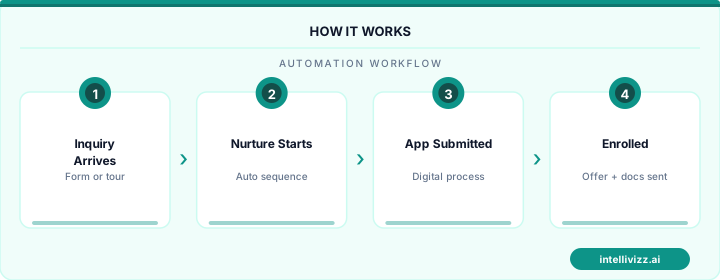
📂 Document Collection That Runs Itself
Personalized checklists and automated reminders keep applications moving forward
Sibling Enrollment Linking
Sibling enrollment creates a unique administrative challenge: a family with three children in different grade levels may be simultaneously managing three separate enrollment processes with partially overlapping document requirements. Without automation, each child's file is managed independently, creating redundant document requests and disjointed family communication.
A well-designed enrollment automation system identifies family relationships in the EMS and applies sibling linking logic:
- Shared document deduplication: Documents already on file for a sibling (birth certificate, insurance information, emergency contacts) do not require resubmission for a new enrollment, or are flagged for review rather than fresh collection.
- Consolidated family communication: Rather than sending separate emails for each child's outstanding items, a consolidated family status email shows all children's enrollment progress in a single view.
- Sibling discount and financial aid coordination: For schools with sibling pricing policies, sibling linking triggers the appropriate financial aid calculation or tuition schedule automatically.
- Enrollment decision sequencing: When a school makes admission decisions, sibling applications may be evaluated together or sequentially. Automation can hold enrollment contracts for younger siblings pending the older sibling's decision, or release them independently based on configurable school policy.
Enrollment Deposit Tracking and Collection
The enrollment deposit — typically ranging from $500 to $5,000 at independent schools, and representing the family's financial commitment to enroll — is a critical conversion milestone in the enrollment pipeline. The interval between acceptance notification and deposit deadline is the window during which families are most likely to choose a competing school, defer enrollment, or simply fail to complete the process due to friction.
Automated Deposit Sequence
- Acceptance notification with deposit instructions: The acceptance email or letter includes a direct link to the online deposit payment portal with clear instructions and the deposit deadline. Schools using paper-based acceptance letters lose significant conversion rate compared to schools that deliver acceptance with an embedded payment link.
- Day 3 post-acceptance: A warm follow-up congratulating the family and confirming the deposit deadline. This message can include links to upcoming new family events, student handbook previews, or summer program information to build enrollment momentum.
- Day 10 post-acceptance: A reminder that the deposit deadline is approaching, with the payment link prominently featured. For families who have not yet paid, this message may also mention that waiting list families are hoping for a spot — gentle scarcity without being coercive.
- Deadline minus 48 hours: Final reminder with clear deadline and payment link. After this point, families who have not paid may be contacted by phone by an admissions officer.
- Deposit received confirmation: Immediate confirmation upon deposit receipt, with next steps in the enrollment process and a warm welcome message reinforcing the family's decision.
For schools managing tuition collection and payment automation beyond the initial deposit, our guides to school payment automation and tuition payment automation for private schools cover the ongoing billing relationship in depth. You may also want to explore daycare enrollment automation for managing waitlists, licensing, and parent onboarding. For a deeper dive into priority queues and spot-acceptance workflows, see our guide on school waitlist management software. For a comprehensive growth strategy, see our guide on how to increase private school enrollment.
Post-Acceptance Onboarding Sequence
Enrollment automation extends beyond the deposit into the post-acceptance onboarding period — the 3–6 months between enrollment commitment and the first day of school. This period is administratively demanding and emotionally significant for families, particularly for new families who are joining the school community for the first time.
Onboarding Sequence Components
- New family welcome packet: Digital delivery of the student handbook, uniform policy, supply list, and community expectation documents. Digital delivery eliminates printing and mailing costs and allows tracking of whether families have accessed the materials.
- Form completion sequence: Health history forms, emergency contact updates, media release authorizations, technology acceptable use agreements. Each form is tracked; incomplete forms trigger reminders on a scheduled basis.
- Transportation and carpool registration: For schools with bus routes or carpool coordination, form completion and route assignment are managed through automated workflows.
- After-school care and activity registration: Links to extended care sign-up, fall sports registration, and elective course selection — delivered at the appropriate point in the summer timeline.
- Parent portal and LMS access provisioning: Automated account creation in the parent portal (Veracross, RenWeb, ParentsWeb) and learning management system once enrollment is confirmed and forms are complete.
- Orientation registration: New family orientation, student orientation, and curriculum night registration — distributed via the onboarding sequence at appropriate times.
The onboarding sequence also serves a retention function. Families who receive consistent, professional, and helpful communication during the summer months before school starts arrive on the first day with higher satisfaction scores and lower anxiety than families who received minimal communication. This matters for a school's reputation and for long-term enrollment retention.
For schools interested in building comprehensive parent communication systems beyond enrollment, our guide to parent communication automation covers the ongoing communication framework for enrolled families. And for schools in the Maryland and DMV region looking at regional compliance and operational considerations, school communication automation in Maryland addresses jurisdiction-specific requirements.
Measuring Enrollment Operations Performance
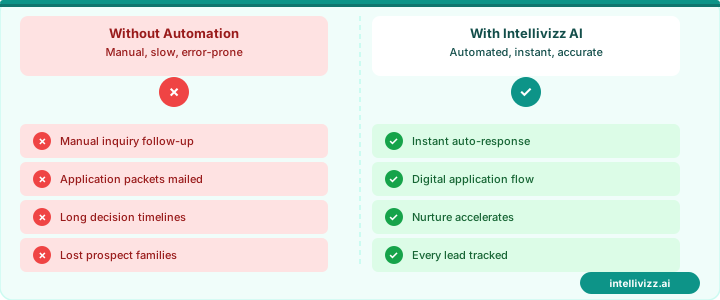
📈 Enrollment Operations KPIs That Matter
Track pipeline velocity, deposit conversion, and document completion to optimize enrollment outcomes
Enrollment operations automation should be evaluated against a specific set of administrative KPIs:
| KPI | Manual Baseline | Automated Target |
|---|---|---|
| Average document completion time | 18–28 days | 8–14 days |
| Application completion rate | 60–75% | 80–90% |
| Deposit conversion rate (accepted → deposited) | 55–70% | 72–85% |
| Time from acceptance to deposit | 14–21 days average | 7–12 days average |
| Staff hours per enrolled student (admin) | 8–15 hours | 3–6 hours |
| Onboarding form completion rate (by first day) | 60–75% | 88–96% |
Administrative staff freed from manual document chasing and status-update emails can redirect their capacity toward the high-value human interactions that genuinely differentiate schools in competitive markets: family relationship building, financial aid counseling, and the personalized admissions experience that influences a family's ultimate enrollment decision. Automation handles the pipeline; people handle the relationship.
Schools looking to implement enrollment automation should also read our guide to how to automate the school enrollment process for a broader overview of the full automation landscape, including marketing funnel and CRM integration considerations that complement the operational pipeline systems described here.
Ready to modernize your school's operations? Explore our education automation solutions, or read our guide to Private School Admissions CRM: Managing the....
Relevant AI Automations
AI Review Management
All-in-one review management: automated review requests, AI-powered responses, and review repurposing for web & social — 3 engines in 1.
Missed Call Text-Back
Instantly respond to missed calls from prospective parents with AI-powered SMS, capturing enrollment leads 24/7
AI Voice Agent - Inbound
AI answers calls 24/7, handles FAQs about programs, tuition, availability, and books tours