
School Waitlist Management Software: Priority Systems, Automated Updates, and Spot-Acceptance Workflows
The Hidden Complexity of a Private School Waitlist
From the outside, a school waitlist looks simple: a ranked list of families waiting for a spot to open. In practice, it is one of the most administratively complex systems a private school manages. A waitlist for a single grade level may need to account for legacy family status, sibling enrollment priority, geographic preference zones, diversity goals, teacher recommendations, and the admissions committee's discretionary judgments — all applied in real time as spots open and close unpredictably throughout the spring and summer.
Then there is the communication challenge. Waitlisted families are in a state of suspended decision-making. They cannot commit to an alternative school without losing their waitlist position, but they cannot plan for your school without confirmation. The school's obligation to these families — honest communication about realistic probability, timely notification when positions change, clear guidance on what they should do next — is both ethically significant and operationally demanding. Done manually, waitlist management consumes an outsized share of admissions director time during the highest-pressure period of the enrollment calendar.
School waitlist management software automates the administrative layer — position tracking, priority calculation, spot-notification workflows, deposit collection, and communication cadences — while keeping the admissions team in control of the decisions that require human judgment.
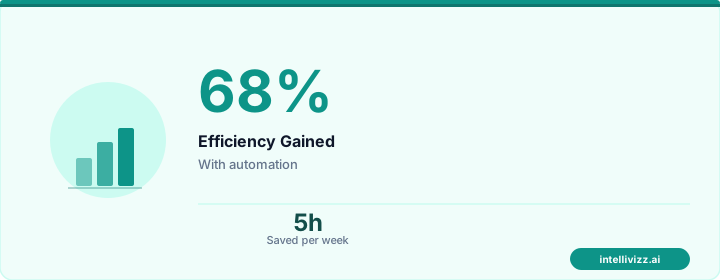
📋 Waitlist Management Without the Manual Work
Priority ranking, spot notifications, and deposit collection handled automatically
Priority Ranking System Design
Most private school waitlists are not pure first-come-first-served queues. They incorporate priority tiers that reflect the school's community values and enrollment goals. The specific priority structure varies by school, but the most common frameworks include:
Common Priority Tier Structures
| Priority Tier | Rationale | Implementation Notes |
|---|---|---|
| Siblings of currently enrolled students | Preserves family continuity; reduces the churn cost of families withdrawing an enrolled child to enroll a sibling elsewhere | Requires cross-reference against enrollment database at time of waitlist entry |
| Legacy families (alumni children/grandchildren) | Honors long-term school community relationships; supports donor relations | Requires verification of legacy connection; may be tiered by recency of alumni relationship |
| Faculty and staff children | Recruitment and retention benefit; supports teacher satisfaction | Straightforward database lookup; status changes if staff member leaves |
| Re-enrolling families (returning after absence) | Preserves relationships with families who left for practical rather than preference reasons | Requires distinction between voluntary withdrawal and financial withdrawal |
| Geographic preference (if applicable) | Community cohesion; transportation feasibility | Applies at boarding schools and schools with geographic mission requirements |
| General waitlist (date-ordered) | Fair queue for remaining families | Timestamp at application submission; tiebreaker by application completeness |
The critical operational requirement is that these priority rules be applied consistently and transparently. When a spot opens unexpectedly in June and the admissions director must determine the next family to contact from a 47-family waitlist, a system that automatically surfaces the correct next contact — accounting for all priority tiers, the specific grade level, and classroom capacity — eliminates both the administrative burden and the risk of inconsistent application that can damage school-family trust.
Classroom Capacity Tracking by Grade
Waitlist management is inextricably linked to classroom capacity — and private school capacity management is grade-specific in ways that make simple "available seats" tracking inadequate. Each grade level has its own target enrollment, its own classroom constraints, and its own staffing ratios. A spot that opens in fourth grade creates no capacity in fifth grade, even if the waitlists for both grades have families waiting.
Effective waitlist software maintains a real-time capacity dashboard by grade level and section, updated automatically when enrolled students withdraw, are retained, or transfer between sections. This dashboard drives the waitlist workflow: when a capacity threshold is reached (e.g., a grade drops to 18 students against a target of 22), the system identifies the next eligible family on the grade-specific waitlist and initiates the spot-offer sequence.
Rolling Admissions Complexity
Schools that practice rolling admissions — accepting students and making waitlist offers throughout the academic year rather than only during a defined spring cycle — face additional complexity. Mid-year spot availability tends to arise from family relocation, school transitions, and financial withdrawals. These openings are often urgent (the family needs a decision within days, not weeks), and the waitlisted family who receives the offer must make an equally rapid decision. Automated rolling admissions workflows must be calibrated for this urgency: faster notification sequences, shorter acceptance windows, and rapid deposit collection designed for the compressed timeline.
Automated Position Updates to Waitlisted Families
One of the most significant pain points for waitlisted families is the silence between application and resolution. When months pass without communication, families understandably assume their position is poor and begin committing elsewhere. The school then loses families who would have accepted an offer — because the family had to make a decision under uncertainty rather than with actual information.
Automated position update sequences address this directly. The communication cadence for waitlisted families should include:
- Initial waitlist placement notification: Sent within 24 hours of waitlist decision. Includes the family's current position (if the school shares specific position), the priority tier, the realistic timeline for decisions, and explicit guidance on what the family should do (or not do) while waiting. Includes contact information for questions and a direct line to the admissions director for significant life changes that might affect enrollment plans.
- Monthly status updates: A brief, honest update that communicates any changes in the family's position, notes the current enrollment status for the grade level, and reassures the family that they remain under active consideration. Families who receive regular updates are significantly more likely to remain available when a spot opens.
- Position movement notifications: When a family moves up on the waitlist — because another waitlisted family withdrew or because a priority-tier family declined — an automated notification informs them of the movement without requiring manual tracking by the admissions director.
- End-of-cycle closure: In late summer, when the school has exhausted its enrollment capacity for the current year, waitlisted families receive a clear, compassionate message closing the current cycle and offering a path to the following year's consideration — either maintaining waitlist status or re-applying through the standard process.
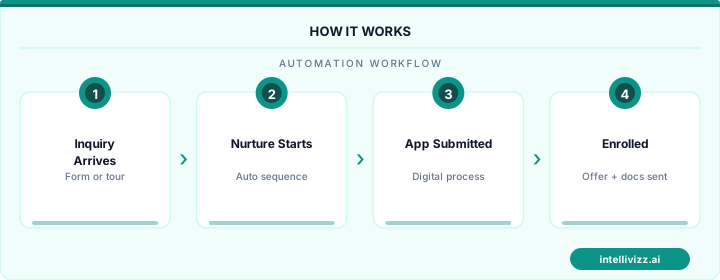
📨 Keep Families Informed, Keep Spots Filled
Regular automated updates reduce waitlist decay by 40-60%
Spot-Acceptance Workflows and Deposit Collection
When a spot opens and the next eligible family is identified, the speed and efficiency of the spot-offer workflow determines whether the school fills the seat or loses it. Families who have been waiting months are simultaneously considering alternatives — many have enrolled elsewhere "just in case" and are weighing the financial and logistical cost of switching. A slow or cumbersome spot-acceptance process tips the decision toward staying with the alternative.
High-Performing Spot-Offer Sequence
- Immediate spot offer notification: Delivered simultaneously by email and SMS, with a direct link to the acceptance portal. The message is warm and specific — it references the child by name, confirms the grade level and anticipated start date, and communicates the acceptance deadline clearly. Standard acceptance windows are 48–72 hours for standard waitlist offers; 24 hours for rolling admissions mid-year offers.
- Acceptance portal with integrated deposit collection: The acceptance link leads directly to a portal where the family can confirm enrollment and pay the enrollment deposit in a single session. Removing the friction between "I want to accept" and "I have formally committed" is critical. Families who must make a phone call, mail a check, or navigate to a separate payment portal to complete the acceptance are significantly more likely to delay — and delays in enrollment decisions almost always resolve in favor of the status quo (the alternative school).
- Acceptance deadline reminders: Automated reminders at 24 hours and 4 hours before the acceptance window closes. These reminders are not aggressive — they are genuinely helpful for families navigating a significant decision under time pressure.
- Declination workflow: When a family declines or allows the acceptance window to expire, the system automatically moves to the next eligible family on the waitlist and initiates their spot-offer sequence — without requiring any manual action from the admissions director. This automation is particularly valuable during summer, when staff availability is limited and response speed is critical to filling seats before the school year begins.
Deposit Collection on Waitlist Acceptance
Enrollment deposits serve a dual function: they demonstrate financial commitment from the accepting family, and they provide the school with advance revenue that funds summer preparation. Waitlist deposit policies should be clearly communicated at the time of initial waitlist placement — families should understand, before they join the waitlist, exactly what financial commitment will be required if a spot is offered. Surprises at the point of offer generate resentment and refusals that have nothing to do with enrollment interest.
The deposit collection system should support multiple payment methods (credit card, ACH bank transfer, and check for families who prefer it), generate an immediate receipt, and automatically update the enrollment record from "waitlist accepted" to "enrolled — deposit received." For families with financial aid interest, the deposit collection workflow should include a parallel prompt to complete the financial aid application if not already done, with an explicit note that deposit payment is required to hold the spot while financial aid is processed. This integration with school payment automation systems ensures that deposit collection feeds directly into the tuition billing pipeline without manual data entry.
Communication Cadence for Long-Term Waitlisted Families
Families who remain on the waitlist through an extended period — across a full school year or longer — require a distinct communication approach. The monthly position update cadence appropriate for a family who has been waiting three months becomes noise for a family in month fourteen. Long-term waitlisted families benefit from a reduced-frequency, higher-value communication cadence:
- Quarterly personal check-ins from the admissions director (automated but personalized) that reaffirm the family's continued interest and invite an update on their circumstances
- Invitations to school events — concerts, sports competitions, community gatherings — that keep the family's connection to the school community warm without creating enrollment pressure
- Annual re-enrollment confirmation, where the family actively confirms they want to maintain their waitlist position for the following year (families who do not confirm are removed, keeping the waitlist accurate)
- Updates on program changes, new faculty, or facilities improvements that reinforce the school's quality during the wait
For the complete framework of enrollment pipeline automation — from first inquiry through waitlist through enrollment — the school enrollment funnel automation guide provides the architectural overview that connects waitlist management to the broader admissions system. And for schools managing parent communication beyond the enrollment pipeline, parent communication automation covers the ongoing engagement systems for enrolled families.
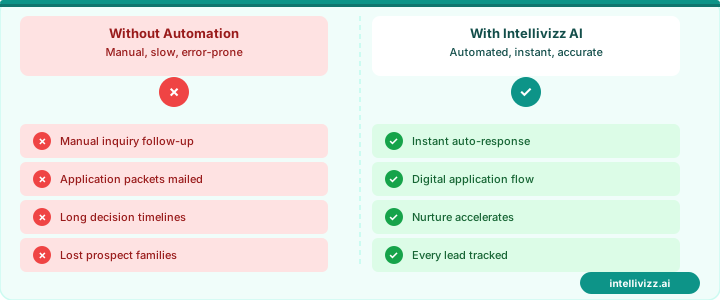
📊 Waitlist Conversion That Fills Every Seat
Automated spot-offer workflows convert more waitlisted families before the year begins
Measuring Waitlist Management Effectiveness
| Metric | Manual Baseline | Automated Target |
|---|---|---|
| Waitlist spot-offer acceptance rate | 45–60% | 65–80% |
| Deposit collection time (from offer to deposit) | 5–10 days | 24–48 hours |
| Waitlist contact decay rate (unreachable families) | 15–25% annually | 3–7% annually |
| Admissions director time per waitlist cycle | 8–15 hours/month | 1–2 hours/month |
| Spot-to-enrollment fill rate | 60–75% | 80–92% |
| Grade-level capacity utilization at year start | 88–93% | 95–99% |
The financial impact of improved waitlist conversion is direct and significant. For a school with a tuition of $28,000 per year and an average of eight waitlist spots that open each cycle, improving the spot-offer acceptance rate from 55% to 75% converts approximately 1.6 additional students — representing roughly $44,800 in annual tuition revenue recovered from what was previously a managed vacancy. Multiply that across multiple grade levels and a multi-year enrollment lifecycle, and waitlist management automation pays for itself many times over in the first enrollment cycle.
Ready to modernize your school's operations? Explore our education automation solutions, School Enrollment Automation: Streamlining the..., or Automated Enrollment Follow-Up for Private Schools:....
Relevant AI Automations
AI Review Management
All-in-one review management: automated review requests, AI-powered responses, and review repurposing for web & social — 3 engines in 1.
Missed Call Text-Back
Instantly respond to missed calls from prospective parents with AI-powered SMS, capturing enrollment leads 24/7
AI Voice Agent - Inbound
AI answers calls 24/7, handles FAQs about programs, tuition, availability, and books tours