
Automated Enrollment Follow-Up for Private Schools: From Acceptance to First Day
The Enrollment Completion Gap
Every private school admissions director knows the frustration: an acceptance letter goes out in March, the family celebrates and tells everyone their child is coming to your school, and then the enrollment packet arrives in their inbox — and it stays there. By May, the school is chasing 30% of accepted families for health forms. By June, 15% still haven't set up tuition payment plans. By July, orientation scheduling is a manual phone tree because families haven't responded to the scheduling link sent in April.
This enrollment completion gap is not a failure of family interest — it is a failure of follow-up systems. Families who accepted your offer are genuinely planning to attend. They are also busy, their to-do lists are long, and a multi-step enrollment packet that requires coordinating with pediatricians, former schools, uniform vendors, and billing offices tends to get deferred until the urgency of August forces action. By then, the administrative scramble falls entirely on your staff during the period when they are also preparing the building, finalizing class assignments, and onboarding new faculty.
Automated post-acceptance enrollment follow-up does not push families who aren't interested — it systematically reminds families who are fully intending to complete enrollment but haven't gotten around to each specific step yet. The result is higher enrollment completion rates, earlier completion timing, and dramatically reduced staff time spent on individual family follow-up. For the complete enrollment pipeline from inquiry through acceptance, the school enrollment automation guide covers the full architecture; this article focuses specifically on the post-acceptance completion stage.
📋 Every Enrollment Step, Tracked and Followed Up Automatically
From acceptance to first day — no family falls through the cracks
The Post-Acceptance Enrollment Checklist
Effective automation begins with mapping every step that must be completed between acceptance and the first day of school, then assigning each step a completion deadline and a follow-up sequence. The typical private school post-acceptance checklist includes:
| Enrollment Step | Typical Deadline | Responsible Party |
|---|---|---|
| Enrollment contract / re-enrollment agreement | 2 weeks post-acceptance | Parent |
| Enrollment deposit payment | Same as contract | Parent |
| Health and immunization records | June 1 (or 60 days before school year) | Parent / pediatrician |
| Academic transcripts (transfer students) | June 1 | Parent / prior school |
| Allergy / medical action plan forms | June 1 | Parent / physician |
| Emergency contact and authorization forms | June 15 | Parent |
| Tuition payment plan setup / autopay enrollment | July 1 | Parent |
| Uniform ordering | August 1 (for delivery before school year) | Parent |
| Class placement acknowledgment | Upon school notification | Parent |
| Parent orientation RSVP | 2 weeks before orientation | Parent |
| Summer bridge program enrollment (if applicable) | June 15 | Parent |
| First-day logistics confirmation (bus, carpool, etc.) | August 15 | Parent |
Each of these steps has its own completion rate, its own common delays, and its own consequences if not completed on time. Health and immunization records not received by state-mandated deadlines create licensing compliance issues. Tuition payment plans not established before the first invoice date create billing chaos in September. Uniform orders placed in August after the school-year deadline arrive after school starts. The automated follow-up system treats each step as an independent workflow with its own triggers and reminder sequences.
Document Collection Sequences
Health forms, transcripts, and medical action plans represent the most administratively burdensome enrollment completion category — not because they are complex for families, but because they require coordination with third parties (pediatricians, prior schools, specialists) who are outside the school's direct communication reach.
Health and Immunization Record Collection
The automated health record collection sequence should begin at acceptance and escalate progressively toward the state-mandated submission deadline:
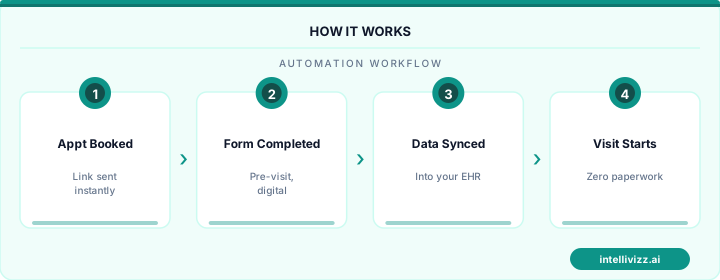
- Week 1 post-acceptance — Initial request: Email with the required immunization form, the state-mandated schedule the child must meet, instructions for obtaining records from the pediatrician, and the submission portal link (or secure upload portal). Include the specific deadline prominently.
- Week 4 — Status check: If records have not been received, a friendly reminder that includes a direct link to request records from the pediatrician's portal (many pediatric practices now offer online record request) and an offer to answer questions about what is required.
- Week 8 — Escalation reminder: More urgent messaging noting the deadline is approaching and what happens if records are not received in time (the child cannot begin school until compliance is confirmed). This message should come from the school nurse or health office, not generic school administration, to signal the seriousness of the requirement.
- 10 days before deadline — Final notice: Individual flag to the admissions director or registrar for personal outreach. Automated systems handle the 90% of families who complete steps with routine reminders; the 10% who still have not responded by this point need a human conversation.
📄 Documents In Without the Manual Chase
Automated collection sequences get health forms and transcripts in weeks before your deadline
Academic Transcript Collection (Transfer Students)
Transfer student transcript collection involves a coordination challenge with the sending school that is entirely outside the receiving school's control. The automated sequence for transcripts focuses on making it as easy as possible for the family to initiate the process and on providing clear instructions for the sending school's records office:
- A transcript release authorization form (which the parent signs) that the school can send directly to the sending institution
- A template letter the parent can send to the prior school's registrar, with the correct contact information for the receiving school's records office
- A reminder sequence with the sending school's standard processing time built into the timeline calculations
- A direct option for the receiving school to contact the sending school's registrar if the family indicates they have submitted the request but records have not arrived
Tuition Payment Setup Sequences
Tuition payment plan establishment is one of the highest-value enrollment completion steps — and one of the most frequently delayed. Families who have not set up payment plans by September create billing complexity, cash flow uncertainty, and administrative work in the first month of school when staff bandwidth is already at its lowest. The payment setup sequence should be its own dedicated workflow, distinct from the other enrollment completion steps, and treated with the same structured follow-up applied to health forms.
The payment setup sequence integrates directly with the school's billing platform and tuition management system. Families receive a direct link to the payment portal with their invoice pre-populated — not a link to a generic billing page where they must find and set up their own account. The difference in completion rate between a direct enrollment link and a generic portal link is substantial: families who must create an account, find the correct invoice, and set up payment terms independently complete the process at significantly lower rates than families who receive a deep link that opens directly to their personalized payment setup.
For the complete tuition collection automation system — including autopay enrollment campaigns, reminder sequences, and late payment handling — our guide to tuition payment automation for private schools provides the detailed implementation framework. The enrollment completion sequence for payment setup is the first touchpoint in the year-long tuition management relationship.
Uniform and Supply Ordering Integration
Many private schools have mandatory uniform requirements fulfilled through a single approved vendor or a small number of vendors. Uniform ordering deadlines are real and consequential: orders placed after the deadline arrive after the first day of school, creating uniform policy exceptions that are administratively awkward and occasionally emotionally difficult for students who start the year feeling out of place.
The uniform ordering reminder sequence is one of the most straightforward automated enrollment follow-ups to implement — and one of the most appreciated by families, who frequently cite uniform ordering confusion as a significant enrollment friction point:
- Initial uniform information email sent with acceptance, including the vendor list, the required items by grade level, the sizing guide, and the deadline for guaranteed delivery before school starts
- A reminder at 6 weeks before the deadline with a direct link to the vendor ordering portal
- A deadline reminder at 2 weeks before the cutoff date
- A final-call message one week before the deadline noting that orders placed after the cutoff will not be guaranteed for first-day delivery
Class Placement Communication and Orientation Scheduling
Class placement announcements and parent orientation scheduling represent a category of enrollment follow-up that is less about chasing completion and more about delivering information efficiently and collecting RSVPs accurately. Automated communication for these steps serves a different function: replacing the chaotic email-and-phone-call approach to orientation RSVP with a structured, self-service system that delivers accurate headcounts to school logistics teams.
Class placement communications should include:
- The assigned teacher(s) by name, with a brief teacher bio or welcome video link
- A classroom supply list specific to the grade level and teacher
- A "meet your teacher" event invitation with an RSVP link
- A parent FAQ about the specific class — daily schedule, homework expectations, communication preferences
Parent orientation RSVP automation goes beyond a simple "can you attend" question. A well-designed orientation RSVP captures which sessions each family needs to attend (new parent orientation vs. returning parent update), meal or dietary requirements if a meal is served, language accommodation needs for non-English-dominant families, and questions the family would like addressed during the orientation session. This data makes the orientation itself more useful and demonstrates to families that the school is attentive to individual needs from day one.
First-Day Preparation Sequences
In the final two weeks before school begins, a first-day preparation sequence serves both practical and emotional functions. Practically, it confirms logistics: bus or carpool assignment, drop-off and pickup procedures, emergency contact verification, and any remaining enrollment steps. Emotionally, it signals to families that the school is organized, attentive, and genuinely excited to welcome their child — a reassurance that matters particularly for families whose children are making a school transition.
🎒 Every Family Ready on Day One
First-day preparation sequences confirm logistics, close open steps, and set the right tone
A first-day preparation sequence sent two weeks before school starts typically includes:
- Two weeks out — Logistics confirmation: Confirm drop-off/pickup arrangements, provide the campus map and parking instructions for the first day, remind families of any outstanding enrollment steps, and share the daily schedule for the first week.
- One week out — Welcome packet: A warm, personalized message that includes a welcome from the division head or principal, a letter from the assigned teacher, any final first-day need-to-knows (what to wear, what to bring, what to expect), and a direct contact for questions.
- Day before — Final check-in: A brief SMS reminder of the next day's start time, drop-off location, and a warm "we can't wait to meet you" message. This message has an extraordinarily high open rate — nearly every parent reads it — making it valuable for including any last-minute logistics updates or reminders.
Measuring Post-Acceptance Enrollment Completion
| Enrollment Step | Completion Rate (Manual) | Completion Rate (Automated) | Average Days to Complete |
|---|---|---|---|
| Enrollment contract | 85–92% | 95–99% | Manual: 18 days / Auto: 8 days |
| Health/immunization records | 70–82% | 90–97% | Manual: 45 days / Auto: 28 days |
| Tuition payment setup | 65–78% | 88–95% | Manual: 52 days / Auto: 22 days |
| Emergency contact forms | 75–85% | 92–98% | Manual: 40 days / Auto: 18 days |
| Orientation RSVP | 55–70% | 82–92% | Manual: 30 days / Auto: 12 days |
| Uniform ordered on time | 60–72% | 85–93% | Manual: varies / Auto: before deadline |
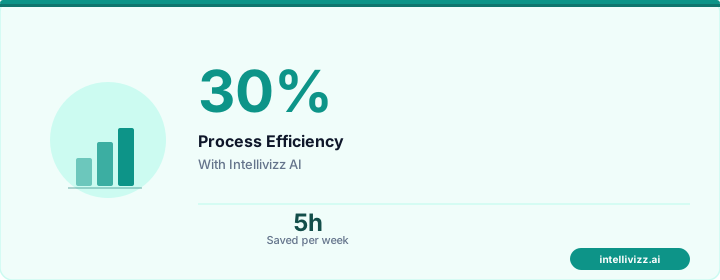
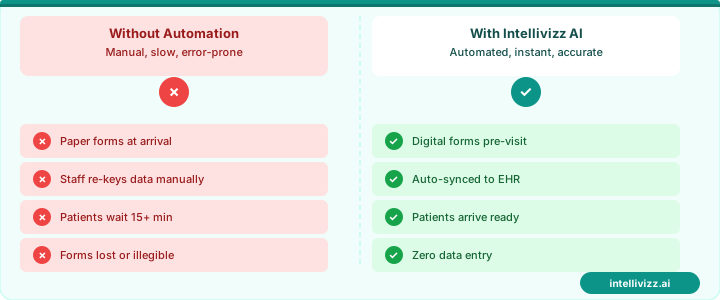
The administrative time savings are significant: enrollment completion follow-up that consumes 8–15 hours per month of registrar or admissions coordinator time with manual systems typically requires 1–2 hours per month of exception management with automated systems. For a private school with 80 new enrollments per year, this represents 80–120 hours of recovered staff time during the spring and summer — time that can be reinvested in campus preparation, faculty support, and the new family relationship-building that sets the tone for retention.
The new family experience also improves measurably. Families who complete enrollment through a well-organized, automated process arrive at orientation feeling confident and prepared — rather than anxious about outstanding paperwork and uncertain logistics. That confidence, established before the first day of school, is one of the strongest predictors of parent satisfaction and long-term family retention. For schools building out the complete enrollment automation system — from inquiry through the end of the first school year — the comprehensive guide to automating the school enrollment process provides the full architecture, and our guide to school re-enrollment campaign automation covers how the first-year experience connects to the retention system that begins with re-enrollment outreach each spring.
Ready to modernize your school's operations? Explore our education automation solutions, or read our guide to School Open House Follow-Up: Converting Campus Tours....
Relevant AI Automations
AI Review Management
All-in-one review management: automated review requests, AI-powered responses, and review repurposing for web & social — 3 engines in 1.
Missed Call Text-Back
Instantly respond to missed calls from prospective parents with AI-powered SMS, capturing enrollment leads 24/7
AI Voice Agent - Inbound
AI answers calls 24/7, handles FAQs about programs, tuition, availability, and books tours