
School Re-Enrollment Campaign Automation: Retain More Families with Less Manual Work
Why Re-Enrollment Deserves Automation
For private and independent schools, re-enrollment isn't just a form — it's the foundation of financial sustainability. A complete school enrollment funnel automation covers both new student acquisition and re-enrollment of current families, and school communication automation is especially effective during re-enrollment season. With 10-15% of families not returning each year, a school with 500 students at $15,000 annual tuition loses $750,000-$1,125,000 in revenue before a single new family is recruited. The cost of acquiring replacement families through marketing is 5-8x the cost of retaining existing ones.
Yet most schools treat re-enrollment as a paper-form-and-deadline process, relying on a single email with a PDF attachment and hoping families complete it on time. By the time admin staff realizes a family hasn't re-enrolled, the family has already been wooed by a competitor or simply decided not to return.
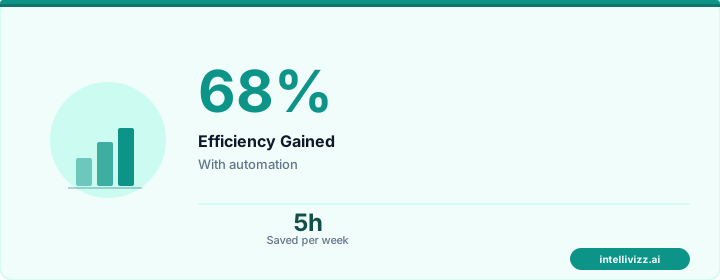
🎓 Keep families engaged with automated communication
See how automation transforms industry operations
The Automated Re-Enrollment Timeline
November: Sentiment Survey
Send an automated satisfaction survey to all current families: "How would you rate your experience at [School Name] this year?" This serves dual purposes — identifying at-risk families (scores below 7) for proactive outreach, and making all families feel heard before re-enrollment opens.
December: Early-Bird Announcement
Automated email and text campaign announcing re-enrollment dates and early-bird incentives. Example: "Re-enrollment for 2027-28 opens January 15. Families who complete enrollment by February 1 receive a $500 tuition credit and priority class placement."
January: Re-Enrollment Opens
Day 1: Automated message with direct link to online re-enrollment portal. No PDFs, no printing, no mailing. The form should take 5 minutes to complete, with most fields pre-populated from existing records.
January-February: Multi-Touch Follow-Up
For families who haven't re-enrolled:
- Day 3: Reminder text with link
- Day 7: Email from head of school with personal note about the upcoming year's exciting plans
- Day 14: Phone call from division head or advisor (triggered by automation, executed by staff)
- Day 21: Final reminder before early-bird deadline with countdown
March: Deadline Management
Final deadline reminders and transition of non-re-enrolled families to "at-risk" outreach from admissions leadership. Families who miss the deadline receive a personal call asking about their plans and addressing any concerns.
Early-Bird Incentives That Work
Effective incentives create urgency without devaluing your program:
- Tuition credit ($250-$750): The most effective incentive — directly reduces cost and creates a deadline-driven urgency
- Priority class/teacher placement: Particularly effective in elementary schools where teacher assignment matters to families
- Enrollment fee waiver: Waive the $100-$300 re-enrollment fee for early completions
- Sibling priority: Early re-enrollment secures priority admission for siblings in waitlisted grades
Data from schools using automated early-bird campaigns shows 75-80% of families re-enroll within the first two weeks when an attractive incentive is offered, compared to 45-50% without an incentive.
Handling At-Risk Families
Automation identifies at-risk families through signals:
- Low satisfaction survey scores (below 7/10)
- Financial aid requests that weren't fully met
- Student behavioral or academic concerns
- Non-response to initial re-enrollment messages
These families receive a different sequence: a personal call from their child's advisor or division head, an invitation to discuss concerns, and — where appropriate — enhanced financial aid offers. This high-touch approach for the 10-15% who are wavering prevents far more attrition than mass emails to the whole school.
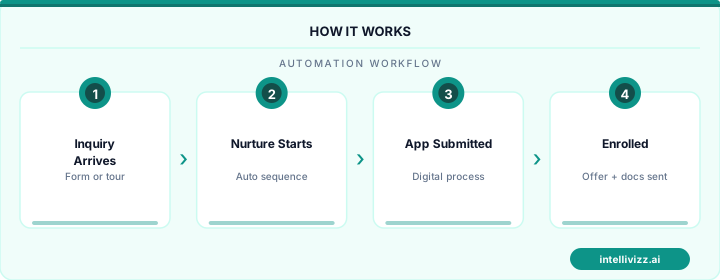
🎓 Keep families engaged with automated communication
From manual processes to automated excellence
Technology Stack
A complete re-enrollment automation system includes:
- Online enrollment portal: Mobile-friendly, pre-populated forms that take minutes to complete
- Communication automation: Multi-channel messaging (email, SMS) with conditional logic based on enrollment status
- Survey tool: Integrated satisfaction surveys with automated routing of low scores to leadership
- Payment processing: Online enrollment fee and deposit collection with installment options
- Dashboard: Real-time re-enrollment tracking by grade, division, and deadline
Schools already using enrollment automation for new families can extend the same platform to re-enrollment, creating a unified enrollment management ecosystem.
Results from Automated Re-Enrollment
- Re-enrollment rates increase from 82-87% to 92-96%
- Time-to-completion drops from 45 days average to 12 days
- Admin staff saves 100-150 hours during re-enrollment season
- At-risk families are identified 30-45 days earlier, allowing proactive intervention
- Revenue stability improves, enabling better budgeting and planning
Timing the Re-Enrollment Ask: When to Reach Out and How Often
Re-enrollment campaign timing is one of the most consequential and underappreciated decisions in private school administration. Ask too early — in October for a September enrollment — and families have not yet experienced the full academic year that drives their re-enrollment decision. Ask too late — in May for a September start — and families who were on the fence have already committed elsewhere, often to a school that began its re-enrollment conversation in February. The optimal re-enrollment ask window for most independent and parochial schools begins 5–6 months before the next academic year and uses a structured campaign sequence across that window rather than a single point-in-time communication.
Automated re-enrollment campaign sequencing operates differently for each student cohort based on enrollment risk. Families with high satisfaction signals — strong portal engagement, event attendance, active parent volunteer participation, no outstanding billing issues — receive an early re-enrollment invite framed as a priority enrollment access opportunity: families who re-enroll by a specific date receive first pick of their preferred class section, guaranteed sibling placement, or an early-bird financial aid confirmation. Families with lower engagement signals receive a more proactive outreach that includes a scheduled call from the admissions or division director to explore any concerns before the decision crystallizes. Families with outstanding financial holds or documented complaints are flagged for direct personal outreach from an appropriate administrator before any automated sequence proceeds.
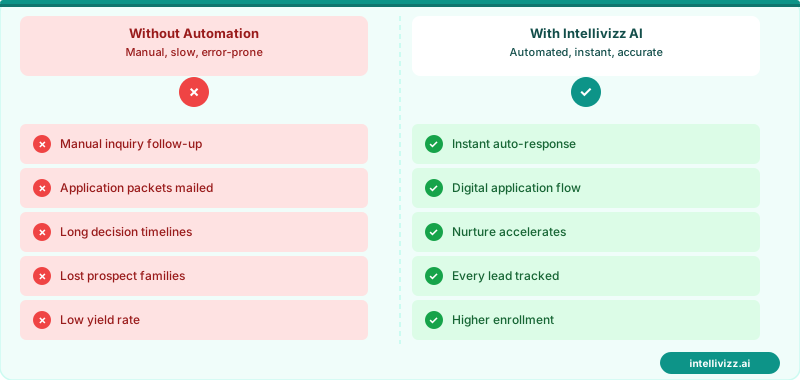
🎓 Start the Re-Enrollment Conversation Before Families Start Looking Elsewhere
Early-window automation secures 60–70% of re-enrollments before spring decision season
Reducing Decision Friction: Digital Re-Enrollment and Financial Aid Integration
Once a family has decided to re-enroll, administrative friction in the re-enrollment process is a leading cause of last-minute defections to competing schools. A family that has decided to return but faces a multi-step paper-based re-enrollment process, uncertain financial aid timelines, and unclear next steps will sometimes make a late decision to switch simply because a competitor's online portal made re-enrollment effortless in comparison. Automated re-enrollment workflows remove this friction by delivering a personalized, pre-populated re-enrollment form to the family via a single click from an email link — reducing the completion time from 30–45 minutes to under 10 minutes for returning families whose information is already in the system.
Financial aid workflow integration is critical for the families most at risk of not re-enrolling. Families who receive need-based aid should receive their re-enrollment aid determination early in the campaign window — ideally before the enrollment contract is presented — so they can make a fully informed decision rather than signing a contract and hoping the aid award arrives favorably. Automated financial aid status updates that communicate application completeness, processing status, and award timeline reduce the uncertainty that leads families to hedge with an application to a competing school while waiting for aid confirmation.
| Re-Enrollment Segment | Timing | Primary Barrier | Automation Approach |
|---|---|---|---|
| High-satisfaction families | 5–6 months pre-start | Low — priority incentive | Early-access framing + 1-click form |
| Low-engagement families | 5 months pre-start | Passive drift / competitor evaluation | Director outreach + personal follow-up |
| Financial aid families | 6 months pre-start | Aid uncertainty | Early aid determination + status updates |
| Outstanding issue families | 5 months pre-start | Unresolved grievance | Human-first outreach, automation paused |
Schools building a complete enrollment management system — spanning re-enrollment campaigns, new student recruitment, and ongoing parent communication — will benefit from the framework in parent communication automation for schools, which covers the year-round engagement infrastructure that reduces re-enrollment attrition by maintaining strong family satisfaction throughout the academic year.
Post-Decision Engagement: Securing Re-Enrolled Families Through Start of Year
Re-enrollment campaign success is measured not at the point when a family signs the contract, but at the point when that family returns in September — and returns the year after that. Schools that treat the re-enrollment contract as the end of the campaign experience meaningful late-summer attrition: families who signed a re-enrollment contract in February but received no substantive school communication until August registration paperwork may have made a quiet decision to transfer during the intervening months, particularly if a competing school made a compelling outreach during the same period. Post-signature engagement automation maintains the family's emotional connection to the school throughout the spring and summer, reinforcing the re-enrollment decision with content that builds anticipation rather than triggering doubt.
Post-signature engagement for re-enrolled families should feel qualitatively different from pre-enrollment marketing — it is a relationship-building sequence, not a sales sequence. Automated touchpoints that deliver genuinely useful logistical information (class assignment timeline, supply list, transportation registration deadlines), community-building content (introducing new faculty, sharing summer program opportunities, highlighting fall event calendar highlights), and personal recognition (welcoming the student back for their specific grade or division) sustain engagement during the long gap between re-enrollment decision and school start. Families who receive this sustained, relevant post-signature communication show significantly lower summer attrition rates than those who receive only transactional communications (registration paperwork, tuition payment reminders) between contract signing and September.
Ready to modernize your school's operations? Explore our education automation solutions, or read our guide to After-School Program Upsell Automation: Increase....
Relevant AI Automations
AI Review Management
All-in-one review management: automated review requests, AI-powered responses, and review repurposing for web & social — 3 engines in 1.
Missed Call Text-Back
Instantly respond to missed calls from prospective parents with AI-powered SMS, capturing enrollment leads 24/7
AI Voice Agent - Inbound
AI answers calls 24/7, handles FAQs about programs, tuition, availability, and books tours