
Restaurant Review Automation: How to Collect Google Reviews on Autopilot
Restaurants operate in one of the most review-sensitive industries. A 2025 TouchBistro report found that 94% of diners check Google reviews before trying a new restaurant, and a half-star difference in average rating can swing revenue by 19%. Every review matters — and restaurants that automate their collection process consistently outperform those that leave it to chance.
The challenge is unique to restaurants: guests are anonymous (no appointment record), visits are short (60-90 minutes), and staff are too busy during service to make personal asks (an AI answering service can handle calls while the team focuses on guests). Automation solves all three problems by creating touchpoints that don't depend on staff bandwidth or guest identification.
The Restaurant Review Automation Playbook
Strategy 1: WiFi-Triggered Review Requests
Offer free guest WiFi that requires an email address or phone number to connect. After the guest disconnects (typically when they leave), trigger an automated review request.
This approach captures contact information naturally, without staff involvement. The guest is already on their phone, and the WiFi login creates a reciprocity effect — they received free WiFi, so a review request feels reasonable.
Template (SMS): "Thanks for dining at [Restaurant]! 🍽️ If you enjoyed your meal, a quick Google review helps us and helps other foodies: [link]"
Strategy 2: POS-Integrated Follow-Ups
If your POS system captures guest phone numbers or emails (through reservations, loyalty programs, or online ordering), trigger review requests after each transaction.
Modern POS systems like Toast, Square, and Clover integrate with automation platforms via Zapier or direct API. When a transaction closes, the automation fires 2-3 hours later.
Strategy 3: QR Codes on the Table and Check
Place QR codes on table tents, check presenters, and receipts that link directly to your Google review page. This is the simplest form of review automation — no technology integration required.
The key is placement timing. The QR code on the check presenter reaches guests at their most satisfied moment — after a great meal, before they leave. Add a simple prompt: "Loved your meal? Scan to tell us on Google ⭐"
Strategy 4: Online Order and Delivery Follow-Ups
For restaurants with delivery and takeout (now 30-40% of revenue for many restaurants), automate review requests after every order. The online ordering platform already has the customer's contact info.
Timing matters: send 45-60 minutes after the estimated delivery time, when the customer has finished their meal. Template: "Hi [Name], how was your order from [Restaurant]? If everything was delicious, a Google review means the world to our team: [link]"
Strategy 5: Reservation Platform Integration
If you use OpenTable, Resy, or similar, trigger review requests 2 hours after the reservation time. The platform has the guest's phone number and email, and you know exactly when they dined.
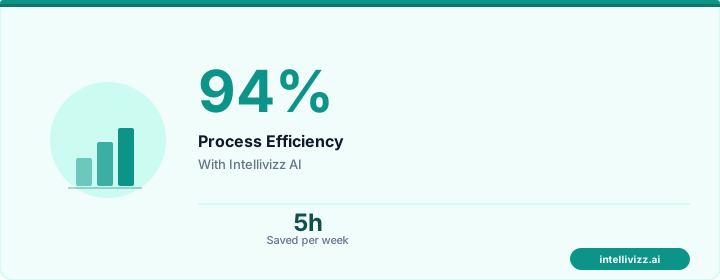
⭐ Your online reputation is your #1 marketing asset
See how automation transforms industry operations
Sentiment Pre-Filtering for Restaurants
Restaurant experiences vary more than most industries — one table might have an amazing experience while another waited 40 minutes for entrees. A sentiment pre-filter protects your rating:
- First message: "How was your experience at [Restaurant]? Reply: 😍 Amazing | 😊 Good | 😐 Just OK | 😔 Not Great"
- 😍 or 😊 responses → receive the Google review link
- 😐 or 😔 responses → receive a private feedback form and an apology: "We're sorry to hear that. Your feedback helps us improve. What could we have done better? [link to form]"
This routing prevents negative experiences from becoming public reviews while still capturing actionable feedback from dissatisfied guests.
Multi-Location Considerations
Restaurant groups with multiple locations need location-specific automation:
- Each location needs its own Google Business Profile and unique review link
- Automation triggers should route to the correct location based on the transaction or reservation source
- Review performance should be tracked per location with location-level benchmarks
- Templates can be standardized across locations but should include the specific location name
Seasonal Campaign Calendar
- Valentine's Day / Mother's Day / Father's Day: Peak dining occasions. Guests dining for celebrations are in excellent moods — prime review territory. Trigger post-dinner review requests specifically for these dates.
- Summer patio season: Outdoor dining creates memorable experiences. Capture reviews from patio guests to accumulate seasonal reviews that attract next summer's diners.
- Holiday party season (Nov-Dec): Large group bookings and event dining generate guests who want to share their experience. Post-event review requests convert well.
- New menu launches: When you debut a new menu, guests are excited to share opinions. Pair the launch with a review push to capture fresh, menu-specific feedback.
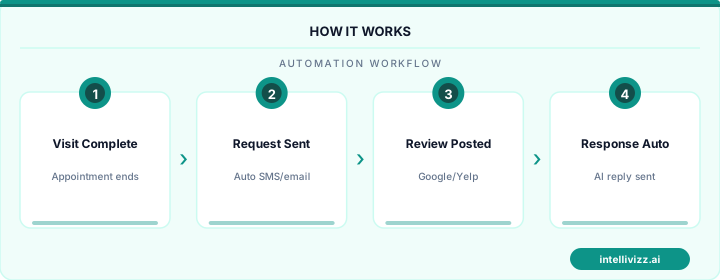
⭐ Your online reputation is your #1 marketing asset
From manual processes to automated excellence
Measuring ROI
Track these restaurant-specific metrics:
- Review velocity: New reviews per week (target: 5-10 for a busy restaurant)
- Source breakdown: Which strategy generates the most reviews? (WiFi vs. POS vs. QR vs. delivery)
- Rating trend: Weekly average rating (should stay above 4.3 for competitive markets)
- Reservation correlation: Compare reservation volume against review count milestones
- Delivery review rate: Track delivery-specific reviews separately — these influence a different customer segment than dine-in reviews
For restaurants looking to handle the increased call volume that a stronger Google presence generates, consider pairing review automation with an AI receptionist for restaurants that handles reservation calls, menu questions, and order inquiries 24/7.
The restaurants winning in 2026 have built automated review flywheels that generate a steady stream of fresh, positive reviews. Hotels are following the same playbook — see how with hotel review request automation — making their Google listings irresistible to the next hungry searcher.
Turning Reviews Into Marketing Assets
Collecting reviews is only half the equation. Smart restaurants repurpose review content across marketing channels to amplify social proof, inform menu decisions, and attract new diners. Here is how to extract maximum marketing value from every review you receive.
Embedding Reviews on Your Website
Display your best Google reviews directly on your restaurant's website using structured data markup that search engines can read. Place a rotating review widget on your homepage, menu page, and reservation page — these are the three highest-traffic pages where social proof most influences decisions. Curate reviews that mention specific dishes, atmosphere details, or service qualities rather than generic "great food" comments, because specificity builds credibility. Restaurants that display authentic reviews on their booking page see a 15-22 percent increase in online reservation completion rates.
Social Media Repurposing Strategies
Transform five-star reviews into visual content for Instagram, Facebook, and TikTok. Overlay review quotes on high-quality food photography, tag the reviewer when possible, and post during peak dining decision hours — typically 10-11 AM and 3-4 PM. Create a weekly "Guest Love" series that highlights one review with behind-the-scenes context about the dish or experience mentioned. This content performs 3-4 times better than promotional posts because it feels authentic rather than sales-driven.
Building a consistent review pipeline through Google review generation strategies ensures you always have fresh material to repurpose across your marketing channels.
Review-Based Menu Optimization Signals
Mine review text for patterns that inform menu engineering. If 30 percent of five-star reviews mention your truffle pasta, that dish deserves premium menu placement and a price increase. If negative reviews consistently cite slow dessert service, the issue is operational — not culinary. Use sentiment analysis to categorize feedback by dish, service speed, ambiance, and value perception. This data supplements sales mix reports with qualitative context that sales numbers alone cannot reveal, helping you make smarter decisions about what to promote, modify, or retire.
For more on restaurant operations, explore our guide on automating restaurant reservations with AI or learn about maximizing your Google review count.
Relevant AI Automations
No-Show Reduction SMS Sequence
Multi-touch reservation reminder: confirmation, 24-hour, and 2-hour reminders — reduces no-shows by 50-60%.
Shift Coverage & Call-Out Alert System
When a staff member calls out, instantly alerts available team members and fills the shift — eliminates scrambling.
Automated Loyalty & VIP Program
Track visits and spending automatically — reward loyal diners with personalized perks that drive 40% more repeat business.