
How to Get More Google Reviews: 12 Proven Strategies That Work in 2026
Google reviews are the single most influential factor in local search rankings. According to BrightLocal's 2025 Consumer Review Survey, 87% of consumers read online reviews for local businesses, and 73% only pay attention to reviews written in the last month. If your business isn't actively collecting Google reviews, you're invisible to the people searching for your services right now.
But here's what most advice gets wrong: getting more Google reviews isn't about asking once and hoping for the best. It's about building a systematic, repeatable process that turns every satisfied customer into a review. In this guide, we'll walk through 12 strategies that actually work — from simple in-person tactics to fully automated review request systems that run while you sleep.
Why Google Reviews Matter More Than Ever
Before we dive into tactics, let's be clear about what's at stake. Google uses three primary factors for local search ranking: relevance, distance, and prominence. Reviews are the #1 signal for prominence, which means a business with 200 reviews will consistently outrank a competitor with 20 — even if that competitor is slightly closer to the searcher.
The math is simple: every review you don't collect is a customer your competitor wins instead. Medical practices, dental offices, law firms, restaurants, and service businesses all compete in the same local search arena.
⭐ Your online reputation is your #1 marketing asset
Smart technology, better results
Strategy 1: Ask at the Moment of Peak Satisfaction
Timing is everything. The best moment to ask for a review is when your customer is at peak satisfaction — right after a successful outcome. For a landscaper, that's when the client sees their transformed backyard for the first time. For an auto detailer, it's the moment the customer inspects their gleaming vehicle. For a financial advisor, it's the day after a portfolio hits a milestone return.
Train your customer-facing team to identify these moments and make the ask in person. A simple "We'd really appreciate it if you could share your experience on Google" converts at 2-3x the rate of a follow-up email.
Strategy 2: Use SMS Follow-Ups Within 2 Hours
The review request that arrives 2 hours after a visit converts at nearly 5x the rate of one sent 24 hours later. Text messages have a 98% open rate compared to email's 20%, making SMS the most effective channel for review requests.
The key is to include a direct link to your Google review page. Don't send them to your website or a generic review platform — eliminate every friction point between the request and the review.
Strategy 3: Automate Your Review Request Workflow
Manual follow-ups don't scale. If you see 30 patients a day or serve 100 restaurant guests, you can't personally text each one. This is where automation becomes essential.
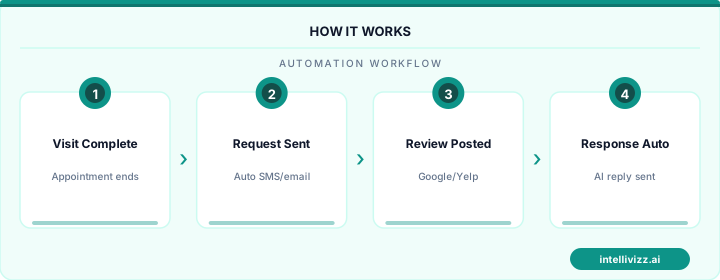
An automated review request system triggers a personalized text or email after each appointment or transaction. The best systems integrate directly with your scheduling or POS software, so no manual work is required. Intellivizz's automation workflows can send multi-step review request sequences — an initial text at 2 hours, a reminder at 24 hours, and a final follow-up at 72 hours — personalized with the customer's name and the service they received.
Businesses using automated review campaigns typically see a 3-5x increase in monthly review volume within the first 60 days.
⭐ Your online reputation is your #1 marketing asset
The data speaks for itself
Strategy 4: Make It Ridiculously Easy
Every extra click costs you 50% of potential reviewers. Use a shortlink (like g.page/yourbusiness) or QR code that drops them directly into the Google review form with your business pre-selected. Print QR codes on receipts, business cards, table tents, and checkout counters.
For healthcare practices, include the QR code on discharge paperwork. For law firms, add it to your email signature. For restaurants, print it on the bill holder.
Strategy 5: Respond to Every Review — Good and Bad
Responding to reviews isn't just good manners — it directly impacts your ability to generate new ones. Google's algorithm favors businesses that actively engage with reviewers. And when potential reviewers see that you respond thoughtfully, they're 68% more likely to leave their own review.
For negative reviews, a measured, professional response shows prospective customers that you care. Never get defensive. Acknowledge the issue, apologize, and offer to resolve it offline. This approach frequently leads to the reviewer updating their rating. For tips on handling criticism, check out our guide on negative review response strategies for healthcare.
Strategy 6: Use Email Campaigns for Existing Customers
Don't just focus on new customers. Your existing customer base is a goldmine of untapped reviews. Send a quarterly email to loyal customers who haven't left a review, framing it as a way to help other people discover your business.
Segment your list by customer satisfaction — if you track NPS or satisfaction scores, start with your promoters. A personal email from the business owner or lead provider converts better than a generic branded template.
Strategy 7: Train Your Team With Scripts
Your staff won't ask for reviews unless you give them the words. Create simple, natural scripts:
- After a service: "I'm glad everything went well today. If you have a moment, we'd love a Google review — it really helps other people find us."
- At checkout: "Thank you for choosing us! If you have 30 seconds, a Google review would mean the world to our team."
- On the phone: "I'm happy we could help. Would you mind leaving us a quick Google review? I can text you the link right now."
Role-play these scripts in team meetings until they feel natural, not scripted.
Strategy 8: Leverage Check-In and Follow-Up Touchpoints
If your business has natural follow-up touchpoints — delivery confirmations, project completion check-ins, post-service surveys — embed a review request into those communications. The review ask feels organic when it's part of a message the customer already expects.
For home service contractors, the follow-up call after a repair is the perfect moment. For real estate agents, the week after closing. For small businesses using AI answering services, the post-call satisfaction survey can include a review prompt. For accountants, the week after tax returns are filed captures peak gratitude. Hotels can automate their entire review process — see our AI receptionist for hotels guide.
Strategy 9: Create a Review Funnel Page
Build a simple landing page (yourbusiness.com/review) that thanks the customer for their visit and presents a large, obvious "Leave a Google Review" button. This page serves as the universal destination for all your review request campaigns — QR codes, text links, email buttons, and in-person asks all point here.
Advanced version: add a sentiment check first. Ask "How was your experience?" with a thumbs up/down. Route happy customers to Google; route unhappy customers to a private feedback form. This protects your public rating while still capturing valuable feedback.
Strategy 10: Showcase Reviews as Social Proof
Display your Google reviews prominently on your website, social media, and marketing materials. When customers see that others have left reviews, they're more likely to contribute their own. It creates a flywheel effect.
Embed a live Google review widget on your homepage. Share standout reviews as Instagram stories or Facebook posts with the reviewer's first name and a "Thank you!" message. This visibility makes reviewing feel normal and expected.
Strategy 11: Run a Review Acceleration Campaign
If you're starting from zero (or near zero), run a focused 30-day acceleration campaign. Set a specific goal — "100 reviews in 30 days" — and rally your team around it. Combine every tactic in this guide simultaneously: in-person asks, automated SMS, email campaigns, QR codes everywhere, and social media reminders.
Note: never offer incentives for reviews. Google's terms of service explicitly prohibit compensating customers for reviews, and violations can result in all your reviews being removed. Instead, make the ask about helping your community discover your business.
Strategy 12: Monitor and Iterate With Analytics
Track your review velocity — the number of new reviews per week. Set up Google Alerts for your business name so you never miss a review. Use Google Business Profile insights to see how reviews impact your search impressions and customer actions.
If your velocity drops, diagnose why. Did a staff member stop asking? Did an automation break? Did you stop responding to reviews? The businesses that consistently grow their review count are the ones that treat it as an ongoing metric, not a one-time project.
Industry-Specific Tips
Home Services (Plumbing, HVAC, Electrical, Landscaping)
Home service businesses have a unique advantage: the technician is physically present at the moment of peak satisfaction — when the AC starts working, the leak is fixed, or the yard looks pristine. Train field technicians to make the ask before they leave the property: "If you're happy with the work today, a Google review would really help us out." Combine with an automated text 30 minutes after the job ticket closes. Home service reviews mentioning specific work performed ("replaced our water heater in 3 hours") are the most detailed and SEO-valuable reviews any business can collect.
Automotive (Dealerships, Repair Shops, Detailing)
Automotive businesses collect reviews most effectively at vehicle delivery — when the customer is excited about their new car, relieved their repair is done, or impressed by a fresh detail. The key differentiator: include a photo prompt. "Would you mind snapping a photo with your car and mentioning it in your review?" Google reviews with photos receive 35% more engagement from future searchers and signal authenticity to the algorithm.
Professional Services (Accounting, Consulting, Financial Advisory)
Professional service reviews require different timing than transactional businesses. Ask at milestone completions: after closing the books for the fiscal year, after delivering a consulting engagement report, or after resolving a complex tax situation. Frame the ask around expertise: "Your feedback helps other business owners find the right advisor." For a deeper look at how professional service firms automate client acquisition, see our guide on automated client onboarding workflows.
E-Commerce and Retail
Physical retail locations collect reviews via receipt QR codes and post-purchase SMS. E-commerce businesses should time review requests based on delivery confirmation plus a "use window" — typically 3-7 days after the product arrives. Asking too early catches the unboxing excitement but misses product quality feedback; asking too late catches the forgetfulness window. For subscription businesses, the ideal ask comes after the second delivery, when the customer has validated their purchase decision.
Schools and Educational Institutions
Schools have unique dynamics — parents are the reviewers, not the students. Timing requests around enrollment decisions and parent-teacher conferences yields the best results. For a complete playbook, see our guide on how to get more Google reviews for schools.
Frequently Asked Questions
How many Google reviews do I need to rank well locally?
There's no magic number, but businesses with 40+ reviews and an average rating above 4.0 consistently outperform those with fewer reviews. The key metric is review velocity — how many new reviews you get each month — rather than a static total.
Can I ask customers for 5-star reviews specifically?
No. Google's guidelines prohibit soliciting specific star ratings. Ask for honest feedback, and if your service is good, the stars will follow. Filtering out unhappy customers before they reach Google (using a sentiment funnel) is acceptable.
How do I handle fake negative reviews?
Flag the review through Google Business Profile by selecting "Flag as inappropriate." Google will review and may remove reviews that violate their policies (spam, conflicts of interest, off-topic content). In your public response, stay professional and note that you have no record of the reviewer as a customer.
Should I use a review management platform?
For businesses with more than 20 customers per week, yes. Manual tracking breaks down at scale. Platforms that integrate with your CRM or scheduling software — like Intellivizz's automation suite — ensure no customer falls through the cracks.
How often should I send review request follow-ups?
Three touches maximum: an initial request at 2 hours, a reminder at 24 hours, and a final ask at 72 hours. After that, respect the customer's choice not to review. Over-asking damages relationships and can feel spammy.
Do Google reviews from Google Local Guides count more?
Google has not confirmed any ranking weight difference based on reviewer status. However, reviews from established Google accounts with review history are less likely to be flagged or removed as spam, so they're practically more durable.
Start Building Your Review Engine Today
The businesses that dominate local search in 2026 aren't the ones with the biggest ad budgets — they're the ones with the most (and most recent) Google reviews. Every strategy in this guide can be implemented starting today, and the compound effect of consistent review collection builds an unassailable competitive moat.
If you want to automate the entire process — from post-visit SMS sequences to review monitoring and response — schedule a free consultation with Intellivizz to see how AI-powered review automation can triple your review velocity in 60 days. Browse our automated review request workflows in the automation catalog.
Ready to get started with automation? Explore our AI Review Response Automation: How to Reply to Every....