
How to Get More Google Reviews for Schools: A Complete Guide for Administrators
For private schools, charter schools, and educational institutions, Google reviews directly influence enrollment. Parents researching schools rely heavily on peer feedback — a 2025 Niche.com survey found that 67% of parents read Google reviews before scheduling a school tour, and schools with 4.5+ star ratings receive 2.4x more tour requests.
Yet most schools treat review collection as an afterthought. Administrators worry about asking parents for favors, or they simply don't have the systems in place to do it systematically. This guide provides a structured approach to generating Google reviews for schools that feels natural, respects parent relationships, and scales with your enrollment.
Why Google Reviews Matter for Schools
Parents searching for "best private schools near me" or "top-rated elementary schools in [city]" see Google's local results first. Your star rating and review count are the first things they notice — often before they even click through to your website.
Reviews also provide social proof that brochures and websites cannot. A parent describing their child's experience carries more weight than any marketing copy. When prospective families read 20+ positive reviews from current parents, the trust barrier drops significantly.
Additionally, Google reviews improve your overall SEO. Schools with consistent review activity rank higher in local search, which means more organic visibility during enrollment season — exactly when it matters most.
⭐ Your online reputation is your #1 marketing asset
From manual processes to automated excellence
The Best Moments to Ask Parents for Reviews
Timing is everything in review collection. These are the peak satisfaction moments for school families:
Enrollment Confirmation
When a family commits to your school, they're excited and optimistic. Send a welcome message within 48 hours that includes a soft review request: "We're thrilled to welcome the [Family Name] family! If you'd like to share what drew you to [School Name], a Google review helps other families discover our community."
First Week Success
Parents are most relieved — and most vocal — when their child has a positive first week. After the first 5 school days, send a check-in message. If the response is positive, follow up with a review link.
Parent-Teacher Conferences
After a positive conference where the parent hears about their child's progress, satisfaction is at a peak. Send an automated follow-up within 24 hours with a review request.
School Events and Performances
After school plays, concerts, sports events, and graduation ceremonies, parents are emotionally engaged and proud. This is an ideal time for a review request — the positive emotion translates directly into glowing reviews.
Year-End / Graduation
The end of the school year brings reflection and gratitude. A year-end thank-you message with a review request captures families at their most appreciative.
Building an Automated Review Collection System
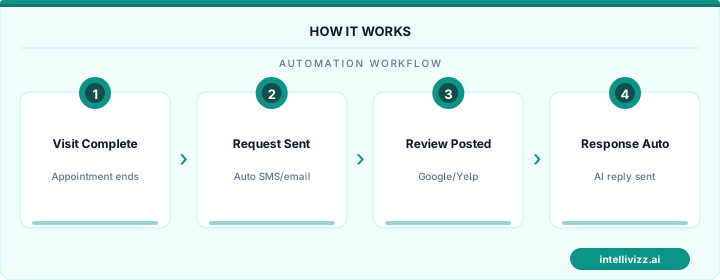
Manual review requests don't scale across hundreds of families. Here's how to build an automated system:
Step 1: Identify your triggers. Map the moments listed above to data points in your student information system (SIS). Enrollment date, first day of school, conference dates, and event dates can all trigger automated messages.
Step 2: Set up multi-channel sequences. Use both email and SMS. Parents check text messages immediately but may prefer the formality of email for a longer request. A typical sequence: SMS at the trigger moment, email follow-up at 24 hours, final SMS at 72 hours.
Step 3: Personalize every message. Include the family name, student name (with permission), and specific event or milestone. "Hi Sarah, we loved seeing Emma's confidence grow this semester!" converts far better than a generic template.
Step 4: Provide a direct link. Use your Google Business Profile short link so parents land directly on the review form. Every extra click loses 50% of potential reviewers.
Email and SMS Templates That Work
Here are templates adapted for the school context:
Post-enrollment SMS: "Welcome to the [School Name] family! 🎒 If you'd like to share what made you choose us, a quick Google review helps other families: [link]"
Post-conference email: "Thank you for attending [Student]'s parent-teacher conference. We hope you left feeling confident about their progress. If you have a moment, sharing your experience on Google helps prospective families learn about our school: [link]"
Year-end email: "As we wrap up another wonderful year at [School Name], we want to thank you for being part of our community. Your family's experience could guide other parents searching for the right school. Would you take 2 minutes to share it? [link]"
⭐ Your online reputation is your #1 marketing asset
See how automation transforms industry operations
Leveraging School Community Channels
Schools have built-in community channels that businesses don't:
- PTA/PTO meetings: Mention the review initiative at parent meetings and provide QR codes on table tents.
- School newsletters: Include a standing "Review us on Google" section with a direct link.
- School app notifications: If your school uses a parent communication app, add periodic review reminders.
- Carpool line signage: A QR code on a sign near the pickup line catches parents during wait time.
Handling Negative Reviews for Schools
Not every review will be positive. When negative reviews appear:
- Respond within 24 hours. Acknowledge the concern and express willingness to discuss it privately.
- Never reference specific students or families. Protect privacy at all costs.
- Take it offline. Provide a direct phone number or email for the appropriate administrator.
- Follow up after resolution. If the issue is resolved satisfactorily, the parent may voluntarily update their review.
Measuring Review Generation Impact on Enrollment
Track these metrics to connect review activity to enrollment outcomes:
- Review velocity: New reviews per month (target: 5-10 during enrollment season)
- Tour request correlation: Compare tour requests before and after reaching review milestones (50, 100, 150 reviews)
- Enrollment source tracking: Ask new families how they found you — "Google search" responses increase with review volume
- Rating maintenance: Keep above 4.5 stars; investigate any sustained dip below this threshold
Schools that implement systematic review collection typically see a 25-40% increase in tour requests within the first enrollment cycle. The reviews create a virtuous cycle: more reviews lead to higher rankings, which drive more website traffic, which generates more tour requests, which create more satisfied families who leave more reviews.
The schools winning the enrollment race in 2026 are those that treat Google reviews as a core marketing metric, not an afterthought. Start building your review engine today and let your community's voice become your most powerful enrollment tool.
Related Reading
- School Review Collection Automation
- How to Get More Google Reviews (General Guide)
- Automated Review Request Systems
Ready to modernize your school's operations? Explore our education automation solutions, or read our guide to How to Increase Private School Enrollment: A Complete....