
Law Firm Review Generation: 8 Automated Strategies to Build Your Online Reputation
For law firms, online reviews are the new word-of-mouth referral. A 2025 FindLaw survey found that 84% of potential clients check Google reviews before contacting an attorney, and firms with 50+ reviews receive 3x more contact form submissions than firms with fewer than 10.
Yet most law firms collect reviews passively, relying on the occasional grateful client to leave feedback. This guide presents 8 strategies that systematically generate reviews for law firms — from initial client intake through case resolution — while respecting bar association ethics rules.
The Ethics of Review Solicitation for Attorneys
Before diving into tactics, let's address the ethical question. The ABA Model Rules of Professional Conduct do not prohibit lawyers from asking clients for reviews. Most state bars permit review solicitation as long as you don't offer compensation, make misleading statements, or pressure clients.
Key ethical boundaries:
- No incentives: Never offer fee reductions, gifts, or other consideration in exchange for a review.
- No specific requests: Ask for honest feedback, not specifically positive reviews.
- No confidentiality violations: Never reference case details in public review responses.
- Timing matters: Don't ask during active representation when the client might feel pressured. Wait until after the matter concludes.
With those guardrails in place, the following strategies are both effective and ethically sound.
⭐ Your online reputation is your #1 marketing asset
From manual processes to automated excellence
Strategy 1: Post-Resolution Automated Sequence
The highest-converting moment to request a review is immediately after a favorable case resolution. The client feels relieved, grateful, and positively disposed toward your firm.
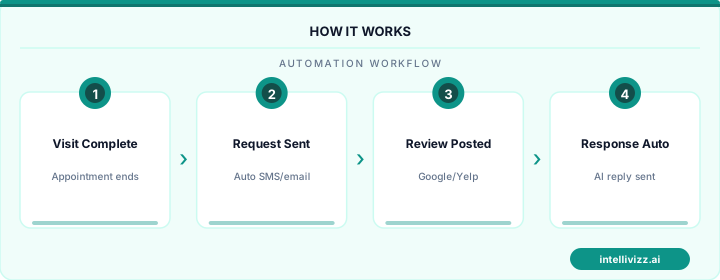
Set up an automated sequence that triggers when a case status changes to "Closed - Resolved" in your case management system. Send an SMS within 4 hours, followed by an email at 24 hours. Keep the message simple: "Congratulations on the resolution of your matter. If you felt well-served by our team, a brief Google review helps other people in similar situations find qualified legal help: [direct link]."
This single automation can double or triple your monthly review volume without any attorney or staff involvement.
Strategy 2: The Intake Momentum Capture
Don't wait until case resolution to build goodwill. After a strong initial consultation, clients are often impressed by your knowledge and responsiveness. Send a brief satisfaction check-in 24 hours after the first meeting.
If the response is positive, follow up with a soft review request: "We're glad the consultation was helpful. If you're comfortable sharing your experience so far, a Google review helps other people find the right attorney." This captures reviews from clients whose cases may take months to resolve. For firms looking to streamline this process, explore our guide on AI receptionist solutions for law firms.
Strategy 3: Milestone Moments During Representation
For long-running cases (litigation, estate planning, business transactions), identify natural milestone moments where the client feels progress: a successful motion, a favorable settlement offer, a completed transaction phase.
Send a personalized check-in at these milestones, and include a review request for those who express satisfaction. This approach works particularly well for practices where case resolution can take 6-18 months.
⭐ Your online reputation is your #1 marketing asset
See how automation transforms industry operations
Strategy 4: Staff-Initiated Warm Handoff
Train paralegals and legal assistants to identify moments of client satisfaction during phone calls and meetings. When a client expresses gratitude or relief, the staff member can say: "I'm so glad we could help. If you have a moment, a Google review would really mean a lot to our team. I'll send you the link right now."
Then immediately trigger the automated SMS with the review link. The combination of personal ask plus instant link delivery yields conversion rates of 30-50% — far higher than automated-only approaches.
Strategy 5: Review Request in Closing Documents
Include a review request card or insert with your closing letter package. When clients receive their final documents, they're reviewing the outcome and feeling closure. A physical card with a QR code linking to your Google review page catches them at this reflective moment.
Format suggestion: A professionally printed card that says "Thank you for trusting [Firm Name] with your legal matter. Your experience could help someone in a similar situation find the right attorney." with a prominent QR code below.
Strategy 6: Client Appreciation Events
Many successful firms host annual client appreciation events — holiday gatherings, legal education seminars, or community events. These gatherings create positive associations with your firm.
Follow up within 48 hours of the event with a thank-you message that includes a gentle review request. Attendees are in a positive frame of mind and more receptive to the ask.
Strategy 7: Referral Source Cross-Pollination
Clients who refer others to your firm are your biggest advocates. When you receive a referral, reach out to the referring client with thanks — and include a review request if they haven't already left one.
"Thank you for referring [name] to us. Your confidence in our work means a great deal. If you haven't already, sharing your experience on Google helps other people find trustworthy legal representation."
Strategy 8: Reactivation Campaign for Past Clients
Your biggest untapped asset is clients from the past 2-3 years who were satisfied but never left a review. Run a quarterly email campaign to this segment.
Frame it as community service: "A few minutes of your time could help someone going through what you went through find the legal support they need." Past clients who had positive outcomes are usually happy to help — they just need to be asked.
Choosing the Right Automation Platform
Law firms need review automation that integrates with their existing systems. Look for:
- CRM/case management integration: Automatic triggers based on case status changes eliminate manual work entirely.
- SMS capability: Text messages outperform email by 4-5x for review requests.
- Multi-step sequences: A 3-message sequence captures significantly more reviews than a single request.
- Ethical compliance: No review gating, no incentive mechanisms, no pressure tactics.
- Analytics: Track request volume, conversion rates, and review trends to optimize over time.
All-in-one platforms like Intellivizz that combine review automation with law firm intake automation, missed call text-back, and client communication workflows offer the best ROI for firms that want to automate their entire client acquisition and retention pipeline.
Measuring Success
Track these metrics monthly to gauge your review generation performance:
- Review velocity: New reviews per month (target: 8-15 for a mid-size firm)
- Conversion rate: Reviews collected / requests sent (benchmark: 12-18%)
- Average rating: Should maintain above 4.5 stars
- Source attribution: Which strategy generates the most reviews
With consistent automation and a multi-strategy approach, most law firms can accumulate 100+ reviews within 12 months — creating a powerful competitive advantage in local search that compounds over time.
Ready to grow your firm with automation? Explore our professional services automation solutions, How Does AI Help Law Firms Get More Clients? 8..., or Attorney Lead Follow-Up Automation: Close More Cases....