
Attorney Lead Follow-Up Automation: Close More Cases Without Hiring More Staff
The 47-Hour Problem That Is Costing Your Firm Clients
Washington, DC law firms can explore our dedicated guide to the AI receptionist for law firms in Washington, DC. A prospective client contacts your law firm at 2:17 PM on a Tuesday. They've just been served divorce papers. They're scared, confused, and searching for an attorney. They submit the contact form on your website, call your office and reach voicemail, and then send an email to the intake address listed on your contact page. Then they open three more law firm websites in adjacent browser tabs and repeat the process.
Research from the legal marketing industry consistently finds that the average law firm takes 47 hours to respond to a new web inquiry — nearly two full business days. By that point, the prospect has already had consultations with the two firms that responded within the hour, selected their attorney, and signed a retainer agreement. Your inquiry response arrives two days later as an afterthought, and the prospect doesn't even remember submitting your form.
This is not a small problem. Legal services research shows that law firms responding to web inquiries within 5 minutes are 100 times more likely to convert that lead than firms responding after 30 minutes. The legal market is intensely competitive, prospects are often in urgent circumstances, and the decision to hire an attorney rarely involves the kind of extended comparison shopping that characterizes other professional service purchases. Whoever responds first, responds professionally, and demonstrates immediate competence gets the case. Attorney lead follow-up automation exists to ensure your firm is always that firm.
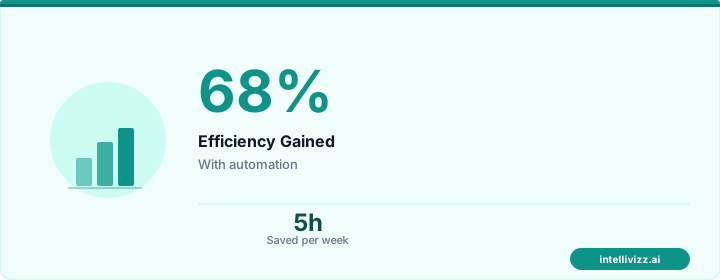
⚖️ Every missed call could be a $5,000+ case
See how automation transforms industry operations
Where Law Firm Leads Come From in 2026
Before building a follow-up system, it is essential to understand the full landscape of lead sources that require coverage. Most law firms draw leads from several distinct channels, each with different response expectations and qualification signals:
Website Contact Forms and Live Chat
Your own website is typically your highest-quality lead source because prospects who find your site organically or through paid search have already demonstrated meaningful intent — they searched for a term related to their legal problem, evaluated your site, and decided to reach out. These leads have high intent and high conversion potential, and they expect a response within minutes, not hours. Any contact form submission that goes unanswered for more than 30 minutes is a lead at high risk of being captured by a competitor.
Google Ads and LSA Leads
Google Local Services Ads (LSAs) are increasingly dominant in legal lead generation, particularly for practice areas with high consumer intent like personal injury, criminal defense, and family law. LSA leads receive a special notation in Google's platform — and Google actively tracks whether law firms respond promptly, using response rate and speed as factors in LSA ranking. Firms that respond slowly to LSA inquiries not only lose individual leads, they also degrade their long-term LSA performance. Automated AI phone follow-up for missed LSA calls is therefore both a lead-conversion tool and a ranking-protection tool.
Avvo, FindLaw, and Legal Directory Leads
Attorney directory platforms generate significant inquiry volume, particularly for solo practitioners and small firms that rank well in those ecosystems. These leads tend to be early-stage — prospects comparing multiple attorneys rather than ready to sign immediately — making nurture sequences particularly important. A single-touch response is rarely sufficient; multi-step follow-up over 3–7 days dramatically improves conversion rates from directory leads.
Referral Leads
Referrals from past clients, other attorneys, or professional contacts have the highest baseline conversion rate of any lead source — typically 25–45% compared to 2–8% for cold digital leads. But they still require prompt, professional follow-up. A referred prospect who calls your office and reaches voicemail has a negative first experience that partially cancels the trust established by the referral relationship. AI phone follow-up that answers immediately and schedules a consultation while making clear "Attorney [Name] will be joining you personally for your consultation" maintains the trust equity of the referral while ensuring no one falls through the cracks.
Social Media and Paid Social Leads
Facebook and Instagram lead generation campaigns, particularly for practice areas like personal injury, bankruptcy, and family law, can generate high lead volumes at relatively low cost per lead — but these leads have the lowest purchase intent and require the most sophisticated nurture sequences to convert. The prospect who filled out a Facebook form at 11 PM while seeing a personal injury ad is not in the same headspace as someone who searched "car accident attorney near me" and submitted your contact form. Social leads require educational content, trust-building, and patient multi-touch follow-up before conversion.
Automated Follow-Up Sequences by Practice Area
One of the most important principles in attorney lead follow-up automation is that different practice areas require fundamentally different messaging, urgency calibration, and sequence timing. A one-size-fits-all follow-up sequence performs poorly because it fails to address the specific emotional state, decision timeline, and informational needs of each prospect type.
Personal Injury (PI) Follow-Up Sequences
Personal injury leads are often time-sensitive in two directions simultaneously: the prospect may have immediate medical needs and financial pressure from lost wages, while the statute of limitations clock creates legal urgency. PI follow-up sequences should lead with empathy and immediate value — offering a free consultation that can happen today or tomorrow, addressing the prospect's concern about whether they have a case, and providing immediate information about medical treatment and documentation steps regardless of whether they retain the firm.
Effective PI sequences include an immediate (under 5-minute) outreach via SMS and phone, a same-day email with a case evaluation form, a 24-hour follow-up that adds specific value about the prospect's likely case type, and a 3-day follow-up with a client success story relevant to their situation. Automated AI phone follow-up for law firm calls handles the initial missed-call response, then human intake staff take over once the prospect engages.
Family Law Follow-Up Sequences
Family law prospects — particularly those going through divorce or child custody disputes — are in acute emotional distress. The follow-up sequence must strike a balance between urgency and sensitivity. Leading with aggressive sales messaging ("Don't let your spouse get the upper hand — call us NOW") is both off-putting and ethically questionable. Instead, effective family law sequences lead with empathy, provide immediate educational value (what to expect in the first 30 days of a divorce proceeding, how child custody decisions are made in your state), and position the consultation as a conversation about the prospect's situation rather than a sales meeting.
Family law sequences also benefit from longer nurture windows. A divorce proceeding can take 6–18 months from decision to completion; the prospect who inquires today but doesn't retain for 30 days is still a real lead worth maintaining. Bi-weekly educational emails about the divorce process, property division, and co-parenting agreements keep your firm top-of-mind during the decision period without being intrusive.
Criminal Defense Follow-Up Sequences
Criminal defense leads are often the most time-urgent of any practice area. A prospect who has just been arrested or is facing imminent arraignment needs an attorney within hours, not days. Immediate AI phone follow-up that captures the basic facts (charge type, jurisdiction, court date if known) and connects the prospect with available emergency consultation time is critical. Criminal defense practices that use automated after-hours AI phone answering see dramatically higher after-hours lead conversion — because many criminal defense inquiries arrive in evenings and weekends when staff are unavailable.
For suspects who haven't yet been arrested but are under investigation, the sequence is longer and more educational: explaining the investigation process, the importance of legal representation before questioning, and the risk of speaking to law enforcement without counsel. This educational sequence builds both trust and urgency simultaneously.
Estate Planning Follow-Up Sequences
Estate planning leads represent the opposite end of the urgency spectrum from criminal defense. Most estate planning prospects are not in crisis — they are planning ahead, often motivated by a life event (new child, home purchase, business formation, aging parent) that created awareness of the need. The follow-up sequence should acknowledge this motivation, provide immediate educational value about the estate planning process and what a basic plan includes, and create a gentle path to scheduling that doesn't feel high-pressure.
Estate planning sequences also benefit from extended follow-up windows and seasonal triggers. A prospect who inquired in January but didn't convert can be re-engaged in April ("It's a great time of year to update your estate plan as you finalize your taxes") or in September ("Back-to-school season is a good time for families to review their estate planning"). Automated re-engagement sequences that send relevant messages at natural trigger points dramatically extend the effective conversion window beyond the initial follow-up period.
AI Phone Follow-Up for Inbound Missed Calls
Every missed call costs a law firm real revenue. Studies of law firm call handling show that 35–45% of inbound calls go unanswered during business hours — during lunch, when staff are in consultations, when call volume spikes. After hours, the missed call rate rises to near 100%. For high-volume practice areas like personal injury and family law, where each case can generate $5,000–$50,000 in fee revenue, missed calls represent massive opportunity cost.
AI phone follow-up systems integrate with your phone system to detect missed calls and initiate an automatic outbound SMS within 60 seconds: "Hi [caller name], this is [Firm Name]. I'm sorry we missed your call — we'd like to help. Can we schedule a brief call to learn about your situation? [Scheduling link]." This message alone recovers a significant percentage of callers who would otherwise move on to the next firm in their search results.
For callers who don't respond to the initial SMS, the system initiates a follow-up email within 15 minutes, then a second SMS the next morning, creating a multi-touch sequence that increases total recovery rates to 25–40% of missed callers versus the 5–10% who call back spontaneously when only voicemail is offered.
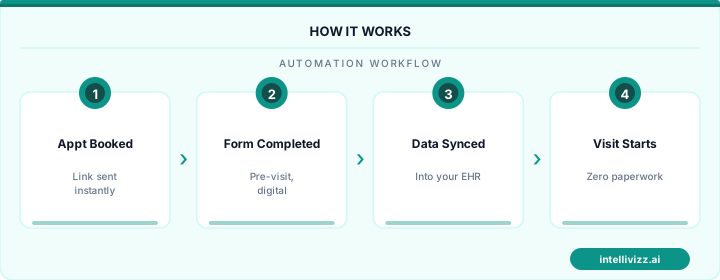
⚖️ Every missed call could be a $5,000+ case
From manual processes to automated excellence
Ethical Considerations: ABA Model Rules and Automated Follow-Up
Any discussion of automated attorney lead follow-up must address the professional responsibility framework governing attorney solicitation. The ABA Model Rules of Professional Conduct — and the state-specific rules that derive from them — impose meaningful constraints on how law firms can reach out to prospective clients, and those constraints apply to automated communications as fully as to manual ones.
Rule 7.3: Solicitation of Clients
Model Rule 7.3 prohibits in-person, live telephone, and real-time electronic solicitation of prospective clients when the attorney's motivation is pecuniary gain, unless the prospective client is a lawyer or has a prior relationship with the attorney. However, this rule applies to proactive outreach to prospects who have not initiated contact. When a prospect submits a contact form, calls your office, or otherwise initiates the inquiry, their follow-up falls outside the solicitation prohibition — they have invited the response. For a deeper dive into keeping booked consultations on the calendar, see our guide on law firm no-show reduction.
Automated follow-up sequences triggered by prospect-initiated contact are therefore generally permissible under Model Rule 7.3 in most states. However, firms should consult their state's specific rules, as some states have adopted more restrictive solicitation rules than the Model Rules, particularly for personal injury and workers' compensation matters.
Communication Identification Requirements
All automated communications must clearly identify the sender as a law firm, include the required "Attorney Advertising" disclaimer where applicable under state rules, and not misrepresent the nature of the communication. An automated SMS that says "Hi, this is Sarah from [Firm Name] — I saw your inquiry and wanted to connect" without clarifying that Sarah is an AI system may run afoul of disclosure requirements in some jurisdictions. Compliant automated messaging either clearly identifies itself as automated or is structured so that an actual staff member sends the initial message within the automated workflow.
Confidentiality and Data Handling
Information shared by prospective clients in initial inquiries — including the nature of their legal matter — creates at minimum a duty to maintain confidentiality under Rule 1.6 in most states' interpretation. Automated systems that capture and store prospect information must use appropriate security measures, and any third-party vendors handling that data must comply with data security requirements. This is particularly important for criminal defense and family law matters where prospect information is highly sensitive.
For additional context on ethical and compliant intake practices, see legal client intake software best practices and how AI helps law firms grow their client base.
CRM Integration and Lead Tracking
Attorney lead follow-up automation is only as good as its integration with the systems that track and manage client relationships. Law firm CRM integration is the layer that enables personalization, prevents duplicate outreach, and provides the reporting needed to measure ROI.
The major legal CRM platforms each have their own integration requirements:
| CRM Platform | Integration Method | Key Data Synced |
|---|---|---|
| Clio Grow | Native API + Zapier | Contact creation, matter type, consultation status |
| Lawmatics | Native webhook API | Pipeline stage, follow-up tasks, email opens |
| MyCase | REST API | Lead record, assigned attorney, notes log |
| Practice Panther | API + webhook | Contact record, intake questionnaire responses |
| HubSpot (custom) | HubSpot API | Full contact record, deal stage, all communications |
When a prospect submits a contact form, the automation platform creates a CRM contact record, assigns a practice area tag, triggers the appropriate follow-up sequence, and logs all subsequent interactions (SMS sends, email opens, link clicks, phone calls) against the contact record. When a staff member reviews the lead, they see the full engagement history — which messages the prospect opened, which links they clicked, how many times they visited your website — and can personalize their human follow-up accordingly.
Conversion Benchmarks and ROI Metrics
Law firms that deploy automated lead follow-up systems consistently report measurable improvements across several key metrics:
| Metric | Manual Follow-Up | Automated Follow-Up |
|---|---|---|
| Average response time to web inquiry | 47 hours | Under 5 minutes |
| Lead-to-consultation conversion rate | 8–15% | 22–38% |
| Consultation-to-retainer rate | 35–50% | 40–58% |
| Leads recovered from missed calls | 5–10% | 25–40% |
| After-hours leads captured | Near 0% | 60–75% |
| Cost per retained client | $400–$800 | $150–$350 |
| Monthly retainers from same lead volume | Baseline | +35–65% |
For a mid-sized personal injury firm generating 150 inbound inquiries per month at an average case value of $15,000 gross fee, improving lead-to-retainer conversion from 12% to 22% represents 15 additional cases per month — $225,000 in additional monthly revenue. Even at lower case values and smaller inquiry volumes, the ROI from attorney lead follow-up automation is among the highest available to a law firm without adding attorney headcount.
For firms also concerned about after-hours coverage, combining lead follow-up automation with an AI receptionist for law firms creates a complete inbound coverage system that ensures no prospective client ever reaches voicemail and no lead goes cold from slow follow-up. The two systems work in concert: the AI receptionist captures the call and handles initial qualification, while the follow-up automation nurtures any lead that doesn't immediately book a consultation.
Explore how client reactivation campaigns and new client welcome sequences can extend the value of your intake automation beyond initial conversion and into the full client lifecycle.
Ready to grow your firm with automation? Explore our professional services automation solutions, or read our guide to Law Firm Missed Call Text Back: Why Every Unanswered....