
How Much Do Missed Calls Cost a Business? The ROI of Answering Every Call
Every time your business phone rings and nobody answers, money walks away. Not hypothetical money — real, calculable revenue. A 2025 study by Numa found that 62% of calls to small businesses go unanswered, and 85% of callers who reach voicemail will not call back. They'll call your competitor instead. An AI after-hours receptionist ensures your business captures calls even outside business hours, while an AI answering service for small businesses handles high call volume at a fraction of the cost of a full-time receptionist.
The cost varies dramatically by industry, but the pattern is universal: missed calls represent the highest-ROI problem most businesses aren't measuring. This article provides the data, the calculations, and the solutions.
The Universal Cost Formula
The cost of a missed call equals: (Missed calls per month) × (% that are revenue-generating inquiries) × (Conversion rate if answered) × (Average transaction value or customer lifetime value)
Let's apply this across industries with real benchmarks.
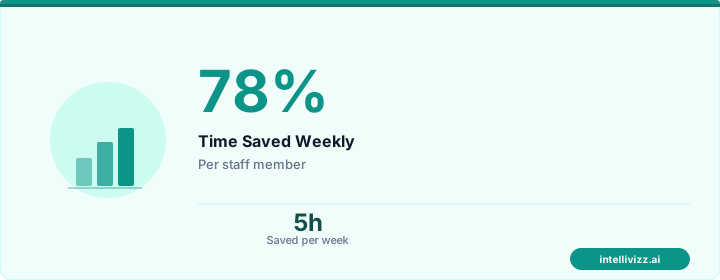
📞 62% of business calls go unanswered — don't be one of them
See how automation transforms industry operations
Industry-by-Industry Cost Analysis
Medical Practices
- Average incoming calls: 200-300/week
- Missed call rate: 25-35%
- New patient calls among missed: 30-40%
- New patient LTV: $1,200-$3,500
- Annual cost of missed calls: $100,000-$175,000
For detailed medical practice calculations, see our deep-dive: How Much Do Missed Calls Cost Your Medical Practice?
Law Firms
- Average incoming calls: 50-150/week
- Missed call rate: 30-40%
- Potential client calls among missed: 40-50%
- Average case value: $3,000-$15,000
- Annual cost of missed calls: $150,000-$500,000
Law firms face the highest per-call cost because legal matters are high-value and clients in need rarely wait. They call the next attorney immediately.
Dental Practices
- Average incoming calls: 150-250/week
- Missed call rate: 20-30%
- New patient calls among missed: 25-35%
- New patient LTV: $1,000-$2,500
- Annual cost of missed calls: $75,000-$130,000
Real Estate Agents/Teams
- Average incoming calls: 30-80/week
- Missed call rate: 40-50%
- Serious buyer/seller inquiries among missed: 30-40%
- Average commission per transaction: $8,000-$15,000
- Annual cost of missed calls: $80,000-$250,000
Real estate has the highest missed call rate because agents are frequently in showings, meetings, and driving. Speed-to-lead is critical — the first agent to respond wins 78% of the time.
Restaurants
- Average incoming calls: 100-200/week
- Missed call rate: 35-50% (especially during service)
- Revenue-generating calls among missed: 60-70% (reservations, takeout orders)
- Average order/reservation value: $40-$120
- Annual cost of missed calls: $62,000-$150,000
Home Services (Plumbing, HVAC, Electrical)
- Average incoming calls: 40-100/week
- Missed call rate: 35-45%
- Service request calls among missed: 50-60%
- Average job value: $300-$1,500
- Annual cost of missed calls: $80,000-$200,000
The Compound Effect of Missed Calls
The numbers above represent direct lost revenue. But missed calls have compound effects:
- Lost referrals: Every customer you didn't acquire is also their network you didn't access. A lost customer represents 2-3 lost referrals over time.
- Negative brand impression: Callers who can't reach you form a negative impression. If they later see your ads or Google listing, they remember the unanswered call.
- Competitor advantage: Your missed call is your competitor's answered call. You're not just losing revenue — you're funding your competition.
- Wasted marketing spend: If you're spending $5,000/month on marketing that drives phone calls, and 30% of those calls go unanswered, you're effectively burning $1,500/month in marketing spend.
Solutions by Budget
$0/month: Missed Call Text-Back (Manual)
Check voicemail hourly and text every missed caller back immediately. Free but labor-intensive and inconsistent.
$50-150/month: Automated Missed Call Text-Back
When a call is missed, an automatic text is sent within seconds: "Sorry we missed your call! How can we help? Reply here or we'll call you back shortly." Recovers 30-40% of missed calls by converting them to text conversations.
$100-300/month: AI Receptionist
An AI-powered system answers every call instantly — 24/7. It can schedule appointments, answer FAQs, qualify leads, and route urgent calls. Eliminates the missed call problem entirely. The ROI is typically 10-50x the monthly cost.
$500-1,500/month: Human Answering Service
Live operators answer overflow and after-hours calls. Effective but expensive, and quality varies by operator. Best for businesses that need a human touch for complex or emotional calls.
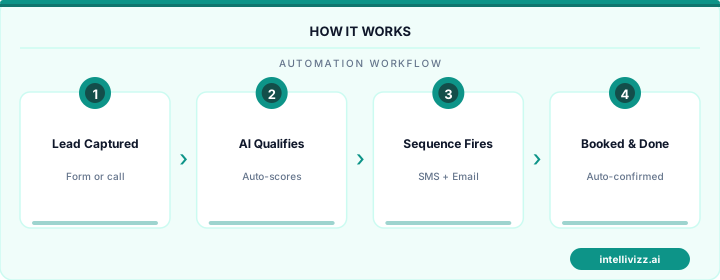
📞 62% of business calls go unanswered — don't be one of them
From manual processes to automated excellence
Calculating Your Specific ROI
To calculate the ROI of a phone answering solution for your business:
- Get your missed call count from your phone system (most VoIP providers track this)
- Estimate the percentage that are revenue opportunities (usually 30-50%)
- Multiply by your average customer value
- Compare that number to the monthly cost of your chosen solution
For the vast majority of businesses, even the most expensive answering solution pays for itself within the first week of operation. The question isn't whether you can afford to answer every call — it's whether you can afford not to.
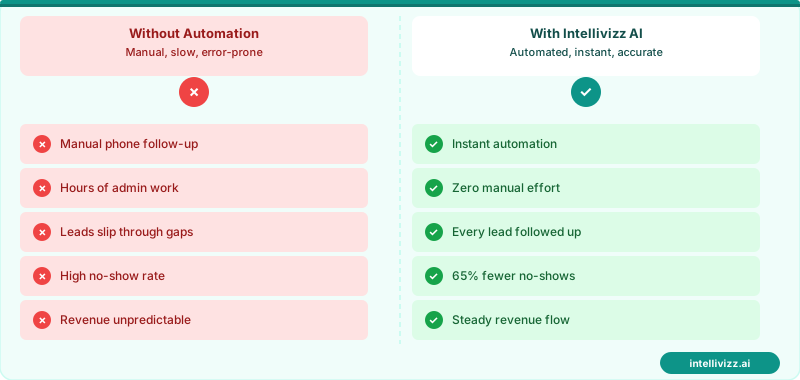
📞 Every unanswered call is a revenue decision — you just didn't make it intentionally.
Quantify the cost. Fix the problem. Stop leaving money on the table. Related: learn how a missed call text back service can recover every missed call automatically.
The Compounding Problem: Lost Calls Become Lost Reviews
The direct revenue loss from a missed call is only part of the damage. When a caller can't reach you, they don't stay on hold — they call your competitor. And when your competitor delivers a great experience, they get the review you should have earned. Over 12 months, a practice missing 15 calls per week is effectively donating 780 potential 5-star reviews to competing businesses in their market. Online review volume is a direct ranking factor on Google Maps — meaning missed calls don't just cost you appointments, they cost you visibility.
The calculation most businesses miss: each new patient or client acquired through a call is typically worth 3–7 future visits, referrals, or purchases. The lifetime value of a missed call is rarely captured in a single appointment slot. Model it with LTV and the numbers become alarming.
Where Calls Go Unanswered Most Often
For most service businesses, missed calls cluster around predictable times: lunch hours (12–2pm), late afternoon (5–7pm), and weekends. These aren't random failures — they're structural gaps where call volume outpaces staff availability. The fix isn't always more staff. It's building coverage specifically for those windows, whether through extended hours, an answering service, or an AI voice agent that handles first contact and books directly into your calendar.
| Business Type | Avg. Call Value | Weekly Missed Calls | Annual Revenue Lost |
|---|---|---|---|
| Dental practice | $350 | 20 | $364,000 |
| Law firm | $2,500 | 8 | $1,040,000 |
| Med spa | $280 | 15 | $218,400 |
| Real estate agency | $8,000 | 5 | $2,080,000 |
See how speed-to-lead automation can turn incoming inquiries — including voicemails — into booked appointments within minutes.
Cross-Industry Revenue Impact: How Missed Calls Compare Across Sectors
The missed call revenue problem is not unique to any single industry, but the magnitude and mechanics vary dramatically across business types. Understanding how missed calls create revenue leakage in fundamentally different business models reveals patterns that industry-specific analyses cannot capture.
E-commerce cart abandonment offers a striking parallel to phone-call abandonment in service businesses. Online retailers experience 70% cart abandonment rates, and the recovery playbook — retargeting ads, abandoned-cart email sequences, exit-intent popups — is mature and well-funded. Yet brick-and-mortar and service businesses experiencing 25-35% call abandonment rates rarely deploy equivalent recovery infrastructure. The asymmetry is remarkable: an e-commerce business losing a $45 cart gets three automated recovery emails within 24 hours, while a dental practice losing a $3,200 implant patient to a missed call gets nothing. The technology gap between digital commerce recovery and phone-call recovery is closing rapidly, but adoption lags by years.
SaaS churn correlation studies reveal that B2B software companies whose support lines go unanswered during business hours experience 2.3x higher monthly churn than companies with sub-60-second answer times. For a SaaS company with $5M ARR and 5% monthly churn, improving phone answer rates from 70% to 95% correlates with churn reduction worth $300,000-$450,000 annually. The mechanism is not the missed call itself but the erosion of customer confidence that compounds across multiple unsatisfying support interactions.
Retail foot traffic conversion rates provide another cross-industry lens. A retail store converting 20% of walk-in visitors to buyers is considered healthy, and retailers invest heavily in store layout, staff training, and point-of-purchase displays to move that rate. Phone calls to retail locations convert at 30-50% — significantly higher than foot traffic — yet retailers staff phones as an afterthought. A specialty retailer missing 10 calls per day at a 40% conversion rate and $150 average transaction value loses $219,000 annually, yet many retailers have no visibility into their missed call volume because they have never installed call tracking.
B2B pipeline velocity — the speed at which prospects move through the sales funnel — degrades measurably when inbound calls go unanswered. A B2B company with a 90-day average sales cycle that misses the initial inbound call extends that cycle by 12-18 days because the prospect contacts competitors during the response gap. At the enterprise level, where deal values range from $50,000 to $500,000, even a single missed call that delays a deal close by one quarter has material impact on revenue recognition timing and sales commission structures.
Consulting engagement lifecycles illustrate the high-value end of the missed call spectrum. A management consulting firm whose partners miss calls from prospective clients during business development windows risks losing engagements worth $100,000-$2,000,000. Unlike transactional businesses where a missed call loses one sale, consulting firms lose the entire multi-month engagement plus downstream referrals from the relationship that never formed. Senior partners at top-25 consulting firms have reported losing engagements specifically because a competitor answered their prospect's call when they did not.
Franchise territory saturation creates a unique missed call dynamic. In dense franchise markets — fast-food, fitness, home services — a missed call from a prospect does not mean a lost sale to a non-competitor; it means a lost sale to another franchisee of the same brand. A Servpro franchise in a territory with three neighboring Servpro territories that misses a water-damage emergency call loses that $4,000-$12,000 job to a sister franchise, not to a competitor brand. The franchisor's system-wide revenue is unaffected, but the individual franchisee's P&L takes the full hit. Multi-unit franchise operators who have installed AI answering systems across their territories report capturing 15-25% more inbound leads than single-unit operators in adjacent territories who rely on manual phone answering during business hours only.
Ready to get started with automation? Explore our AI automation solutions, or read our guide to The Real Cost of Missed Business Calls (And How to Fix....