
Speed to Lead Automation: Why Responding in 5 Minutes Makes or Breaks Your Conversion Rate
The 5-Minute Rule That Changes Everything
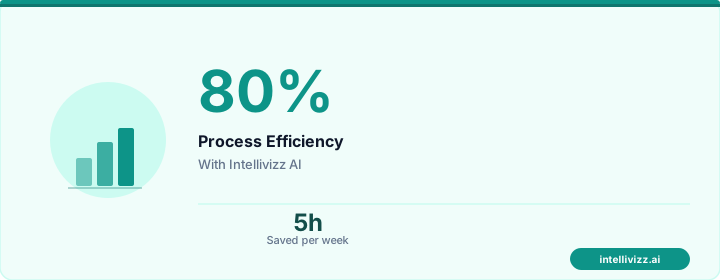
Research from MIT and InsideSales.com revealed a finding that transformed sales strategy: leads contacted within 5 minutes of their inquiry are 21 times more likely to enter the sales pipeline than leads contacted after 30 minutes. After 5 minutes, lead qualification rates drop by 80%.
The reason is simple psychology. When someone fills out a form, makes a phone call, or sends an inquiry, they're at peak interest and attention. They're likely still at their computer or phone, still thinking about the problem they need solved. Five minutes later, they've moved on to the next task. Thirty minutes later, they've already contacted your competitor who responded first.
In healthcare specifically, speed to lead is even more critical — patients choosing a new provider make their decision within the first 1-2 contacts.
💡 Automation handles the routine — you handle the growth
From manual processes to automated excellence
Where Most Businesses Fail
Despite the overwhelming evidence, the average business response time to a new lead is 47 hours. Nearly half of businesses never respond at all. The gap between knowing speed matters and actually being fast enough is where automation bridges the divide.
Common failure points include:
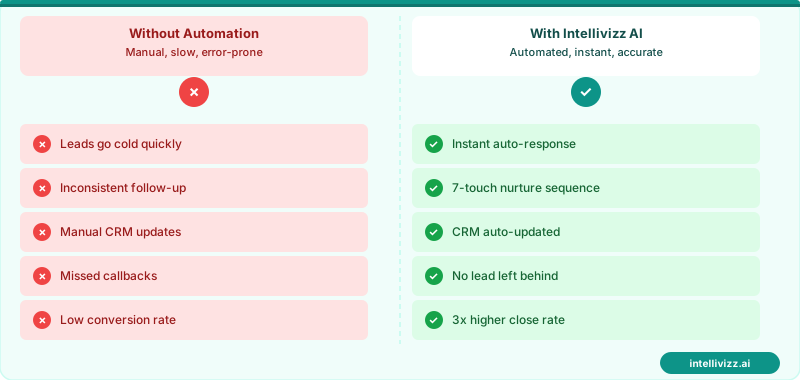
- After-hours inquiries: 60% of web form submissions happen outside business hours when no one is available to respond
- Staff multitasking: Front desk or sales teams handling multiple responsibilities can't prioritize immediate lead follow-up
- Routing delays: Lead goes to a general inbox, then gets assigned to a rep, then the rep calls — adding 2-4 hours of lag
- Weekend and holiday gaps: Leads from Friday evening through Monday morning sit for 48-60 hours
Building a Speed-to-Lead Automation Stack
Layer 1: Instant Acknowledgment (0-60 seconds)
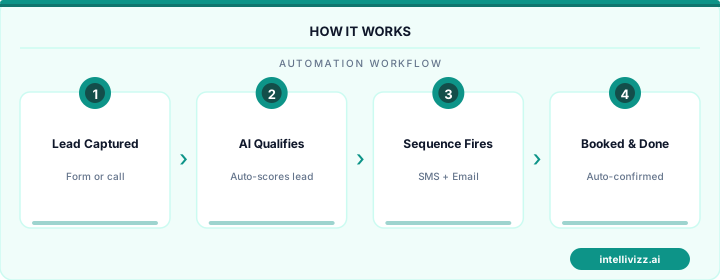
Every lead source (web form, phone call, chat, social media DM) triggers an immediate automated response:
- Web form: Auto-reply email + SMS within 30 seconds: "Thanks for reaching out! A member of our team will contact you shortly. In the meantime, here's [relevant resource]."
- Phone call: AI receptionist answers on the first ring and engages the caller in conversation, gathering qualifying information
- Chat: AI chatbot engages immediately with qualifying questions
- Social media: Auto-response acknowledges the inquiry and offers next steps
Layer 2: Qualification (1-5 minutes)
While the lead receives their acknowledgment, the system:
- Enriches the lead with available data (name, company, location)
- Scores the lead based on source, inquiry type, and demographics
- Routes high-priority leads to the best available team member via push notification
- Logs the lead in the CRM with full context from the initial interaction
Layer 3: Human Follow-Up (5-15 minutes)
The assigned team member receives a notification with complete context: who the lead is, what they inquired about, what the AI already discussed, and suggested talking points. The human call happens within minutes, informed and personalized — not cold and scripted.
Automation by Lead Source
| Lead Source | Avg Current Response | Automated Response | Conversion Impact |
|---|---|---|---|
| Website form | 4-8 hours | < 60 seconds | +300-400% |
| Phone inquiry | 30% missed | 100% answered | +200-250% |
| Google Ads click-to-call | 45% missed | AI answers instantly | +350% |
| Social media message | 12-24 hours | < 2 minutes | +500% |
| Referral introduction | 1-3 days | Same-day outreach | +150% |
💡 Automation handles the routine — you handle the growth
See how automation transforms industry operations
Industry-Specific Applications
Medical Practices
New patient inquiries that receive a callback within 5 minutes book appointments at 3x the rate of 30-minute callbacks. An AI phone system can schedule the appointment during the initial call — reducing speed-to-lead to zero.
Legal Services
Potential clients contacting multiple firms simultaneously choose the first firm that responds substantively. Law firms using AI intake capture leads that competitors lose to voicemail.
Real Estate
Property inquiries are extremely time-sensitive — buyers move fast. AI-powered real estate follow-up ensures every Zillow, Realtor.com, and website lead gets instant engagement.
Small Business Services
For small businesses without dedicated sales teams, automation is the only way to compete with larger competitors on response speed.
Measuring Speed to Lead
Track these metrics to optimize your system:
- Time to first response: seconds from inquiry to acknowledgment (target: < 60 seconds)
- Time to human contact: seconds from inquiry to live conversation (target: < 15 minutes during business hours)
- After-hours response time: should match business-hours speed via automation
- Lead-to-appointment conversion rate: segmented by response time buckets
- Response time by channel: identify which channels have the longest gaps
Frequently Asked Questions
Does speed matter more than personalization?
You need both, but speed is the prerequisite. A fast, generic response outperforms a slow, personalized one. The ideal is a fast, AI-personalized response followed by a well-informed human call — which is exactly what automation enables.
What if we're a small team and can't respond within 5 minutes?
That's precisely the use case for automation. AI handles the instant response, qualification, and even appointment scheduling. Your team follows up with qualified leads during business hours. The automation ensures no lead goes unacknowledged, regardless of team size.
⚡ The first business to respond wins. Automation makes sure that business is yours.
Respond to every lead in under 60 seconds — automatically, around the clock.
Building the Automated Response Infrastructure
Speed-to-lead automation isn't a single tool — it's a stack. At minimum, it requires: a mechanism to capture the lead (web form, phone call, chat widget, social DM), a trigger that fires the moment the lead arrives, and a response channel (SMS, email, or outbound call) that reaches the prospect within 60 seconds. Each handoff in this chain introduces latency, so the architecture matters as much as the individual tools.
The most common failure point is the gap between form submission and CRM entry. Many businesses receive a form submission, which emails a notification to a sales inbox, which someone manually creates a CRM record from, which triggers an outreach task — a process that takes 20–40 minutes even when staff are attentive. Eliminating manual steps from this chain is the single highest-leverage automation investment most businesses can make.
Channel Strategy for Speed to Lead
Not all response channels are equal in speed or effectiveness. SMS outperforms email for initial response — open rates for text messages within the first 3 minutes are 97%, compared to 20% for email within the same window. Phone outbound calls convert at the highest rate but require available staff or an AI voice agent. The optimal speed-to-lead infrastructure uses SMS as the primary first-touch channel, email as a secondary channel with more detail, and an outbound call as the third touchpoint for high-value leads who don't respond to the first two.
| Response Channel | 3-Minute Open Rate | Lead Conversion Rate |
|---|---|---|
| SMS (automated) | 97% | 32–38% |
| Email (automated) | 20% | 14–20% |
| Outbound call (AI agent) | N/A | 40–52% |
Healthcare practices face unique considerations when implementing speed-to-lead systems — see our dedicated guide on speed to lead in healthcare.
Ready to get started with automation? Explore our AI automation solutions, How Fast Should You Respond to a Lead? The Research..., or AI Lead Follow-Up Automation: Never Let Another Lead....