
AI Lead Follow-Up Automation: Never Let Another Lead Go Cold
The Follow-Up Failure That Kills Revenue
The statistics are damning: 80% of sales require at least 5 follow-up contacts, but 44% of salespeople give up after just one attempt, and 92% give up after four. The gap between what's required and what actually happens represents billions in lost revenue across every industry.
It's not laziness — it's capacity. A salesperson managing 50 active leads can't realistically execute 5+ personalized follow-ups per lead while also handling new inquiries, appointments, and administrative tasks. Something has to give, and follow-up is always what gets dropped.
Speed to lead matters enormously, but it's only the first step. What happens after that initial contact determines whether the lead converts or disappears.
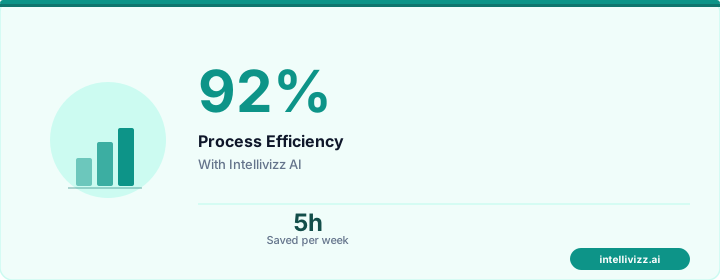
💡 Automation handles the routine — you handle the growth
See how automation transforms industry operations
What AI Follow-Up Automation Does
AI-powered follow-up goes beyond simple drip sequences. It uses intelligence to determine what to say, when to say it, and through which channel:
Behavioral Triggers
Instead of time-based sequences ("send email 3 days after email 1"), AI monitors lead behavior and responds contextually:
- Lead opens your email but doesn't reply → send a different angle 24 hours later
- Lead visits your pricing page → trigger a text about pricing flexibility
- Lead downloads a case study → send a related success story
- Lead goes quiet for 2 weeks → re-engage with a value-add (article, tip, industry news)
Channel Optimization
AI learns which channels each lead prefers and adjusts:
- If email open rates are low but texts get read → shift to SMS
- If the lead never answers calls but responds to emails → stop calling, increase email frequency
- If the lead engages most on LinkedIn → add social touches to the sequence
Message Personalization
AI generates follow-up messages personalized to the lead's industry, role, pain points, and interaction history:
- Reference their specific inquiry or expressed need
- Include relevant case studies from their industry
- Adjust tone based on engagement level (warmer for engaged leads, re-engagement style for cold leads)
- Vary message format (question, value-add, social proof, direct ask)
The Follow-Up Sequence Framework
| Day | Channel | Purpose | Example |
|---|---|---|---|
| 0 | Phone + Text | Initial response | "Thanks for reaching out. I'd love to help with [need]." |
| 1 | Value-add | Send relevant resource or case study | |
| 3 | Text | Check-in | "Did you have a chance to review what I sent?" |
| 7 | Social proof | Share a client success story in their industry | |
| 14 | Phone | Direct ask | Personal call with specific scheduling proposal |
| 21 | Re-engage | New angle: industry trend, limited-time offer, or new feature | |
| 30 | Text | Soft close | "Still interested in [solution]? Happy to help whenever you're ready." |
| 60/90 | Long-term nurture | Monthly value content to stay top-of-mind |
Industry Applications
Medical Practices
New patient inquiries that don't book on the first call enter an automated follow-up sequence. Practices using AI receptionists capture lead data during the initial call, enabling personalized follow-up about specific health concerns or service interests.
Legal Services
Case inquiries require rapid, sensitive follow-up. Law firms using AI follow-up convert 2-3x more consultations because every inquiry receives immediate, persistent attention.
Real Estate
Real estate agents managing dozens of leads simultaneously benefit enormously from AI that tracks each lead's property interests and sends relevant listings automatically.
Small Business Services
For small businesses without dedicated sales teams, AI follow-up is the only scalable way to maintain consistent contact with every lead.
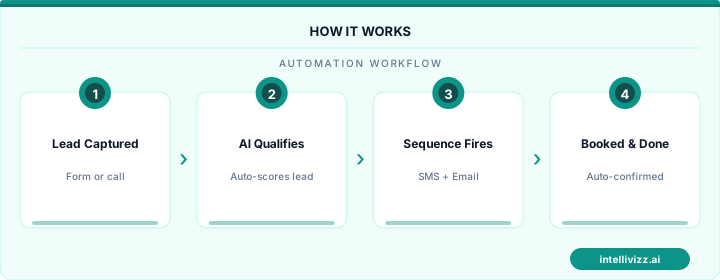
💡 Automation handles the routine — you handle the growth
From manual processes to automated excellence
Measuring Follow-Up Performance
- Lead-to-appointment rate: % of leads that schedule a meeting or appointment
- Follow-up completion rate: % of leads receiving the full sequence (should be 100% with automation)
- Optimal conversion touchpoint: Which touch in the sequence generates the most conversions?
- Revenue per lead: Total revenue attributed to automated follow-up sequences
- Response rate by channel: Which channel generates the most engagement per lead segment
Lead Scoring Integration and Sales Team Handoff Automation
AI lead follow-up automation generates its highest value when it is connected to a lead scoring model that differentiates between leads that should remain in automated nurture and leads that are ready for human sales engagement. Without this integration, automated follow-up either over-nurtures high-intent leads who would convert faster with a direct sales conversation, or under-nurtures low-intent leads who are handed off to sales before they are ready — resulting in wasted sales capacity and lower close rates. The scoring model evaluates behavioral signals across the automated follow-up sequence: email opens and click-through on specific content types, website page visits (pricing page, case study downloads, competitor comparison pages), response to qualification questions embedded in conversational AI interactions, and explicit intent signals like free trial activation or demo request.
When a lead's cumulative score crosses a defined threshold — calibrated against historical closed-won patterns in the CRM — the automation executes a sales handoff rather than continuing the nurture sequence. This handoff is designed to be warm: the sales rep receives a lead summary that includes every automated interaction, the specific content consumed, the qualification signals observed, and a recommended opening angle based on the content pattern. The lead receives a personalized outreach from the human rep that references their research journey ("I saw you were looking at our implementation timeline — I want to make sure you have the right information for your situation"). This continuity, enabled by the automated context-building during the nurture phase, dramatically improves first-conversation conversion rates compared to cold outbound sequences.
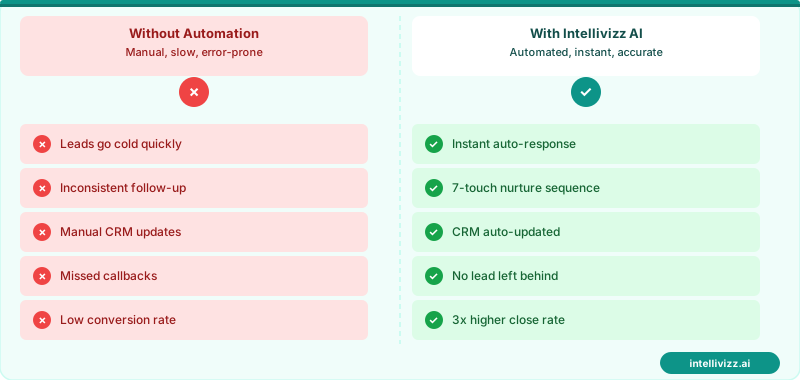
🤖 Nurture at Scale. Hand Off at the Right Moment.
AI lead scoring identifies sales-ready prospects 40% faster than manual qualification
Re-Engagement Sequences for Cold and Stalled Leads
Every lead pipeline contains a significant inventory of contacts who initially expressed interest, received initial automated follow-up, and then went quiet — neither converting nor explicitly opting out. These stalled leads are a high-value asset that most businesses systematically underutilize. A lead that engaged with two emails and downloaded a resource six months ago demonstrated genuine interest; the failure to convert was a timing or urgency issue, not a fit issue. AI-driven re-engagement automation identifies these stalled leads by analyzing time since last engagement and comparing the lead's profile against recent closed-won patterns — surfacing leads where a new trigger (a product update, an industry news event, a competitive development) creates a re-engagement opportunity.
Re-engagement sequences for cold leads differ from initial follow-up in both tone and content. Where initial sequences are educational and value-building, re-engagement sequences tend to be shorter, more direct, and anchored to a specific reason for reaching back out. A product update that addresses a specific use case the lead explored, a new case study from their industry, or a limited-time offer tied to a business event (end-of-quarter, annual planning season) provides the "news hook" that makes re-engagement feel relevant rather than pestering. AI personalization that references the lead's prior engagement ("Since you looked at our reporting features last spring, I wanted to share how we've expanded them") creates a continuity of context that generic re-engagement blasts cannot achieve.
| Lead Stage | Automation Action | Sequence Length | Avg. Re-Engagement Rate |
|---|---|---|---|
| Active nurture (0–30 days) | Scored content delivery | 8–12 touches over 30 days | N/A (primary sequence) |
| Stalled (31–90 days inactive) | Re-engagement sequence | 3–4 touches over 21 days | 8–14% |
| Cold (91–180 days inactive) | News-hook re-engagement | 2 touches + pause | 4–8% |
| Long-term cold (180+ days) | Quarterly newsletter only | Ongoing passive | 2–4% per send |
Businesses looking to maximize the return on their inbound lead generation investment will find the broader framework on client reactivation campaign automation highly complementary — covering the re-engagement strategies for past customers that parallel the cold lead re-engagement sequences described here, with additional context on relationship-based outreach for service businesses.
Conversational AI and the Zero-Friction Lead Qualification Experience
Traditional lead follow-up automation relies on one-way content delivery — emails, downloads, and drip sequences that push information to the lead and hope that relevant content will eventually prompt an action. Conversational AI transforms this model by enabling genuine two-way dialogue at the earliest stage of the lead relationship: a chat interaction, SMS conversation, or voice call where the lead's questions are answered in real time, their situation is actively assessed, and their path to the next step is cleared of the friction that delays conversion. The difference in lead experience is qualitative, not just quantitative — a prospect who feels heard and responded to in real time converts at fundamentally higher rates than one who receives a pre-written email sequence regardless of their immediate question or concern.
Conversational AI lead qualification can be deployed across multiple entry points in the lead generation funnel. Website chat widgets that initiate conversation based on behavioral triggers (time on pricing page, return visit to a specific feature page, download of a high-intent resource) capture leads at peak consideration moments. SMS conversation workflows triggered by form submissions allow leads to ask clarifying questions within minutes of initial inquiry, reducing the gap between interest and qualification. Inbound call AI that handles initial qualification calls for high-volume lead environments — connecting to a live conversation rather than a voicemail — captures the intent and urgency of phone-preferred leads that email nurture sequences systemically fail to convert. Each of these conversational touchpoints, properly configured, narrows the qualification timeline and increases the proportion of leads who reach a sales-ready status before their interest wanes.
Ready to get started with automation? Explore our AI automation solutions, or read our guide to How Fast Should You Respond to a Lead? The Research....