
How Fast Should You Respond to a Lead? The Research Behind the 5-Minute Rule
The Research Is Definitive — And Most Businesses Ignore It
In 2011, researchers at MIT's Sloan School of Management, in collaboration with InsideSales.com, published what became one of the most widely cited studies in B2B and B2C sales research. They analyzed 1.25 million sales leads across six companies, tracking response times and qualification outcomes over three years. Their finding was stark and has been replicated in every subsequent study on the topic: firms that attempted to contact leads within one hour of receiving a query were nearly seven times more likely to qualify the lead than those who waited even one hour. Firms that contacted leads within five minutes were 21 times more likely to qualify the lead than those who waited 30 minutes.
This finding has been confirmed, refined, and extended by Harvard Business Review, Velocify, Drift, and numerous industry-specific studies. The numbers vary slightly by methodology and industry, but the directional finding is universal: lead response time is one of the most powerful determinants of conversion outcomes, and the relationship is exponential — not linear — as response time increases from minutes to hours.
Despite this, the average response time for B2B leads is approximately 42 hours. The average response time for service business leads — legal, real estate, medical, financial services, home services — is 8–24 hours. The gap between what the research prescribes and what businesses actually deliver is not a few minutes. It is measured in hours and days.
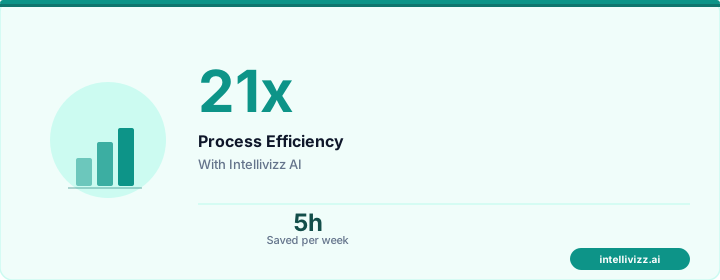
⏱️ 5 Minutes = 21x Better Odds of Qualification
The MIT study finding that changed how high-performing businesses think about lead response
The Core Studies and What They Found
The MIT / InsideSales.com Study (2011)
The landmark study by James Oldroyd, Kristina McElheran, and David Elkington analyzed 1.25 million leads generated by 29 B2C companies across six industries. Their key findings:
- Leads contacted within the first minute of inquiry had a conversion rate 391% higher than those contacted at the two-minute mark.
- Leads contacted within five minutes were 21x more likely to be qualified than those contacted after 30 minutes.
- After the first hour, the odds of successfully contacting and qualifying a lead dropped by more than 10 times.
- After 24 hours, the probability of successful contact dropped to roughly 17% of the probability at the one-minute mark.
The researchers attributed the dramatic decay to two factors: the prospect's attention and intent are highest at the moment of inquiry, and the window before the prospect contacts competing providers is measured in minutes, not hours.
Harvard Business Review Analysis (2011)
An analysis published in Harvard Business Review by the same research team synthesized the data into a practical business framework. Their finding: the optimal first-contact window for qualification is within five minutes of lead receipt. After five minutes, the probability of successful qualification begins its exponential decline. After 10 minutes, the probability of contact drops 400% compared to immediate response. The HBR analysis also documented that only 37% of companies respond to leads within an hour — and 24% never respond at all.
Velocify Research (2012–2018)
Velocify, a sales automation platform, conducted multiple studies on lead response across insurance, mortgage, education, and legal services. Their longitudinal data confirmed the MIT findings and added industry-specific detail: in mortgage lending, a 1-minute response time produced a 391% increase in conversion over a 1-hour response. In education, leads responded to within 1 minute converted at 9x the rate of leads responded to after 5 minutes. In legal services, the decay curve was among the steepest observed — partially explained by the high volume of comparative inquiries legal prospects submit simultaneously to multiple firms.
Drift's Lead Response Survey (2019)
Drift surveyed 433 B2B companies across industries and found that only 7% responded to leads within 5 minutes of form submission. The median response time was 42 hours. Their mystery shopper analysis found that 55% of companies took more than 5 business days to respond to an inbound inquiry, and 23% never responded at all. The gap between the research prescription (5 minutes) and actual business behavior (42 hours median) remained virtually unchanged from the 2011 baseline findings.
The Conversion Decay Curve: What Happens at 5, 15, 30, and 60 Minutes
The academic research is useful for establishing the framework, but the conversion decay curve across specific time intervals is what translates the data into operational urgency:
| Response Time | Relative Contact Probability | Relative Qualification Probability | Practical Implication |
|---|---|---|---|
| Under 1 minute | 100% (baseline) | 100% (baseline) | Ideal; requires full automation |
| 1–5 minutes | ~75% | ~80% | Excellent; achievable with fast alert + human callback |
| 5–15 minutes | ~50% | ~45% | Good; still well above average business performance |
| 15–30 minutes | ~35% | ~25% | Marginal; significant qualification loss already occurring |
| 30–60 minutes | ~20% | ~12% | Poor; most competitive advantage lost |
| 1–24 hours | ~10% | ~5% | Near-negligible; lead likely resolved elsewhere |
| 24+ hours | ~2–5% | ~2% | Essentially a cold lead; conversion very unlikely |
The practical reading of this curve is not that speed is the only variable — lead quality, offer relevance, and follow-up persistence matter significantly. But speed is the variable that determines whether you are competing for the lead at all. A prospect who submitted an inquiry simultaneously to four firms 45 minutes ago has probably already spoken with at least one of those firms. If that conversation went well, the prospect's decision is effectively made before you call.
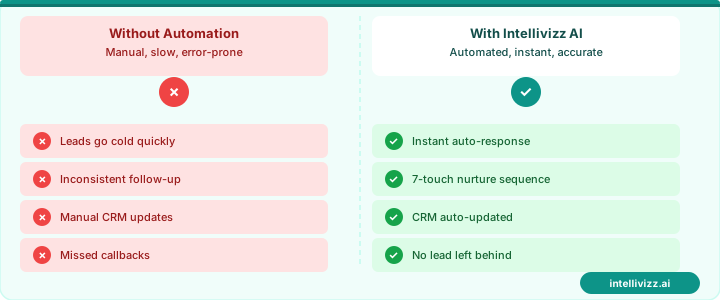
📉 The Conversion Decay Is Exponential, Not Linear
At 30 minutes, qualification probability has already dropped 88% from the 1-minute baseline
Industry-Specific Response Time Benchmarks
The five-minute rule is a general prescription; the optimal response time and the competitive cost of delay vary by industry, driven by how urgently prospects need a solution, how many competing providers they contact simultaneously, and what channels they use to inquire.
Legal Services — Target: 5 Minutes
Legal service prospects — particularly in personal injury, criminal defense, and family law — are among the most time-sensitive in any service industry. Research from Martindale-Avvo found that 42% of legal consumers contact more than one law firm when seeking representation. The firm that responds first earns the first conversation; the firm that wins the first conversation closes 60–70% of qualified leads. The target response time for legal services is the same as the general research benchmark: five minutes or less. For the automation systems that make this possible, see our guide to attorney lead follow-up automation.
Real Estate — Target: 5 Minutes
Real estate inquiry behavior mirrors legal: prospects submit multiple inquiries simultaneously, urgency is high (particularly for buyers with financing in place), and the agent who responds first earns a disproportionate share of the conversation. NAR research indicates that 50% of buyers work with the first agent they contact. For AI-powered response systems in real estate, our guide to AI for real estate lead follow-up covers the full implementation stack.
Medical and Healthcare — Target: 30 Minutes
Medical practice leads — appointment requests, new patient inquiries, specialist referrals — have a slightly more forgiving response window because the urgency pattern is different. Except for urgent care and emergency-adjacent inquiries, patients typically contact one or two providers rather than five. The competitive pressure is lower, but the research still shows meaningful conversion degradation after 30 minutes, and same-day response dramatically outperforms next-business-day response.
Education — Target: 1 Hour
Educational inquiries — private school admissions, tutoring, higher education — have the most forgiving response window among service industries, because the decision timeline is longer (parents are typically choosing for a future enrollment cycle) and the inquiry behavior is more sequential than parallel. That said, a one-hour response target is still dramatically faster than the average business's actual performance, and early responsiveness signals organizational professionalism that influences admission decisions.
Home Services and Contractors — Target: 15 Minutes
Home services leads — plumbing, HVAC, roofing, landscaping — are often urgency-driven (a leak, a failing system, storm damage). The first contractor who calls earns the first site visit; the first site visit closes the majority of emergency home service calls. A 15-minute response target is achievable with simple missed call automation and appropriate on-call protocols. For the broader cost analysis of slow response, our guide to how much missed calls cost a business quantifies the revenue at stake.
Why Businesses Fail to Meet the 5-Minute Standard — and What the Research Says About Solutions
The gap between the research prescription and actual business behavior is not primarily caused by ignorance of the data. Most business owners who have engaged with sales performance literature are aware that fast response matters. The gap is caused by operational constraints: leads arrive outside business hours, the person responsible for lead follow-up is with another client, the notification system delivers alerts to an email inbox that is not monitored in real time.
The research on solutions is equally clear: automated immediate response — an AI-powered acknowledgment, a chatbot greeting, an automated text message sent within seconds of form submission — dramatically improves the contact probability by anchoring the prospect's attention and initiating the interaction before human callback occurs. Drift's conversational marketing research found that deploying a chatbot for immediate engagement on inbound inquiries produced a 15% increase in qualified leads even when human follow-up remained at the existing average response time. Adding human callback within 5 minutes on top of the automated initial response produced a 36% increase in qualified leads.
The technology stack for achieving sub-5-minute response — across all channels, 24 hours a day, 7 days a week — is the subject of our companion guide to speed-to-lead automation, which covers implementation in detail. This article is about understanding why the investment is justified; the automation guide covers how to build it.
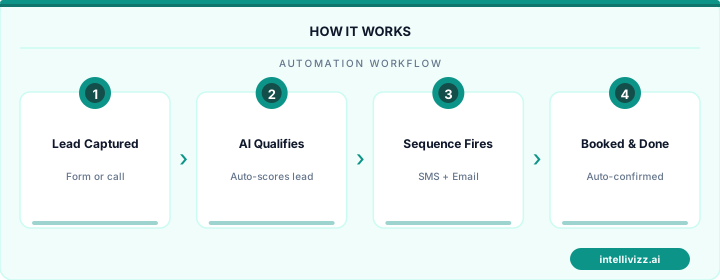
🤖 AI Response in Seconds, Human Follow-Up in Minutes
The combination that achieves 5-minute response at any lead volume, at any hour
The Business Case: Quantifying What Slow Response Costs You
Abstract research findings become actionable when translated into revenue terms for a specific business. Consider a professional services firm that generates 60 qualified leads per month through its website and paid advertising:
- At a 20% lead-to-client conversion rate (typical for warm inbound leads with fast response) and a $3,000 average client value: 12 new clients × $3,000 = $36,000 in monthly revenue from leads.
- At a 5% lead-to-client conversion rate (consistent with research outcomes for 1–2 hour average response times): 3 new clients × $3,000 = $9,000 in monthly revenue from the same leads.
- The revenue difference attributable primarily to response time: $27,000 per month — $324,000 per year — from the same lead volume, the same offer, and the same service quality.
This calculation overstates the impact of response time in isolation — offer quality, pricing, and competitive alternatives also matter — but it directionally captures the magnitude of revenue at stake. For most professional services businesses, achieving 5-minute average response time is the single highest-ROI operational improvement available, because it recovers revenue from leads that were already earned through marketing investment but lost through operational failure.
The research on lead response time has been consistent for more than a decade. The tools to act on it have never been more accessible or affordable. The competitive advantage available to the businesses that close the gap between the research prescription and their actual performance is significant — and it compounds every day that their competitors continue to respond in hours rather than minutes. For an overview of the AI-powered tools that make instant response possible for small and mid-size businesses, see our guide to the AI answering service for small business.
Ready to get started with automation? Explore our AI automation solutions, or read our guide to AI Lead Follow-Up Automation: Never Let Another Lead....