
Real Estate Lead Automation: Convert More Leads From Every Source With Faster Follow-Up
The 5-Minute Window That Determines Real Estate Success
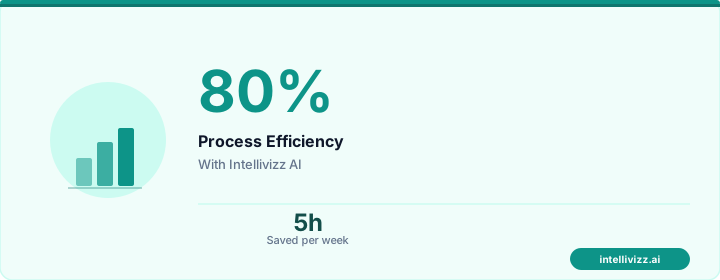
In 2026, the most consequential metric in real estate lead generation is not cost per lead, source quality, or total lead volume. It is response time. Studies of real estate lead behavior consistently show that the probability of converting an inbound lead drops by over 80% if the first response does not arrive within 5 minutes. A prospect who submits a Zillow inquiry at 9:15 AM and hears nothing until 11:00 AM has almost certainly already toured homes with another agent.
This is not a subtle effect. Real estate prospects — particularly buyers in active markets — are often submitting inquiries to multiple agents simultaneously. They will respond to whichever agent reaches them first with a relevant, helpful message. The agent who reaches them at minute 3 gets the appointment. The agent who calls at minute 47 gets voicemail. This dynamic explains why real estate teams with sophisticated automated follow-up systems consistently outperform larger teams with more agents but slower response infrastructure.
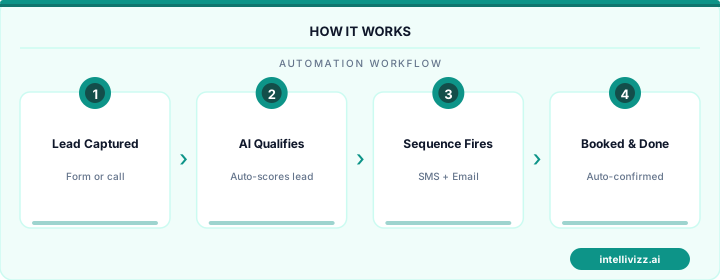
Real estate lead automation is the set of systems — CRM integrations, auto-response workflows, multi-channel follow-up sequences, lead routing rules, and long-term nurture programs — that ensure every lead from every source receives an intelligent, personalized-feeling response within the critical window and continues to receive relevant follow-up for as long as the prospect is in the market.
🏠 Speed wins in real estate — automate your lead response
The data speaks for itself
Lead Source Consolidation: The Foundation of Any Automation System
Most real estate agents and teams receive leads from 5–10 different sources simultaneously: Zillow, Realtor.com, Homes.com, their own website, social media advertising, open house registrations, direct mail responses, referrals, and past client re-engagement. Each platform has its own notification system, its own lead format, and its own speed requirements. Managing this across separate inboxes and notification systems is operationally impossible at scale.
The first step in building a lead automation system is consolidating all lead sources into a single CRM platform. This consolidation typically involves:
- Portal API integrations: Zillow, Realtor.com, and similar platforms offer API connections or Zapier integrations that push new leads directly into your CRM within seconds of submission — eliminating the delay of waiting for a platform email notification and manually logging the lead.
- Website and landing page forms: Contact forms, home valuation tools, and listing inquiry forms on your own website should connect directly to the CRM via native integration or webhook, with the lead's source URL captured so you know which page or campaign generated the inquiry.
- Phone lead capture: For inbound calls, call tracking numbers assigned per source allow the CRM to create a lead record automatically when a call arrives, with the source attribution logged before the call is even answered.
- Open house registration: Digital sign-in forms at open houses (a tablet with a form, or a QR code linking to a Google Form or native CRM form) push registrations directly into the CRM, including the property address and event date for context in follow-up communications.
- Social media leads: Facebook and Instagram lead ad integrations push form submissions directly to the CRM in real time — no manual export/import required.
The operational discipline of maintaining this consolidation pays dividends in two directions: every lead receives consistent automated follow-up, and the CRM's attribution data makes it possible to calculate true cost per lead and cost per acquisition by source — information that is essential for intelligent marketing budget allocation.
Digital Workflow Architecture: Email Sequences, SMS Drips, and Social Retargeting
The operational core of real estate lead automation is not a single touchpoint — it is an orchestrated multi-channel digital workflow that coordinates email sequence delivery, SMS drip cadences, CRM pipeline stage transitions, and social media retargeting in a synchronized system. Each channel plays a distinct role based on its inherent strengths: email carries detailed information and establishes credibility; SMS captures attention and elicits immediate responses; social retargeting maintains brand visibility during periods of prospect silence; CRM pipeline rules enforce structure and accountability across the entire workflow.
Email Sequence Architecture for Real Estate Leads
Real estate email sequences that convert are structured around the prospect's decision stage, not around the agent's desire to get a meeting. The sequence architecture follows a three-phase model:
Phase 1 — Context-Relevant Introduction (Days 1–3): The first two emails are entirely about the prospect's inquiry. Email 1 is delivered within 2 minutes of lead creation and references the specific property or search area from the inquiry form — including current MLS data, recent comparable sales in the target neighborhood, and a direct scheduling link for a property tour. Email 2, sent 24 hours later if there is no response, takes a different angle: a curated list of three to five similar properties that match the prospect's apparent criteria, accompanied by a brief market commentary paragraph that demonstrates the agent's local expertise. Both emails are triggered automatically by the CRM workflow engine the moment the lead enters the system, with the property and neighborhood data populated dynamically from MLS API connections.
Phase 2 — Value Delivery (Days 4–21): Prospects who have not responded to the initial context emails enter a value-delivery sequence designed to build authority without pushing for a meeting. This sequence includes: a neighborhood market report (auto-generated from MLS transaction data for the prospect's target area, sent on Day 7); a mortgage rate and payment calculator email keyed to the prospect's apparent price range (Day 10); a "homes that just came on the market" alert featuring three new MLS listings in their area (Day 14); and a "what buyers are asking about [neighborhood]" FAQ email that addresses the most common objections and questions the agent hears from buyers considering that market (Day 21). Each of these emails contains a soft call to action — a scheduling link, a reply invitation, or a property tour request button — embedded naturally in the content rather than as a hard sell.
Phase 3 — Long-Term Nurture (Month 1+): Prospects who still have not engaged by Day 21 transition to a long-term bi-weekly drip that alternates between market update emails (local price trend summaries, days-on-market statistics, inventory levels) and listing alert emails that push new MLS listings matching the prospect's profile. These bi-weekly touches maintain top-of-mind awareness during the research phase that precedes 60–75% of real estate transactions. The CRM workflow engine automatically adjusts send frequency based on engagement signals — prospects who open emails but do not click receive a higher-frequency sequence than true disengaged contacts, who receive monthly touches only.
SMS Drip Cadence Design
SMS drip sequences for real estate leads operate on a fundamentally different cadence from email sequences — shorter intervals, shorter messages, and a much higher sensitivity to response patterns. The SMS workflow is designed around the principle of conversational threading: each message is crafted to feel like a natural extension of an ongoing dialogue, not a broadcast notification.
Day 1, Minute 1: Property-specific first touch — "Hi [Name], saw your interest in [Address/Area]. [Agent] here. Happy to share more details or set up a showing — what works best for you?"
Day 1, Hour 4 (if no reply): Qualification pivot — "Quick question: Are you working with a lender yet? Happy to connect you with a few top options in [City] if helpful."
Day 2 (if no reply): New listing alert — "Three homes in [Area] just came on the market this morning — one matches your criteria closely. Want me to send details?"
Day 5 (if no reply): Market data hook — "[Area] had [X] new listings this week and [Y] went under contract. The inventory is moving fast — worth connecting if you want to stay ahead of it."
Day 10 (if no reply): Soft check-in — "Still happy to help whenever you're ready. The market in [Area] has shifted a bit — let me know if you'd like a quick update."
Day 21 (if no reply): Long-pause re-engagement — "Checking in — are you still looking in [Area] or has your search shifted? No pressure either way, just want to make sure I'm sending you relevant info."
Response rate data from real estate teams using structured SMS drip sequences shows that 28% of leads who do not respond to the Day 1 message respond to one of the Day 2–Day 10 messages. Of those, 44% ultimately schedule a showing or consultation within 30 days of their first response. The drip cadence is the mechanism that captures this delayed-engagement segment — which would be entirely lost in a manual follow-up environment.
Social Retargeting Pixel Workflows
Social retargeting is the automation layer that operates silently in the background while email and SMS sequences handle direct outreach. When a prospect visits an agent's website, IDX property search, or landing page — events that are typically triggered by clicking a link in an email or SMS message — the Meta Pixel, Google Tag, and TikTok Pixel fire and add the visitor to custom retargeting audiences. These audiences then receive paid ad impressions on Facebook, Instagram, Google Display Network, and TikTok that keep the agent's brand visible even during periods of prospect silence.
The retargeting pixel workflow is configured in layers based on the prospect's engagement depth:
- Homepage visitors: Added to a broad retargeting audience that sees general agency brand ads — testimonials, team introductions, area expertise positioning. Ad spend is lowest for this tier because intent signals are weakest.
- Listing detail page visitors: Added to a property-specific retargeting audience that sees carousel ads featuring the specific listing they viewed, plus similar properties at comparable price points. These prospects have demonstrated specific intent and receive the highest ad impression frequency.
- Valuation tool users: Added to a seller-specific retargeting audience that sees ads featuring recently sold properties in their neighborhood, with sold price prominently featured. This audience is most receptive to messaging about listing timing and market opportunity.
- Repeat visitors (3+ site sessions): Automatically promoted to a high-intent segment that triggers both an increased retargeting ad budget allocation and a CRM workflow task for human agent outreach — because repeated site visits without contact are a strong signal of active evaluation.
The CRM integration with social retargeting platforms occurs through the Meta Conversions API and Google Enhanced Conversions, which allow the CRM to pass lead-level data back to the ad platforms. This enables attribution modeling that tracks which ad impressions influenced a prospect's decision to book a showing or submit an inquiry — closing the loop between paid social spend and transaction revenue.
CRM Pipeline Stage Automation Rules
Pipeline stage automation transforms the CRM from a passive database into an active workflow engine. Rather than relying on agents to manually move leads through pipeline stages, automation rules trigger stage transitions based on verifiable behavioral events:
| Pipeline Stage | Trigger Event | Automated Actions on Stage Entry |
|---|---|---|
| New Lead | Lead record created from any source | Launch email sequence Day 1, launch SMS drip Day 1, activate retargeting pixels, assign to agent queue |
| Engaged | Prospect opens 2+ emails OR replies to any SMS | Upgrade to high-frequency email cadence, increase retargeting ad budget for this prospect, generate agent task for personal outreach within 24 hours |
| Consultation Booked | Prospect clicks scheduling link and booking is confirmed in calendar | Pause drip sequences, send pre-consultation prep email with agent bio and agenda, generate agent briefing document summarizing prospect's search history and engagement timeline |
| Active Buyer | Consultation completed and prospect confirmed as active buyer | Activate daily MLS alert digest for prospect's exact criteria, add to priority retargeting segment, assign weekly agent check-in task |
| Under Contract | Agent marks as under contract in CRM | Pause all marketing sequences, activate transaction milestone communication series (inspection reminder, appraisal update, closing date countdown) |
| Closed | Transaction closed in CRM | Launch post-close review request sequence, add to past-client annual check-in program, trigger referral ask message at 30-day post-close mark |
| Re-Engage | No engagement for 45 days from Engaged or later stage | Restart long-term nurture sequence at Phase 3, reduce retargeting ad frequency to monthly budget, schedule quarterly agent check-in task |
Lead Routing: Getting the Right Lead to the Right Agent
For teams with multiple agents, lead routing is as important as lead response. The wrong assignment creates friction, reduces conversion, and generates agent dissatisfaction. Effective lead routing systems apply multiple routing criteria in priority order:
Geographic Routing
Assign leads based on the property address or search area specified in the inquiry. Agents with geographic specialization in specific neighborhoods or zip codes convert those leads at dramatically higher rates — they know the inventory, the pricing dynamics, and the local context that makes a buyer feel they are working with a true local expert.
Price Range Routing
Some teams route leads by price range, assigning high-end leads to senior agents with luxury transaction experience and entry-level leads to newer agents who are building their pipeline. This approach aligns agent experience with client expectations and maximizes the probability of a successful transaction on both ends of the price spectrum.
Property Type Routing
Investor-focused leads — those inquiring about multi-family properties, distressed listings, or explicitly mentioning investment intent — perform best when routed to agents with investor relations experience. Consumer buyer leads inquiring about primary residences perform best with agents focused on the consumer buyer experience. Real estate investor outreach automation covers the investor-specific follow-up approach in more detail.
Availability and Capacity Routing
Round-robin routing — distributing leads in rotation among available agents — ensures equitable distribution but ignores capacity and availability. More sophisticated systems check agent calendar availability, current active client count, and real-time availability status before assigning a lead. An agent who is at capacity or on vacation should be excluded from the rotation automatically.
Lead Source Routing
Some teams route by lead source: Zillow leads go to agents who pay for Zillow Premier Agent, website leads go to agents who generated that web traffic through personal marketing efforts, and referral leads go to the specific agent who has the referral relationship. Respecting these source-to-agent associations maintains agent trust in the routing system and prevents the perception that the team leader is taking leads that agents have earned through their own marketing investment.
🏠 Speed wins in real estate — automate your lead response
Smart technology, better results
Multi-Channel Nurture Sequences: Converting the Slow Movers
Research from the National Association of Realtors consistently shows that the majority of home buyers — 60–75% — do not transact within 30 days of their first inquiry. They are in research mode, preparing financing, evaluating neighborhoods, or planning a move that is 3–18 months away. Without a systematic long-term nurture system, these prospects — who represent the majority of your lead volume — receive 2–3 follow-up attempts and then go dark, only to resurface as someone else's client when they are finally ready to transact.
Effective long-term nurture sequences for real estate operate across multiple channels with content that matches the prospect's phase:
Active Buyer Nurture (Days 1–30)
Prospects who show high engagement signals — viewing multiple listings, requesting showings, asking specific questions — are in active evaluation mode and should receive frequent, high-value touchpoints: new listing alerts matching their criteria, price reduction notifications on properties they've viewed, neighborhood market reports, and direct agent check-ins every 3–5 days. The goal is to be the agent who keeps them most informed, which creates a natural first-choice relationship when they are ready to write an offer.
Pre-Active Nurture (Months 1–6)
Prospects who engaged initially but have gone quiet are not necessarily lost — they may be working on financing, waiting on a life event, or simply gathering information more slowly than the initial inquiry suggested. Monthly market update emails, occasional new listing alerts when a particularly relevant property appears, and a quarterly personal check-in from the agent maintain the relationship without overwhelming the prospect. The automated sequence runs in the background; the agent's time is reserved for the check-in calls.
For comprehensive coverage of the long-term follow-up approach for buyers specifically, AI for real estate lead follow-up covers the behavioral signals and sequence logic in detail.
Long-Term Drip (Months 6–18+)
Prospects who have not engaged with any content for 3+ months should move into a low-frequency long-term drip: a monthly market report, a quarterly "how's the search going?" personal note, and seasonal content (spring buying tips, year-end mortgage considerations). These prospects are not active, but they remain in the pipeline because home purchase timelines frequently extend beyond initial estimates. An agent who maintains a light-touch relationship for 12 months becomes the natural choice when the prospect finally pulls the trigger — and the cost of maintaining that relationship through automation is negligible.
Seller Lead Automation
Seller leads — home valuation requests, listing inquiry forms, expired listing outreach, and FSBO contacts — require a different automation approach than buyer leads. Sellers are evaluating the agent's ability to price accurately, market effectively, and sell quickly. The first-response message should immediately establish the agent's credibility with relevant market data: "Based on recent sales in your neighborhood, homes similar to yours are selling in [X] days at [Y% of list price]. I'd love to do a detailed analysis specific to your property — can we schedule 30 minutes this week?" For a deeper dive into platform-specific tactics, see our guide on Zillow lead auto-response. For a deeper dive into response timing, see our guide on speed to lead in real estate and why every minute counts.
Seller nurture sequences for pre-listing leads (homeowners who may sell in 6–18 months) should include market update content relevant to their neighborhood, home preparation guides, and periodic check-ins that ask about their timeline without being pushy. Real estate listing email automation covers the seller-side communication workflows in depth.
Brokerage Lead Distribution Policy: Compliance and Fairness Obligations
Brokerage-level lead distribution is not merely an operational preference — it is a compliance obligation governed by fair housing law, NAR Code of Ethics standards, and, since the 2024 NAR settlement, explicit contractual requirements around buyer representation. Managing brokers who structure lead assignment policies without accounting for these legal frameworks expose their brokerage to commission disputes, fair housing complaints, and potential MLS disciplinary action.
The NAR settlement that took effect in August 2024 fundamentally changed the buyer-agent relationship: agents may no longer receive compensation from the listing side without a written buyer representation agreement signed before the first property tour. This requirement has restructured how brokerages must handle inbound buyer leads. A lead assigned to an agent triggers an obligation to execute a buyer representation agreement before any showing is conducted. Brokerages that distribute leads to agents who are not yet trained on buyer agreement execution face compliance gaps that create legal and reputational exposure for the entire office.
Managing brokers should verify three things before any lead enters the distribution queue:
- Buyer representation readiness: The receiving agent must hold a current, compliant buyer representation agreement template approved by the brokerage's legal counsel. Agents who cannot produce a signed agreement before a showing should be removed from the lead rotation until they complete the required training.
- Fair housing compliance: Lead routing policies must not — directly or through disparate impact — assign leads by the prospect's apparent race, national origin, familial status, religion, sex, disability, or any protected class under the Fair Housing Act. Geographic routing policies that coincide with racially identifiable neighborhoods require careful legal review. The managing broker is responsible for auditing routing logic for discriminatory patterns.
- Procuring cause documentation: When a lead has already toured properties with another agent — inside or outside the brokerage — the receiving agent and managing broker must assess procuring cause before the agent invests significant follow-up effort. A broker who assigns a lead without verifying procuring cause history risks a commission dispute at closing that consumes brokerage arbitration resources and damages agent relationships.
Commission Split Structures and Production-Tier Lead Access
The most durable accountability mechanism in residential brokerage is not a software escalation rule — it is the commission split structure. Brokerages that tie lead access to production tier and split compliance create a self-reinforcing accountability system: agents who perform at a defined level earn access to brokerage-distributed leads, and agents who fail to meet follow-up standards lose access to the next lead in the rotation.
Production-tier lead access structures typically operate on three tiers:
Tier 2 — Active Producers (6–24 closed transactions in the trailing 12 months): Participate in the primary round-robin rotation for leads that match their geographic license area. Split structure: 70/30, with desk fees waived if monthly production exceeds a defined gross commission income (GCI) threshold. Lead distribution priority is weighted by contact compliance score — agents who consistently meet the brokerage's 30-minute contact window receive leads before agents with documented contact failures.
Tier 3 — Top Producers (25+ closed transactions or $5M+ volume in trailing 12 months): Receive first-refusal rights on all inbound leads from premium sources — portal partnerships, builder referral programs, relocation company accounts. Split structure: 80/20 or flat monthly cap (e.g., $25,000 annual cap after which the agent retains 100% of commission). Access to premium lead sources is contingent on quarterly performance reviews conducted by the managing broker and documented in the agent's personnel file.
The cap structure — popularized by brokerages like Keller Williams and adopted broadly across independent offices — aligns agent incentives with brokerage lead investment. Once an agent has paid their annual cap, every additional transaction that closes is fully their commission. This creates a powerful incentive to work brokerage-distributed leads aggressively early in the production year, when each closed transaction contributes toward reaching the cap threshold. Managing brokers who understand this incentive structure time their lead distribution pushes for Q1 and Q2, when agent motivation to close is at its highest. Brokers who publish a clear agent roster showing which production tier each agent occupies also reduce internal disputes over lead allocation, since the criteria are visible to everyone on the team.
MLS Compliance, IDX Display Rules, and Brokerage Lead Attribution
Every lead generated through an IDX property search on the brokerage website originates from MLS-licensed data. The MLS participation agreement imposes display rules that directly affect how brokerage websites can capture and attribute those leads. Brokerages that violate IDX display requirements — by removing required attribution text, by republishing listing data outside the licensed display context, or by capturing leads in ways that obscure the listing agent's identity — face MLS compliance complaints from cooperating brokers and potential suspension of IDX access.
The practical brokerage implication is this: leads generated from IDX search are attributed to the brokerage, not to the agent whose marketing drove the website traffic. The managing broker has authority over how those leads are distributed, and that authority is part of the brokerage value proposition that justifies the commission split structure. Agents who generate their own leads through personal marketing — direct mail campaigns, personal social media advertising, sphere of influence referrals — retain full ownership of those leads regardless of which CRM the brokerage uses to manage contact records. The brokerage's lead distribution policy should define this boundary explicitly to prevent disputes over lead ownership when agents depart the brokerage.
Well-structured brokerage operations connect every component of the lead pipeline — from IDX attribution and NAR-compliant buyer representation agreements through production-tier routing and commission split accountability — into a single coherent operating framework. Brokerages that treat lead distribution as an operations problem without addressing the commission, compliance, and fair housing dimensions of the policy will find that their accountability structures collapse under the weight of agent disputes, regulatory scrutiny, and the legal obligations that the post-settlement real estate landscape now imposes on every buyer lead assignment.
Ready to build a lead system that works while you sleep? Explore our real estate automation solutions, How to Automate Real Estate Lead Follow-Up Without..., or Real Estate CRM Automation: Build a Pipeline System....
Relevant AI Automations
AI Review Management
All-in-one review management: automated review requests, AI-powered responses, and review repurposing for web & social — 3 engines in 1.
AI Voice Agent — Property Inquiry Handler
AI voice agent answers inbound calls, qualifies buyer/seller intent, captures property preferences, budget, timeline, an
Website Property Search Lead Capture
Captures leads from website property search, IDX integration, or landing page forms