
Real Estate CRM Automation: Build a Pipeline System That Works While You Sleep
Why Most Real Estate CRMs Fail (And It Is Not the Software)
The real estate industry has spent billions of dollars on CRM software over the past two decades. Nearly every brokerage, team, and solo agent has purchased at least one CRM platform. Many have purchased three or four. Yet for the majority of practitioners, the CRM sits largely unused after the first few months — a graveyard of contacts with incomplete information, leads with no follow-up history, and pipeline stages that have not been updated since the license was purchased.
The failure mode is almost never the software itself. It is the assumption that agents will consistently enter data, update pipeline stages, log calls, and set follow-up tasks manually — on top of everything else they are doing. This assumption does not survive contact with the reality of a working agent's day. When the choice is between calling a hot lead and updating a CRM contact record, the lead wins every time. The CRM falls behind, becomes unreliable, gets abandoned.
Real estate CRM automation solves this structural problem by removing the dependence on manual data entry wherever possible. When leads enter the system automatically, pipeline stages update based on observed behavior, tasks generate from triggers rather than manual creation, and transaction milestones fire communications without agent input — the CRM stays current without anyone having to maintain it. And a current CRM is a production asset rather than an administrative burden.
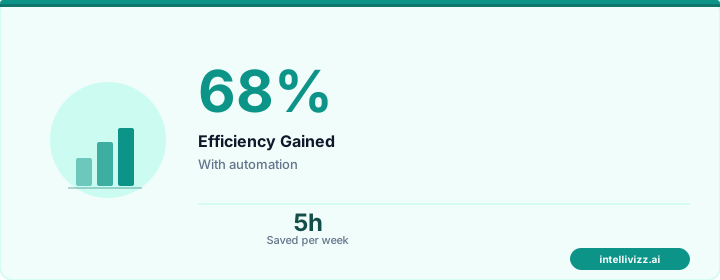
🏠 Speed wins in real estate — automate your lead response
Smart technology, better results
Lead Lifecycle Stages in Real Estate CRM
Before configuring automation, you need a clearly defined lead lifecycle that maps the stages a prospect moves through from first contact to closed transaction. Most real estate CRMs support configurable pipeline stages, but many agents use the default setup without tailoring it to the actual buyer or seller journey. The result is a pipeline that looks populated but provides no actionable guidance on what to do next with any given lead.
A well-designed real estate lead lifecycle for buyers includes: New Lead (uncontacted), Attempted Contact (outreach in progress), Contacted (conversation established), Qualified (timeline, budget, and needs confirmed), Active Search (showing homes), Under Contract (offer accepted), Closed, and Post-Close Nurture. For sellers: New Lead, Listing Appointment Scheduled, Listing Appointment Completed, Active Listing, Under Contract, Closed, Post-Close Nurture.
Each stage transition should be definable in terms of specific observed behaviors or actions — not gut feelings. "Qualified" means a specific set of criteria has been confirmed in a conversation. "Active Search" means showings have been scheduled. Defining stages precisely allows automation to move leads through the pipeline based on real signals rather than requiring agents to manually judge where each contact belongs.
Automated Lead Assignment and Routing Rules
For teams with multiple buyer agents, the lead assignment decision — which agent gets which lead — is one of the highest-stakes operational choices. Made manually, it is inconsistent, open to favoritism accusations, and slow. Automated routing rules make assignment instantaneous, rules-based, and transparent.
Round-Robin Assignment
The simplest routing rule assigns new leads sequentially to agents in rotation. Round-robin is fair and simple to configure in most CRM platforms. Its weakness is that it does not account for agent capacity — an agent with 40 active leads in their pipeline receives the next lead in rotation regardless of whether they can effectively service it.
Capacity-Based Routing
More sophisticated routing rules incorporate agent lead load. When an agent has more than a defined number of active leads in the pipeline, new leads skip them in rotation until their load drops below the threshold. This prevents lead pile-up with busy agents while ensuring leads are assigned to agents who can actually follow up quickly.
Specialty-Based Routing
Teams with agents who specialize by property type, price range, or geographic area benefit from criteria-based routing. A lead submitting a form expressing interest in commercial properties routes to the commercial specialist. A lead from a luxury neighborhood routes to the luxury market expert. This requires capturing lead qualification data at the point of form submission — a small friction investment that pays off in significantly better lead handling.
Source-Based Routing
Some teams route leads based on source. Zillow leads, which tend to be early-stage and require high-volume outreach, may route to agents trained in portal lead conversion. Referral leads, which arrive pre-qualified and relationship-based, may route to senior agents with higher close rates. Source-based routing maximizes the match between lead quality and agent capability.
| CRM Platform | Routing Capabilities | Best For |
|---|---|---|
| Follow Up Boss | Round-robin, source-based, lead pond (agent claims) | Teams with 3-20 agents, high inbound volume |
| kvCORE | Round-robin, weighted routing, behavioral triggers, pond leads | Large teams and brokerages |
| LionDesk | Basic round-robin, tag-based routing | Small teams and solo agents |
| Chime | AI-assisted routing, behavioral scoring, round-robin | Technology-forward teams focused on conversion optimization |
| Salesforce (w/ RE add-ons) | Fully configurable routing rules via workflow automation | Enterprise brokerages requiring complex routing logic |
Pipeline Stage Automation: Triggers, Tasks, and Reminders
The most valuable automation in any real estate CRM is stage-based task generation. When a lead moves from one pipeline stage to another, the CRM automatically creates the tasks, reminders, and communications appropriate to that stage — ensuring the agent knows exactly what to do next without having to figure it out each time.
New Lead Stage Automation
When a lead enters the system, an automated sequence should immediately begin a contact attempt campaign: a text message within 5 minutes, an email within 1 hour, and a scheduled call task for the next 24 hours. Research consistently shows that leads contacted within 5 minutes of form submission are 100 times more likely to connect than leads contacted 30 minutes later. Automation makes 5-minute response operationally achievable at scale.
For teams looking to benchmark their lead response performance, the cost of missed calls and slow lead response provides the data framework for calculating the revenue impact of response time gaps in your current operation.
Qualified Lead Stage Automation
When a lead is marked as qualified — meaning timeline, budget, and needs have been confirmed — the CRM should automatically schedule a buyer consultation, send a consultation confirmation with agenda and preparation instructions, assign a buyer needs questionnaire to complete before the meeting, and create a task to set up an MLS saved search within 24 hours of the consultation.
Active Search Stage Automation
Once a buyer is actively touring homes, automation supports consistent engagement without overwhelming the agent. Automated showing feedback requests go out after each showing. New listing alerts fire when properties matching the buyer's criteria come to market. Weekly market summary emails keep the buyer informed and demonstrate market expertise. Check-in reminders prompt the agent to make personal contact every 7-14 days.
Under Contract Stage Automation
Contract-to-close is the most task-intensive phase of a real estate transaction and the phase where dropped balls cost the most. CRM automation in this stage should generate a complete transaction checklist with dates keyed off the contract date (inspection deadline, financing contingency, appraisal, walk-through, closing), send automated reminders to all parties 3 days and 24 hours before each deadline, and trigger communications to the buyer confirming each completed milestone.
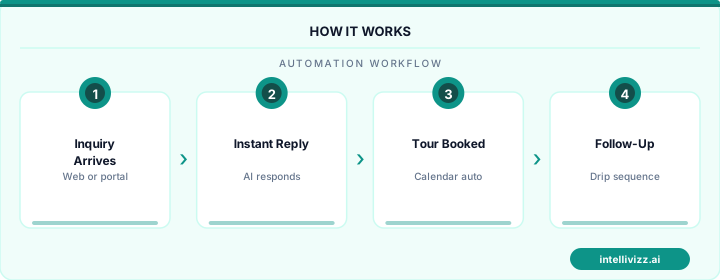
🏠 Speed wins in real estate — automate your lead response
The data speaks for itself
Transaction Management Automation: Contract to Close
The contract-to-close phase is where many agents who are excellent at lead generation and buyer consultation struggle operationally. There are simply too many moving parts — lender, title company, inspector, appraiser, buyer, seller, both agents, both attorneys in attorney-required states — and too many deadlines to manage manually without risk of error.
Transaction coordinator software like Dotloop, SkySlope, and Glide integrates with major real estate CRMs to automate the contract management layer. When a transaction opens in the CRM, it flows into the transaction management system, which generates the complete task list, assigns responsibilities, and tracks document collection automatically.
Automated Milestone Communications
Every transaction milestone — inspection completed, appraisal ordered, loan conditionally approved, clear to close received — should trigger an automated communication to the relevant parties. Buyers who understand where their transaction stands at every step are calmer, more prepared, and more forgiving of inevitable delays than those who hear nothing until problems arise.
Document Collection Automation
The most time-consuming administrative task in real estate transactions is chasing documents — asking lenders for status updates, requesting title company confirmations, reminding buyers to return signed addenda. Automated document reminder sequences reduce this chase time by sending reminder messages at defined intervals after a document request is made, escalating to phone call reminders if email reminders go unanswered.
Sphere of Influence Nurture Campaigns
The sphere of influence — past clients, personal contacts, and professional network members who know and trust you — is the highest-quality lead source in real estate. The challenge is that sphere members are rarely "in market" on any given day. Converting sphere relationships into transactions requires years of consistent, low-pressure contact that keeps you top of mind for the moment when they or someone they know needs a real estate agent.
Manual sphere management at scale is impossible. An agent with 500 sphere contacts cannot personally stay in meaningful contact with all of them. Automated nurture campaigns do the work:
- Monthly market update emails: Neighborhood sales data, price trends, and market commentary delivered consistently without agent preparation time per send
- Anniversary automations: Home purchase anniversary messages to past clients, acknowledging the anniversary and providing a home value estimate — one of the highest-engagement automations in real estate
- Holiday and life event touches: Automated seasonal cards and birthday greetings maintain personal connection at scale
- Review request sequences: Post-closing automated sequences requesting Google, Zillow, and Realtor.com reviews at the moment of maximum client satisfaction
- Referral request campaigns: Periodic messages to past clients explicitly requesting referrals, with language that makes it easy for them to share your contact information
For a comprehensive framework for re-engaging past clients whose contact has lapsed, client reactivation campaign automation covers the re-engagement sequence architecture applicable across real estate and other service businesses.
Team Performance Dashboards and Accountability Metrics
CRM automation generates the data. The performance dashboard makes it actionable for team leadership. A well-configured real estate team dashboard surfaces the metrics that predict future production — not just closed transactions, which are lagging indicators — but the pipeline activity that determines what closes 60-90 days from now.
Leading Indicators to Track
The most important leading indicators in a real estate team CRM dashboard include: new leads by source and agent, contact attempt rate and speed-to-contact for new leads, qualified-to-appointment conversion rate, active searches by agent (number of buyers touring homes), appointments scheduled versus completed, and pending transactions by expected close date.
These metrics tell team leaders where production is strong and where it is at risk — before the weakness shows up in the closed transaction count. An agent with high new leads but low contact rate has a follow-up problem. An agent with high contacts but low qualification rate has a conversion conversation problem. Each issue is visible and addressable before it becomes a production shortfall.
Automated Performance Reports
Weekly performance summary reports, generated automatically and delivered to team leaders every Monday morning, ensure accountability without requiring manual data compilation. Agents receive individual performance summaries showing their own metrics against team benchmarks. Team leaders receive the consolidated view. Neither requires anyone to pull reports manually — the CRM automation handles distribution on schedule.
For agents and team leaders looking to extend their real estate automation infrastructure into investor outreach and off-market lead generation, AI for real estate investor outreach covers the automation strategies applicable to investment-focused real estate practices. And for the data architecture underlying effective CRM automation, real estate CRM lead scoring provides the framework for prioritizing which leads deserve the most immediate attention in a high-volume pipeline.
Implementation Roadmap: From Abandoned CRM to Production Engine
Transforming a neglected CRM into a functioning production system requires a deliberate implementation sequence. Trying to automate everything at once typically results in a complex system that nobody uses. A phased approach builds the foundation before adding complexity:
Week 1-2 — Data hygiene: Audit your existing contact database. Merge duplicates, update contact information, and assign pipeline stages to all active leads. This is the unsexy prerequisite that makes all subsequent automation meaningful.
Week 3-4 — Lead routing and response automation: Configure automated lead routing from all inbound sources and set up the new lead contact sequence (5-minute text, 1-hour email, 24-hour call task). Measure speed-to-contact before and after implementation.
Month 2 — Pipeline stage automation: Build out the task templates and communications for each pipeline stage. Start with the two or three most common stages (Active Search, Under Contract) and expand from there.
Month 3 — Sphere nurture campaigns: Configure the monthly market update, anniversary automation, and review request sequences. These run perpetually once built and compound in value over time.
Month 4+ — Dashboard and optimization: Build performance dashboards, review leading indicator data, and optimize sequences based on engagement metrics. The CRM becomes a learning system — each iteration improves conversion rates throughout the pipeline.
The agents and teams who invest in this infrastructure in the next 12-24 months will operate at a structural efficiency advantage over those who do not. The technology is available. The ROI is documented. What separates the teams that build it from those that do not is the willingness to prioritize system-building over transaction-chasing — a counterintuitive short-term investment that compounds into significant long-term competitive advantage.
Ready to build a lead system that works while you sleep? Explore our real estate automation solutions, or read our guide to Real Estate Drip Campaign Automation: Nurture Leads....
Relevant AI Automations
AI Review Management
All-in-one review management: automated review requests, AI-powered responses, and review repurposing for web & social — 3 engines in 1.
AI Voice Agent — Property Inquiry Handler
AI voice agent answers inbound calls, qualifies buyer/seller intent, captures property preferences, budget, timeline, an
Website Property Search Lead Capture
Captures leads from website property search, IDX integration, or landing page forms