
Real Estate Drip Campaign Automation: Nurture Leads for 18 Months Without Losing Your Mind
The 18-Month Follow-Up Problem No One Wants to Talk About
Every real estate agent knows they should follow up with leads consistently. Every agent also knows they do not. The gap between intention and execution in real estate lead nurture is not a discipline problem or a motivation problem — it is a systems problem. No human being can maintain consistent, personalized follow-up with 200 leads in various stages of a purchasing timeline while also running open houses, writing offers, managing transactions, and prospecting for new clients. The math does not work. Which is exactly why drip campaign automation exists.
The statistics that justify long-term lead nurture in real estate are well-established. The National Association of Realtors consistently reports that the average buyer searches for between six and eighteen months before closing on a home. First-time buyers and luxury buyers often take longer. Sellers spend an average of several months considering their options before listing. The leads that enter your database in January might close in September, or the following March, or eighteen months from now when their lease finally ends and they are truly ready to move.
The agents who capture that eventual conversion are almost never the ones who made first contact. They are the ones who were still in the lead's inbox, still sending useful market updates, still following up with a "just checking in" message at the exact moment the lead decided they were ready. Consistency over a long timeline is the entire game — and automation is the only way to play it at scale.
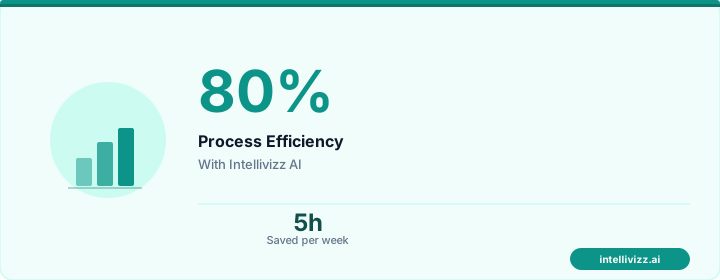
Research consistently shows that 80% of sales require 5 or more follow-up contacts, yet 44% of salespeople give up after a single follow-up. In real estate, agents who follow up 6+ times convert leads at roughly 5x the rate of agents who stop after 1-2 touches — but fewer than 20% of agents reach 6 touches with any systematic consistency.
🏠 Speed wins in real estate — automate your lead response
From manual processes to automated excellence
The Four Core Campaign Types
A comprehensive real estate drip campaign system is not a single sequence — it is a library of campaigns matched to different lead types, relationship stages, and conversion goals. The four core campaign types that belong in every serious agent's automation stack are buyer nurture, seller nurture, sphere of influence, and past client.
Buyer Nurture Campaigns
Buyer nurture campaigns serve leads who have expressed interest in purchasing a home but are not yet ready to transact. They range from early-stage researchers who just started browsing Zillow to pre-approved buyers who are actively writing offers and have simply not yet found the right property. The campaign content and cadence should reflect where in that spectrum the buyer sits.
Early-stage buyer nurture focuses on education and market orientation: how the home buying process works, what to expect from a mortgage pre-approval, neighborhood guides for their areas of interest, and market overview content that helps them understand pricing trends without feeling pressure to buy before they are ready. This content positions you as a trusted resource rather than a salesperson waiting to collect a commission.
Active buyer nurture — for leads who are pre-approved and searching — shifts to market intelligence: new listing alerts filtered to their search parameters, off-market property alerts when available, and proactive market updates when relevant properties come on or off the market. The cadence increases as the buyer moves closer to active search, from monthly to bi-weekly to weekly for leads who are actively touring homes.
Seller Nurture Campaigns
Seller nurture campaigns serve homeowners who are considering selling — eventually. They may have requested a home valuation, attended an open house out of curiosity, or reached out after a neighbor listed. The timeline to listing can range from next month to two years. Your campaign needs to stay relevant across that entire window.
Effective seller nurture delivers three types of content consistently: market data relevant to their specific neighborhood and property type (what similar homes are selling for, days on market trends, list-to-sale-price ratios), home preparation and staging advice that helps them get ready to list without feeling rushed, and agent proof-of-performance content — sold listings in their area, client testimonials, marketing examples — that builds confidence in your ability to sell their home when they are ready. For a deeper look at the listing marketing side of this equation, real estate listing marketing automation covers how top agents systematize their listing marketing playbook.
Sphere of Influence Campaigns
Your sphere of influence — past clients, personal contacts, professional connections, and referral sources — is statistically your highest-ROI lead source. The NAR's Profile of Home Buyers and Sellers consistently shows that 40-50% of buyers and sellers choose their agent based on a referral from a friend, family member, or previous experience. Sphere campaigns keep you top of mind for the referral that has not happened yet.
Sphere campaigns should feel personal and low-pressure. Market update emails, neighborhood news, local event spotlights, and home maintenance seasonal tips work better in this context than hard-sell real estate content. The goal is to stay present as a real person in their lives — not as a salesperson waiting to pounce — so that when someone in their network mentions they are thinking about buying or selling, your name surfaces naturally and warmly.
Past Client Campaigns
Past clients are your most valuable lead source and the most neglected in most agents' follow-up systems. A client who bought a home from you three years ago is a potential seller within the next five years, a potential referral source immediately, and a word-of-mouth advocate if you maintain the relationship. Most agents call once at closing, send a holiday card for two years, and then let the relationship quietly expire. Past client campaigns systematize the ongoing relationship so you are there when it matters.
Annual home anniversary messages, seasonal home maintenance reminders, market value updates for their specific property, and occasional "just checking in" messages that invite reply without expectation keep the relationship warm at a low cost. When the past client is ready to sell or refers a friend who is, you are the obvious first call — not because you pushed them, but because you were consistently present and useful. For agents who want to build this systematically, real estate CRM automation covers the full pipeline management framework that makes past client nurture scalable.
Content Strategy for Each Campaign Type
The most common mistake in real estate drip campaigns is sending the same content to all leads regardless of where they are in their journey. A first-time buyer who just started researching does not need the same message as a seller who has been comparing agents for six months. Segment your content library and match it deliberately to campaign type and stage.
| Campaign Type | High-Value Content Categories | Cadence |
|---|---|---|
| Early buyer | First-time buyer guides, mortgage pre-approval process, neighborhood comparisons, school district data | Bi-weekly |
| Active buyer | New listing alerts, market velocity reports, offer strategy guides, inspection/negotiation tips | Weekly |
| Seller (early) | Home valuation updates, staging guides, neighborhood market reports, recent comparable sales | Monthly |
| Seller (active) | Listing preparation timelines, marketing plan previews, days-on-market trends, pricing strategy content | Bi-weekly |
| Sphere of influence | Market snapshots, local events, home tips, quarterly check-ins, referral asks (occasional) | Monthly |
| Past client | Home anniversary, annual market report, maintenance reminders, home equity updates, referral ask | Quarterly |
Personalization Beyond "Hi, First Name"
The difference between a drip campaign that gets opened and one that gets deleted or unsubscribed is the degree to which it feels relevant to the specific recipient rather than like a newsletter blast. First-name personalization is the baseline — it is table stakes, not differentiation. The personalization that actually moves the needle operates at a deeper level.
Property and Neighborhood Data Personalization
When your CRM stores the buyer's search criteria — price range, target neighborhoods, property type, must-haves — your drip campaigns can reference that specific data. "Based on your search criteria in the Midtown and West End neighborhoods, here is what sold in the past 30 days and what is currently on the market" is dramatically more engaging than "Here is your monthly market update." It demonstrates that you remembered what they told you and are working on their behalf, not just sending automated messages.
For sellers, referencing their specific address and property type creates the same effect. "Your 3-bedroom Colonial in the Lakewood neighborhood has appreciated approximately 8% since we last spoke — here is what your neighbors' homes are selling for right now" is a message that is almost impossible to ignore, because it is specifically about the reader's single largest financial asset. For a technical look at how this data powers automated outreach, AI for real estate investor outreach covers property-level data personalization in depth.
Behavioral Personalization
The most sophisticated real estate drip campaigns respond to behavior, not just the passage of time. When a lead clicks on a specific listing in an email, that click should trigger a follow-up message specifically about that property — or similar properties at the same price point in the same neighborhood. When a seller who has been on a monthly cadence suddenly opens three emails in a row and clicks the home valuation link, that behavioral cluster should trigger a faster follow-up from you personally, not just the next drip email. Behavior is the clearest signal of where a lead is in their journey, and your automation should surface that signal to you in real time.
🏠 Speed wins in real estate — automate your lead response
See how automation transforms industry operations
Trigger-Based vs. Time-Based Campaigns
Most agents are familiar with time-based drip campaigns — an email sequence that fires on day 1, day 7, day 14, day 30, and so on from lead entry. Time-based campaigns are easy to set up and provide predictable coverage, but they are blunt instruments that do not respond to lead behavior or external market changes.
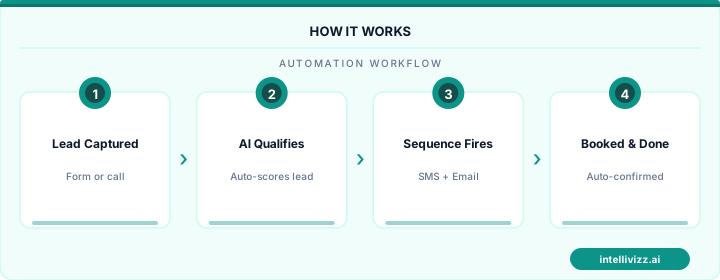
Trigger-based campaigns are more sophisticated: they fire based on events rather than elapsed time. Examples include: a lead who visits your website for the third time in a week triggers a "Can I help you find what you are looking for?" message; a lead who opens a listing email without clicking triggers a follow-up highlighting similar properties; a seller whose neighborhood just saw a major sale triggers a CMA update with the new comparable; a pre-approved buyer who stopped engaging for three weeks triggers a re-engagement sequence with new inventory at their price point.
The most effective drip systems combine both approaches — time-based sequences for consistent coverage across all leads, with trigger-based campaigns layered on top to respond to specific engagement signals and external events. For agents who want to understand how AI can enhance this behavior-based personalization, real estate CRM lead scoring covers how machine learning models predict conversion readiness from behavioral data.
Re-Engagement Sequences for Cold Leads
Every real estate CRM has a graveyard of leads who went cold — they engaged initially, then stopped opening emails, stopped clicking, stopped responding. Before deleting these contacts or letting them rot in your database, a well-designed re-engagement sequence can recover a meaningful percentage without wasted effort on leads who are truly gone.
A re-engagement sequence for cold real estate leads typically runs 3-5 messages over 2-3 weeks with a specific, low-commitment ask. The messaging acknowledges the gap directly ("It has been a while since we last connected — I wanted to check if you are still thinking about buying/selling or if your plans have changed") rather than pretending the silence never happened. The ask is minimal — a reply to confirm they are still interested, or a one-click survey about their current timeline — because the goal is to re-qualify rather than to push toward a transaction.
Leads who respond to re-engagement get re-entered into the appropriate active campaign. Leads who do not respond after the full sequence get archived rather than continuing to receive drip content they never open — preserving your sender reputation and your email deliverability for the leads who are actually engaged. For specific re-engagement strategies that have proven effective in service-based businesses, win-back campaign automation provides frameworks directly applicable to real estate lead nurture contexts.
Performance Metrics and Benchmarks
Drip campaign performance in real estate should be measured against both engagement metrics (how often leads open and click your messages) and outcome metrics (how many engaged leads convert to appointments and eventually to closings). Realistic benchmarks for well-designed real estate drip campaigns:
- Email open rate: 25-40% for personalized campaigns vs. 15-20% for generic mass sends
- Click-through rate: 3-8% on market report and listing content
- Reply rate: 1-3% on personalized follow-up sequences
- Appointment conversion: 3-7% of long-term drip leads convert to consultation within 12 months
- Closing conversion from appointment: 40-60% for well-qualified leads
The metrics that matter most for long-term campaign optimization are reply rate and appointment conversion rate — these are the leading indicators of relationship quality. An email campaign with a 35% open rate and a 0.2% reply rate is generating attention but not conversations. An email campaign with a 22% open rate and a 2% reply rate is generating relationships that convert. Optimize for depth of engagement, not breadth of reach. For agents building their complete lead management system, real estate lead automation provides the end-to-end framework from lead capture through transaction.
When to Stop Dripping: Unsubscribe Signals and Disengagement Thresholds
Long-term drip campaigns only work if the people receiving them want to receive them. Sending 18 months of automated emails to someone who stopped opening after month two is not marketing — it is spam that is slowly poisoning your sender reputation and eroding your email deliverability for everyone else on your list.
Set clear automated disengagement thresholds: leads who have not opened any email in 90 days move to a quarterly cadence; leads who have not opened in 180 days get a re-engagement sequence; leads who complete the re-engagement sequence without response get archived. This segmentation protects your deliverability, keeps your active list genuinely active, and ensures your engagement metrics reflect your actual audience quality rather than a bloated database of non-readers.
Honor unsubscribes immediately and permanently — not just as a legal requirement under CAN-SPAM and GDPR, but as a matter of respect for the person who initially trusted you with their contact information. A lead who unsubscribes from email should still be in your CRM for potential phone follow-up, but should never receive another automated email message. Your CRM should make this distinction clearly and enforce it automatically.
For agents looking to extend their outreach to sellers who are just entering the consideration phase, open house follow-up automation covers how to capture and nurture the seller leads that attend your listings — a high-value audience that is often overlooked in favor of direct seller inquiry leads. And for the buyer-side of the nurture equation, AI for real estate lead follow-up explains how AI-assisted response handles the initial 24-48 hours of a buyer inquiry — the window where most leads are won or lost — before handing off to a long-term drip sequence.
The agents who consistently win the 6-18 month buyer and seller search journey are not the ones with the most leads. They are the ones with the best systems for staying present, useful, and relevant across an entire decision timeline without burning out or going dark. Drip campaign automation is the infrastructure that makes that consistency possible at scale — not as a substitute for human relationships, but as the system that ensures the human relationship has a chance to develop before the lead decides to buy or sell with someone else.
Ready to build a lead system that works while you sleep? Explore our real estate automation solutions, or read our guide to How to Automate Real Estate Lead Follow-Up Without....
Relevant AI Automations
AI Review Management
All-in-one review management: automated review requests, AI-powered responses, and review repurposing for web & social — 3 engines in 1.
AI Voice Agent — Property Inquiry Handler
AI voice agent answers inbound calls, qualifies buyer/seller intent, captures property preferences, budget, timeline, an
Website Property Search Lead Capture
Captures leads from website property search, IDX integration, or landing page forms