
Speed to Lead in Real Estate: Why Every Minute Costs You Listings and Buyers
Real Estate Speed to Lead Is Different — And the Stakes Are Higher
Speed to lead as a concept applies across industries. A dental office that responds to an appointment inquiry within five minutes converts at a dramatically higher rate than one that responds in five hours. But in real estate, the speed-to-lead dynamic has characteristics that make it uniquely high-stakes compared to almost any other service industry.
First, the inventory constraint: a buyer who reaches out about a specific listing at 7 PM on a Tuesday is often a buyer who has found the right property and is ready to act. If you are not the agent who responds, they call another agent. That other agent shows them the property. That other agent becomes their buyer's agent. You have not just lost a lead — you have lost a transaction that was ready to close, often on a property you had the opportunity to represent.
Second, the portal ecosystem: unlike most industries where leads come through your own website or marketing, a significant share of real estate buyer leads originate on Zillow, Realtor.com, and Homes.com — platforms that actively monitor agent response times, publish performance data to consumers, and in some cases penalize slow-responding agents with reduced lead distribution. Your speed to lead is not just a competitive factor; it is a platform metric that determines how many leads you receive in the first place.
This guide focuses specifically on the real estate industry's speed-to-lead landscape. For a broader look at response time data and conversion science across industries, our guide to how fast you should respond to a lead covers the general principles. For the technical implementation of lead response automation, the speed-to-lead automation guide provides the setup framework. What follows is the real-estate-specific context that shapes how those general principles and automation tools apply to agents, teams, and brokerages.
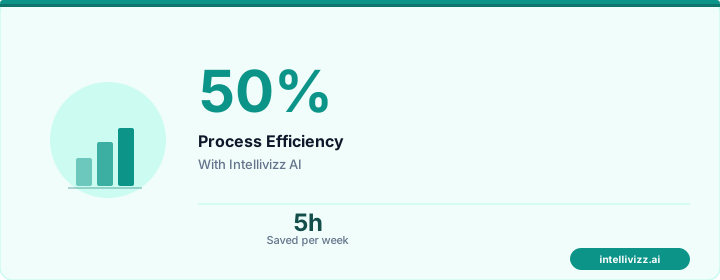
⚡ First Agent to Respond Wins 50% of Converted Leads
Portal data confirms: response speed is the single highest-leverage variable in real estate lead conversion
Portal-Specific Lead Response Requirements
Zillow Premier Agent: The Response Time Economy
Zillow's Premier Agent program is the dominant paid lead source for buyer-side agents in most U.S. markets. What many agents do not fully understand is that Zillow actively measures and acts on response time data in ways that directly affect their lead volume.
Zillow's internal data, published in its Premier Agent performance guidelines, shows that agents who respond within five minutes convert leads at 8x the rate of agents who respond after 30 minutes. The platform uses this data in two ways: it surfaces response time metrics to consumers on agent profiles (buyers can see your average response time before they submit an inquiry), and it factors response performance into lead distribution algorithms — agents who respond faster receive more leads from the same budget.
Key Zillow response dynamics that real estate professionals should understand:
- The 20-second call window: When a buyer submits an inquiry on Zillow, Premier Agent connects the buyer directly to the agent via phone in real time. Agents who miss this connection lose the lead to the next agent in the rotation. This is not a lead you can respond to in five minutes — it is a call you must answer in 20 seconds or miss entirely.
- Text-based inquiry response: For inquiries that do not trigger live calls, Zillow's data shows the critical response window is 5 minutes for a meaningful conversion advantage. Beyond 30 minutes, conversion rates drop by 60–70% compared to sub-5-minute responses.
- Response quality weighting: Zillow grades Premier Agent profiles in part on "response quality" — whether the agent's initial response is substantive (showing the property, answering a specific question) rather than a generic acknowledgment. Automation that sends immediate but generic responses without subsequent quality follow-up does not fully capture the conversion advantage of fast response.
Realtor.com: The ReadyConnect Concierge Dynamic
Realtor.com's primary lead product — ReadyConnect Concierge (formerly called "connections") — operates differently from Zillow Premier Agent. Realtor.com employs its own inside sales agents who contact the buyer first, qualify their intent, and then transfer them live to a participating agent. This warm transfer model places different demands on agent response behavior.
When a Realtor.com concierge calls with a live transfer, the agent has seconds to accept. Agents who repeatedly miss live transfers are removed from the ReadyConnect program. For agents who receive Realtor.com leads through the standard connection model rather than live transfer, response time expectations are similar to Zillow: sub-5-minute initial response strongly outperforms longer delays.
Realtor.com's 2024 conversion study found that buyers who received a response within one minute converted to appointments at 391% the rate of buyers who received a response after 24 hours. This is not a marginal improvement — it is the difference between a lead pipeline and an expensive marketing expense with low measurable return.
Brokerage-Level Response Policies and Team Accountability
Individual agent speed to lead is one dimension of the problem. For teams and brokerages, the organizational challenge is ensuring that response speed standards are consistently met across all agents, not just the high performers who are already motivated to respond quickly.
Brokerage Response Policy Frameworks
| Policy Type | Structure | Enforcement Mechanism | Common in |
|---|---|---|---|
| Response time SLA | Mandatory initial response within defined window (e.g., 5 minutes for portal leads, 15 minutes for website leads) | CRM auto-flag; team lead notification on breach | High-production buyer teams, large brokerages |
| Lead rotation with expiry | Leads rotate to the next available agent if not claimed within a time window | CRM-enforced rotation; unclaimed leads re-pool automatically | Teams with multiple buyer agents |
| ISA first-touch model | All inbound leads routed to ISA before agent; ISA qualifies and transfers | ISA performance metrics; agent receives only qualified transfers | High-volume teams (50+ leads/month) |
| After-hours coverage policy | Defined agent or ISA responsible for after-hours response on rotating schedule | On-call rotation schedule; escalation protocol for missed coverage | Teams in competitive markets where after-hours leads are common |
Brokerages that formalize response time policies see measurable improvement in portfolio-wide conversion rates — not because individual agents change their behavior dramatically, but because the policy closes the gap between the team's best and worst responders. A brokerage where the top agent responds in 3 minutes and the slowest agent responds in 4 hours has a massive revenue leak from the slow end of the distribution. Formalizing and automating a 10-minute maximum response standard captures the majority of that leaked opportunity.
The ISA Role in Real Estate Lead Response
The Inside Sales Agent (ISA) is a role that has become increasingly common in high-volume real estate teams specifically because of speed-to-lead demands. An ISA is a dedicated team member — in-house or virtual — whose primary responsibility is contacting, qualifying, and nurturing inbound leads before handing them to a buyer or listing agent.
What ISAs Do That Automation Cannot (Yet)
The ISA role emerged partly as a response to the limitations of pure automation in real estate lead qualification. An automated response system can send an immediate text to every new portal lead. But it cannot ask the nuanced follow-up questions that distinguish a "ready to buy in 30 days" prospect from a "browsing for fun with no pre-approval" contact:
- "Have you spoken with a lender yet? Do you have a pre-approval letter?"
- "Are you working with another agent currently?"
- "What's driving your timeline — lease expiration, job change, specific school year?"
- "Have you seen properties in person yet, or are you still in the research phase?"
The answers to these questions fundamentally change how the lead should be treated. A pre-approved buyer with a 60-day timeline and a job relocation driving their search gets an agent on the phone within 10 minutes and an in-person showing scheduled within 48 hours. A casual browser three years from buying gets a value-add nurture sequence and a quarterly market update email. The ISA performs this triage in real time.
ISA + Automation: The Hybrid Model
The most effective teams use ISAs and automation together rather than treating them as alternatives. Automation handles the immediate initial response — ensuring that every lead receives acknowledgment within 60 seconds regardless of time of day or ISA availability. The ISA then handles the qualification conversation within the human response window. This hybrid model captures the conversion advantage of sub-60-second initial response while maintaining the qualification depth that only a human conversation provides.
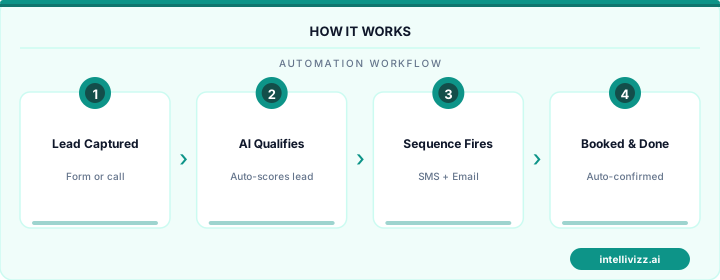
🤝 ISA + Automation: Speed Without Sacrificing Quality
Automation ensures instant acknowledgment; ISA delivers the qualification conversation that converts
Team Lead Routing for Fastest Response
For teams with multiple buyer agents, lead routing strategy has a direct impact on response speed. The wrong routing approach creates internal bottlenecks that negate even the best individual agent response habits.
Routing Strategies Ranked by Speed
- Simultaneous blast (fastest, highest conflict risk): All eligible agents receive the lead simultaneously. First agent to claim it owns it. Maximizes response speed but creates internal competition and resentment if not well-managed. Best for large teams with formal rotation systems.
- Round-robin with time expiry (best balance): Lead goes to the next agent in rotation. If unclaimed within 5 minutes, it moves to the next agent automatically. Balances fairness with speed. Requires CRM enforcement to function correctly.
- Availability-based routing (most sophisticated): Lead routes to the agent whose CRM status is set to "available." Agents who are in showings or with clients can set themselves unavailable, and leads route accordingly. Requires consistent agent CRM hygiene to work well.
- Specialty routing (for specific lead types): Leads from luxury property searches route to your luxury-certified agent. Spanish-language inquiries route to your bilingual agent. Leads from a specific zip code route to your local specialist. Optimizes agent-lead fit over pure speed.
Mobile Response Capabilities: The Field Agent Problem
Real estate agents are field workers. They are in showings, at listing appointments, in client lunches, driving between properties. The agent who is most likely to respond quickly on a Tuesday afternoon is the agent sitting at a desk with no appointments — which is often not the agent who has the most experience or the best skills to handle a high-quality lead.
Mobile response infrastructure for real estate teams must include:
- CRM mobile app with push notification for new leads: Every new lead triggers an immediate push notification to the assigned agent's mobile device, with one-tap calling capability.
- Pre-written text response templates: Agents can respond to initial inquiries with a personalized template in under 10 seconds from their phone, even while between appointments.
- Click-to-call integration from lead notification: The notification itself should contain the prospect's phone number with one-tap dial — not require the agent to navigate to the CRM, find the lead, and copy the number manually.
- Voicemail drop capability: When a lead does not answer, agents can drop a pre-recorded personalized voicemail without waiting through the recording, then immediately move to the next call or task.
After-Hours Lead Handling: The 37% Nobody Responds To
Analysis of portal lead submission patterns consistently shows that 35–40% of buyer inquiries are submitted outside of standard business hours — evenings (6–10 PM) and weekend mornings account for the largest share. These are often the highest-quality leads: a buyer who has spent their evening searching Zillow and submits an inquiry at 8:30 PM is typically more motivated than a casual mid-day browser.
Most real estate teams handle these leads poorly. The inquiry arrives at 8:30 PM; the first human response comes at 9:15 AM the next morning — nearly 13 hours later. By then, the buyer has received responses from other agents, possibly scheduled showings, and may have moved forward without you.
After-hours lead handling for real estate requires an automated first response that goes beyond a generic acknowledgment. The most effective after-hours automated responses include:
- Specific reference to the property the buyer inquired about (address or listing ID)
- A brief value statement: "I specialize in [neighborhood/area] and have helped [X] buyers this year find homes in that price range."
- A direct offer: "I can schedule a showing for you as early as tomorrow morning. Reply with your preferred time and I'll confirm."
- A calendar link for self-serve scheduling of a 15-minute consultation call
For agents who want to go further, AI-powered after-hours response systems can engage in real SMS conversation — answering basic questions about the property, availability for showings, and the agent's experience — without requiring the agent to be awake. For the broader framework of how automated lead follow-up works in real estate, our guide to AI for real estate lead follow-up covers the full system. For specific automation implementation, real estate lead automation provides the technical setup guide.
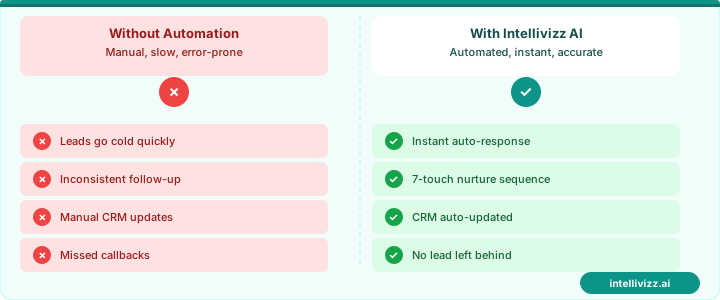
🌙 37% of Leads Arrive After Hours — Answer Them
After-hours automation captures the high-motivation evening buyer your competitors miss
Response Quality vs. Speed: The False Tradeoff
A common concern among experienced agents is that automation-driven fast response sacrifices quality for speed. The worry is that an immediate automated text feels impersonal and cheap compared to a thoughtful, personalized phone call — and that buyers can tell the difference.
This concern reflects a false tradeoff. The right framework is: immediate automated acknowledgment to secure the lead's attention, followed by high-quality human engagement within a short window. The automated first response does not replace the quality call — it ensures the quality call still has a prospect on the other end when it arrives.
Buyers who receive an immediate, relevant automated response followed by a personalized agent call within 10–15 minutes rate the overall experience more positively than buyers who receive a high-quality but delayed agent call 2 hours later. The automation sets a positive first impression; the agent call deepens the relationship. Together, they outperform either approach alone.
The best open house follow-up systems in real estate use the same principle — immediate value delivery followed by personalized agent engagement. Our guide to open house follow-up automation in real estate covers this parallel system in detail, including how to connect open house leads into the same speed-to-lead infrastructure used for portal inquiries.
Measuring Speed-to-Lead Performance
| Metric | Individual Agent Baseline | Optimized Team Target |
|---|---|---|
| Average first response time (business hours) | 45–120 minutes | Under 5 minutes |
| Average first response time (after hours) | 8–14 hours | Under 2 minutes (automated) |
| Lead-to-appointment conversion rate | 8–12% | 18–28% |
| Portal response score (Zillow/Realtor.com) | Varies widely | Top 25% in market |
| After-hours lead response rate | 20–40% | 95–100% (automated) |
| ISA contact rate (leads reached by phone) | N/A (no ISA) | 55–75% within 30 minutes |
The agents and teams who win on speed to lead in real estate are not working harder — they have built systems that work while they sleep, show properties, and serve existing clients. The investment in lead routing infrastructure, ISA support, and automated first-touch systems is not an overhead cost. It is the operational foundation that determines whether your marketing investment converts to closings or disappears into a pipeline full of prospects who simply called someone who answered first.
Ready to build a lead system that works while you sleep? Explore our real estate automation solutions.
Relevant AI Automations
AI Review Management
All-in-one review management: automated review requests, AI-powered responses, and review repurposing for web & social — 3 engines in 1.
AI Voice Agent — Property Inquiry Handler
AI voice agent answers inbound calls, qualifies buyer/seller intent, captures property preferences, budget, timeline, an
Website Property Search Lead Capture
Captures leads from website property search, IDX integration, or landing page forms