
AI for Real Estate Lead Follow-Up: Convert More Leads Without Working Nights and Weekends
The 5-Minute Rule: Why Real Estate Lead Response Time Defines Your Income
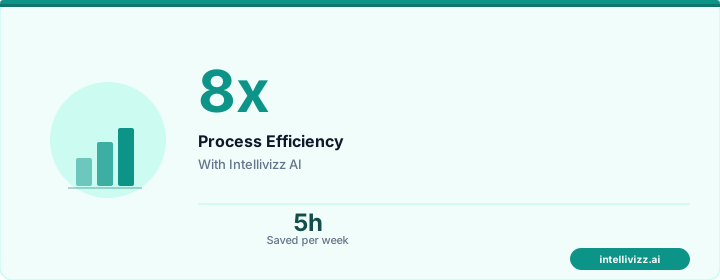
In real estate, the relationship between response time and lead conversion isn't a gentle curve — it's a cliff. Research consistently shows that leads contacted within 5 minutes are 8x more likely to convert than leads contacted within 30 minutes, and 21x more likely to convert than leads contacted after one hour. After 24 hours, most leads are gone. Not because they decided not to buy or sell — but because a faster agent got there first.
The average response time for real estate web leads is 47 minutes. For portal leads from Zillow, Realtor.com, and Redfin, it's 2.5 hours. For open house sign-in sheet follow-ups, it's often never. This is the gap that AI for real estate lead follow-up closes — not by asking agents to work faster or respond to their phones during every showing, but by automating the first response and the entire follow-up sequence so that agents can focus exclusively on the high-value activities that require a human being in the room.
This guide covers the full AI lead follow-up strategy for real estate: lead source-specific approaches, follow-up sequence design, AI voice tools for inbound calls, CRM lead scoring integration, and the conversion metrics that top-performing teams are achieving with automation in 2025–2026.
🏠 Speed wins in real estate — automate your lead response
Smart technology, better results
Why Real Estate Leads Die Without Immediate Follow-Up
Understanding the mechanics of lead decay helps clarify why automation isn't a nice-to-have — it's a structural requirement for any team managing more than 20 leads per month.
When a prospective buyer submits an inquiry on a listing or a seller requests a home valuation, they are at a specific moment of decision-making momentum. That momentum is fueled by immediate context: they just toured the property in photos, they just got off the phone with a friend who mentioned selling, they just looked at their neighborhood comps and got excited. That context is live and vivid.
Within minutes, the context begins fading. They get a work email. Their child needs dinner. Their spouse disagrees with the property. Another agent — the one with AI follow-up — responds with specific information about the property they were looking at and offers three showing times. The prospect books with that agent not because that agent is better, but because that agent was there.
The same buyer who submitted your Zillow inquiry also submitted inquiries on 3–5 other listings from 3–5 other agents. The first professional, personalized response wins the showing. The first showing is where relationships form. The relationship is where commissions come from.
AI Voice Technology: The Phone-Based Frontier of Real Estate Lead Follow-Up
While text and email automation handle the written touchpoints in a lead follow-up cadence, voice AI is rapidly becoming the most powerful differentiator for real estate teams that handle high lead volumes. The telephone has always been the highest-conversion channel in real estate outreach — but it has also been the most constrained, because a human agent can only make so many calls per hour and cannot staff a phone line around the clock. AI voice technology dissolves both constraints simultaneously.
Modern conversational AI systems built on large language models can conduct natural, context-aware phone conversations that qualify real estate leads, answer property-specific questions, book appointments on the agent's calendar, and hand off to a human agent at precisely the right moment. These are not the robotic IVR trees of the 2010s — they are fluent, adaptive voice agents that can handle interruptions, answer follow-up questions, and pivot based on what the prospect says.
How AI Voice Qualification Calls Work
When a new lead enters the system and does not respond to an initial text within 10–15 minutes, the AI voice system initiates an outbound call. The call opens with a natural introduction — "Hi, this is Alex calling from [Agency Name], I saw you were looking at properties in [neighborhood] and wanted to reach out personally to see if I could help." The voice agent is indistinguishable from a human assistant in the first several exchanges, which is the window where qualification data is gathered.
The conversational AI captures structured qualification data during the call through a dynamic interview — not a rigid script, but a branching dialogue that adapts to the prospect's answers:
- Purchase timeline: "Are you looking to move within the next 60 days, or is this more of an exploratory conversation at this point?"
- Financing status: "Have you had a chance to connect with a mortgage lender yet, or is that something we should line up as a next step?"
- Geographic specificity: "You were looking at homes in [neighborhood X] — is that neighborhood specifically important to you, or are there adjacent areas you'd also consider?"
- Motivation driver: "What's prompting the move — is it a job change, family circumstances, or just the right time to make a move?"
- Decision authority: "Is this something you're evaluating on your own, or is there a partner or spouse who's also part of the decision?"
All of this data is transcribed, parsed by the AI's natural language understanding layer, and written into structured fields in the CRM before the call ends. By the time the AI hands off to a human agent — either on the call or by scheduling a callback — the agent has a complete qualification profile without having made a single outbound call themselves.
Voice AI Script Architecture for Real Estate
Effective voice AI deployment for real estate lead follow-up is not a single script — it is a library of conversation branches calibrated to lead source, inquiry type, and prospect signal. The architectural layers include:
Seller Lead Branch: Optimized for home valuation requests and listing inquiry forms. Captures the property address, the owner's motivation and urgency, their current awareness of the market, and whether they are already working with another agent. Designed to get the prospect to agree to a listing presentation.
Long-Term Nurture Re-Engagement Branch: Used for leads that have gone cold after initial contact. Conversational opener references the initial inquiry to establish continuity: "We spoke briefly a few months back about properties in [area] — I wanted to circle back and see if your situation has changed at all." Designed to reactivate the conversation without pressure.
Inbound Call Handler: Used when an agent is unavailable and a prospect calls the agent's direct number. The voice AI answers, conducts a full qualification conversation, and offers to book a callback at the prospect's preferred time — capturing everything that would otherwise be lost to voicemail.
Phone Conversation Analytics and Call Intelligence
AI voice systems generate a layer of data that manual phone follow-up cannot: structured call analytics that reveal patterns across hundreds or thousands of prospect conversations. The call intelligence dashboard produced by platforms like Structurely, Conversica, and ReadyMode provides:
| Analytics Dimension | What It Measures | How Agents Use It |
|---|---|---|
| Talk-to-listen ratio | How much of each call is AI speaking vs. prospect responding | Calibrate script openings — if prospects are talking more, the conversation is engaging |
| Objection frequency | Which objections appear most often ("I'm not ready yet," "I'm working with someone") | Train the AI's objection-handling branches or brief human agents on the most common hesitations |
| Qualification completion rate | Percentage of calls where all five qualification fields are captured | Identify call branches where the conversation breaks down before full qualification |
| Appointment booking rate by script version | Which voice script variants produce the most booked consultations | A/B test script variations and promote the highest-converting version |
| Sentiment trajectory | Whether the prospect's tone becomes more positive, neutral, or negative during the call | Identify conversation moments that create friction and revise the script around those moments |
| Call-to-close attribution | Which leads that went through AI voice qualification ultimately closed a transaction | Calculate the ROI of voice AI specifically, distinct from other automation touchpoints |
This analytics layer is what separates voice AI from simple voicemail drops. Every call produces structured data that improves the next call — creating a compounding feedback loop that manual phone outreach can never achieve at scale.
Conversational AI Platforms for Real Estate Voice Follow-Up
The vendor landscape for real estate voice AI has matured significantly since 2023. The leading platforms as of 2026 operate on distinct technical foundations:
- Structurely (Holmes AI): Purpose-built for real estate, with pre-trained qualification logic specific to buyer and seller journeys. Integrates natively with Follow Up Boss and Sierra Interactive. Best for teams that want a ready-to-deploy voice agent without extensive configuration.
- Conversica: Enterprise-grade conversational AI that handles both voice and written channels. More configurable than Structurely but requires a longer implementation timeline. Best for large brokerages and franchise operations with dedicated technical staff.
- ReadyMode (formerly Xencall): Combines AI-powered predictive dialing with voice AI for inbound call handling. Optimized for high-volume outbound calling with intelligent voicemail detection and live-transfer capability to human agents when the prospect engages.
- Lofty AI (formerly Chime): CRM-native voice AI that operates within the Lofty platform ecosystem. Eliminates integration complexity for teams already using Lofty as their primary CRM and marketing automation hub.
Voice AI for Seller Lead Qualification: A Specific Use Case
Seller leads — homeowners who have submitted a home valuation request or responded to a listing outreach campaign — represent some of the highest-value prospects in real estate and the most underserved by traditional follow-up automation. Text and email sequences work adequately for buyer lead nurture, but seller leads require the kind of trust-building conversation that only voice can achieve. A homeowner deciding whether to list their property is making a decision that involves hundreds of thousands of dollars — they want to hear a confident, knowledgeable voice before agreeing to a listing appointment.
Voice AI for seller lead qualification is calibrated to sound advisory rather than transactional. The opening acknowledges the owner's inquiry without immediately pushing for a meeting: "I pulled some recent sale data for your area and I wanted to share what I found — do you have two minutes?" This approach positions the AI voice agent as bringing value to the call rather than extracting a commitment from the homeowner. Once the prospect is engaged, the conversation transitions naturally into capturing the property details, the owner's timeline and motivation, and their pricing expectations — all of which are logged to the CRM and presented to the listing agent before the follow-up consultation.
The Complete AI Follow-Up Sequence for Real Estate Leads
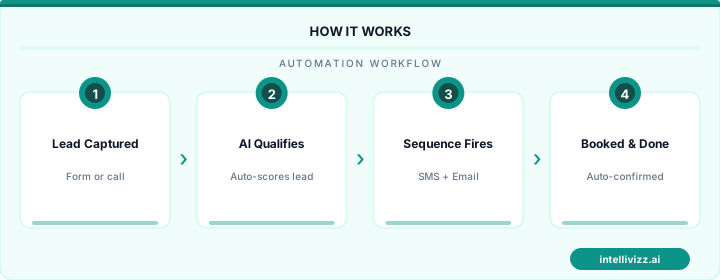
Response 1: Immediate Personalized Contact (0–2 Minutes)
Channel: SMS primary (email as secondary)
Content: Reference the specific property or search criteria. Offer showing times or ask a qualifying question. Keep it short — long messages aren't read immediately. "Hi [name], saw your inquiry about 4521 Maple Drive in Herndon — it's a great property in a strong school district. I have a few showing slots available this week. Do any of these times work: [Tuesday 5 PM / Thursday 6 PM / Saturday 10 AM]?"
Response 2: Qualification Follow-Up (30 Minutes If No Response)
Channel: SMS
Content: A different angle — ask a qualification question rather than repeating the showing offer. "Quick question before you decide: Are you working with a lender yet, or would it help if I connected you with a few top options in [area] to understand what you qualify for?"
This message works because it provides value (lender recommendation) while gathering critical qualification data (financing status). Pre-approval status is the single most predictive factor for conversion speed — leads who are pre-approved close significantly faster and should receive higher-priority human follow-up.
Response 3: Value-Add Email (Day 1)
Channel: Email
Content: Neighborhood market report, recent comparable sales, or a curated list of similar properties within their search criteria. Real estate listing email automation can dynamically generate these materials from live MLS data, making them feel current and relevant rather than like a generic drip campaign.
Response 4: Alternative Listing Suggestions (Day 3)
Channel: Email with visual listing cards
Content: "Three more properties that match your criteria just came to my attention — one hasn't hit the public portals yet." This positions you as having market access beyond what Zillow provides, which is true: MLS listings appear on your IDX site before Zillow's data feed catches up.
Response 5: Market Insight Check-In (Day 7)
Channel: SMS
Content: "Hey [name], the [neighborhood] market has been moving fast — three homes went under contract this week. I can set up a custom search that alerts you the moment new listings match your criteria before they hit the major portals. Want me to set that up?" This is a service offer, not a sales pitch, and it provides a concrete reason to engage.
Response 6–12: Long-Term Nurture (Day 14–90)
Channel: Email bi-weekly, SMS monthly
Content: Market updates, new listing alerts matching their criteria, interest rate commentary, and periodic check-ins. CRM lead scoring automation determines when a lead's engagement signals warrant upgrading to more intensive human follow-up versus continuing in automated nurture.
🏠 Speed wins in real estate — automate your lead response
The data speaks for itself
Inside the Machine: How AI Models Predict Real Estate Lead Conversion
The phrase "AI lead follow-up" is used loosely in real estate marketing — but the actual technology stack powering modern lead conversion AI is far more sophisticated than a timed SMS sequence. Understanding the underlying machine learning architecture helps real estate operators choose platforms intelligently, set realistic accuracy expectations, and interpret the model outputs their systems produce. This section examines the core AI components: natural language processing for intent classification, gradient-boosted decision trees for conversion probability scoring, property-matching embedding models, and the speech recognition pipeline that powers voice call analytics.
Natural Language Processing for Lead Intent Classification
When a prospect submits a free-text inquiry — "Looking for a 3-bed near good schools, flexible on price, hoping to move before summer" — a rules-based system sees a string of text. An NLP-powered intent classifier sees a structured set of signals: a bedroom count constraint, a school quality weighting factor, a temporal deadline, and a price sensitivity indicator. The classification layer transforms unstructured prospect language into machine-readable intent vectors that can be acted on immediately by the downstream automation engine.
Modern real estate AI platforms use transformer-based NLP architectures — variants of BERT, RoBERTa, or fine-tuned GPT models — trained on millions of real estate inquiry texts to perform this classification with high accuracy. The training corpus typically includes inquiry form submissions, chat transcripts, email threads, and SMS exchanges labeled by outcome (did this lead convert to a showing? to a signed contract?). The classifier learns to weight vocabulary patterns, phrase constructions, and temporal language against those conversion outcomes.
Key intent dimensions extracted by the NLP layer include:
- Timeline urgency score (0–1.0): Distinguishes "need to move by June 1st" (urgency: 0.94) from "eventually looking to upsize" (urgency: 0.12). Derived from temporal adverbs, deadline language, and life-event markers ("job transfer," "lease ending," "expecting a baby").
- Price sensitivity signal: Detects budget constraint language ("under $450k," "can stretch to $500k," "price is flexible") versus aspirational language ("looking at the $600k range") — a meaningful distinction for routing leads to agents whose listing inventory matches stated ranges.
- Property specificity index: Measures how specific the inquiry is (exact address, specific neighborhood, named school district) versus generic (broad metro area, vague criteria). Higher specificity correlates with shorter buying timelines in training data.
- Competing-agent signal: Detects language indicating the prospect is already working with another agent ("my Realtor said," "we've been looking with someone") — critical for routing to a human agent immediately rather than launching a long automated nurture sequence.
Gradient-Boosted Conversion Probability Models
The conversion probability score — the number that determines whether a lead gets routed to a human agent immediately or stays in automated nurture — is produced by a gradient-boosted decision tree ensemble, typically XGBoost or LightGBM, rather than a simple rule-based scoring formula. The distinction matters because ensemble models capture non-linear interactions between features that rule-based systems miss entirely.
The model is trained on historical lead-to-close data with features drawn from three categories:
Profile feature set: Lead source channel (organic search vs. paid social vs. portal vs. referral), geographic distance from target properties, inquiry-to-market-price alignment ratio, device type (mobile leads convert differently than desktop leads in aggregate), time-of-day and day-of-week of inquiry, and any pre-qualification data captured through intake forms.
Contextual market feature set: Local inventory levels at time of inquiry, days-on-market trends for the prospect's target price range, current interest rate environment, and seasonal market phase — all of which modulate baseline conversion probability independent of prospect-level signals.
When trained on a dataset of 50,000+ historical leads with verified conversion outcomes, gradient-boosted models achieve AUC (area under the receiver operating characteristic curve) values of 0.78 to 0.86 on holdout test sets — meaning the model correctly rank-orders leads by conversion probability in approximately 82% of cases. Compare this to a human agent's intuitive lead prioritization, which produces AUC values of roughly 0.60 to 0.65 based on behavioral research — the model is meaningfully more accurate at identifying which leads will actually close. Related: learn how Zillow lead auto-response can convert Premier Agent and Flex leads before they go cold.
Property-Matching Embedding Models
The property recommendation engine — the AI component that decides which listings to surface to which leads in follow-up communications — operates on dense vector embeddings rather than keyword filters. Embedding-based matching is what separates modern AI follow-up from legacy MLS alert systems that simply match on bedrooms, bathrooms, and price range.
In an embedding-based system, each property in the MLS is represented as a high-dimensional vector (typically 128 to 512 dimensions) encoding its characteristics: structural attributes (square footage, lot size, age), location attributes (census tract demographics, school ratings, walkability scores, crime indices), price-per-square-foot relative to neighborhood comps, visual attributes extracted from listing photos via computer vision models (kitchen style, backyard quality, natural light), and textual attributes extracted from the listing description via NLP (renovated, motivated seller, investor special).
Each prospect is similarly encoded into an embedding vector built from their inquiry text, behavioral signals, and historical engagement patterns. The recommendation engine computes cosine similarity between the prospect vector and the property corpus, surfacing the top-N most similar properties regardless of whether they match on traditional filter criteria.
This produces recommendations that feel remarkably accurate to prospects: "I wasn't filtering for a pool, but the AI kept showing me pool homes — and it turned out that was exactly what I wanted once I saw them" is a commonly reported experience from buyers who interact with embedding-based recommendation systems. The model is detecting latent preferences from behavioral signals that the prospect themselves has not yet articulated.
| Matching Approach | Feature Space | Recommendation Accuracy (CTR) | Best For |
|---|---|---|---|
| Traditional MLS Filter Match | 4–8 explicit criteria | 11–15% click-through rate | Prospects who know exactly what they want |
| Collaborative Filtering | Behavioral similarity to other buyers | 18–24% click-through rate | Early-stage exploratory buyers |
| Content Embedding Match | 128–512 dimensional property vectors | 27–38% click-through rate | Mid-funnel buyers with evolving preferences |
| Hybrid Ensemble (filter + embedding + collab) | Full feature stack | 34–44% click-through rate | All buyer stages; adapts as preferences crystallize |
Speech-to-Text Pipeline and Voice Call Intelligence Architecture
Voice AI systems in real estate follow-up are built on a three-layer technical stack: an automatic speech recognition (ASR) layer that converts audio to text in real time, a spoken language understanding (SLU) layer that extracts structured entities from the transcribed text, and a dialogue management layer that selects the next conversational turn based on the extracted entities and the current state of the conversation graph.
The ASR layer in enterprise-grade real estate voice AI uses acoustic models fine-tuned on real estate domain vocabulary — critical because general-purpose ASR models struggle with real estate-specific terminology (cul-de-sac, HOA, PITI, MLS, ARV, cap rate) and with the names of neighborhoods, streets, and developments that appear in prospect conversations. Fine-tuned ASR reduces word error rates on real estate calls from 12–18% (general model) to 4–7% (domain-fine-tuned model) — a meaningful accuracy improvement when the downstream SLU layer is trying to extract a correct property address or price range from the transcript.
The SLU layer performs named entity recognition (NER) across several real estate-specific entity classes: property addresses, neighborhood names, price ranges, bedroom and bathroom counts, timeline phrases, agent competitor names, and financing status indicators. These entities are extracted in real time during the call and written into structured CRM fields as the conversation progresses — so by the time the call ends, the lead record is fully populated without any post-call data entry.
The dialogue management layer governs conversation flow using a hierarchical state machine. Each state represents a point in the qualification conversation; transitions between states are triggered by the entities extracted from the prospect's most recent utterance. When the prospect says "we're pre-approved up to $620,000," the SLU layer extracts {financing_status: pre_approved, max_budget: 620000} and the dialogue manager transitions to a branch optimized for pre-approved buyers, adjusting the property suggestions, scheduling urgency, and closing language accordingly — all within 200 milliseconds of the prospect finishing their sentence.
Conversion Benchmarks: What Results Should You Expect?
| Metric | Without AI Follow-Up | With AI Follow-Up | Improvement |
|---|---|---|---|
| Average first response time | 47 minutes | Under 90 seconds | 97% faster |
| Lead-to-conversation rate | 15–20% | 40–55% | 2–3x improvement |
| Lead-to-appointment rate | 3–5% | 12–18% | 3–4x improvement |
| Portal lead conversion (lead to close) | 0.5–1% | 2–4% | 3–4x improvement |
| Open house follow-up completion rate | 40–60% | 100% | Complete coverage |
| Agent time on follow-up per week | 15–25 hours | 3–6 hours (hot leads only) | 75% time savings |
| Annual commission impact (solo agent) | Baseline | +$30,000–$80,000 | Incremental GCI |
| Annual commission impact (5-agent team) | Baseline | +$150,000–$400,000 | Incremental GCI |
The commission impact figures represent the additional gross commission income generated by leads that would have gone cold without AI follow-up — not an improvement in closing rate from existing active leads. This is genuinely new revenue, not a reallocation of effort.
Common Real Estate Lead Follow-Up Mistakes AI Eliminates
Inconsistent Follow-Up Cadence
Agents who follow up manually are inconsistent. They follow up immediately on leads that come in when they're available and miss leads that come in during showings, evenings, or weekends. AI creates perfect cadence on every lead regardless of timing.
Generic Messaging
Copy-paste follow-up templates that don't reference the specific property or search criteria feel impersonal and are largely ignored. AI personalization that pulls the specific property address, neighborhood, price point, and search criteria from the lead record creates messages that feel individually crafted even when sent at scale.
Giving Up Too Early
Studies show 35% of real estate leads require 5+ contacts before responding. Most agents give up after 1–2 attempts. AI sequences continue through the full cadence automatically — so the lead who was simply busy when the first three messages arrived and responds on day 7 is captured rather than lost.
Not Segmenting by Lead Stage
A lead who says "we're buying in 6 months" should receive different content than a lead who says "we need to move by July." AI sequences with conditional logic route leads into stage-appropriate tracks — aggressive showing-focused sequences for near-term buyers, educational and market-update sequences for long-term prospects — rather than sending every lead through the same funnel regardless of timeline.
For real estate teams that are also managing seller outreach, combining AI follow-up automation for buyer leads with AI for real estate investor outreach and listing email automation creates a comprehensive pipeline that captures both sides of the transaction without requiring additional staff. The agents who close the most transactions in 2026 are not the ones working the most hours — they are the ones whose systems work the most hours on their behalf.
Ready to build a lead system that works while you sleep? Explore our real estate automation solutions, or read our guide to Speed to Lead in Real Estate: Why Every Minute Costs....
Relevant AI Automations
AI Review Management
All-in-one review management: automated review requests, AI-powered responses, and review repurposing for web & social — 3 engines in 1.
AI Voice Agent — Property Inquiry Handler
AI voice agent answers inbound calls, qualifies buyer/seller intent, captures property preferences, budget, timeline, an
Website Property Search Lead Capture
Captures leads from website property search, IDX integration, or landing page forms