
Zillow Lead Auto-Response: Converting Premier Agent and Flex Leads Before They Go Cold
Why Zillow Leads Require Platform-Specific Response Automation
Zillow leads are not generic real estate inquiries. They come from a platform with specific lead quality characteristics, unique program structures, distinct buyer behavior patterns, and a competitive environment where the agent's response speed is the primary differentiator. A generic real estate lead response system — even a well-designed one — will consistently underperform on Zillow leads because it was not built around the platform's specific dynamics.
This guide is specifically about Zillow lead handling. For the broader principles of real estate lead response automation and speed-to-lead strategy, our guide to AI for real estate lead follow-up provides the foundational framework, and the speed-to-lead research and benchmarks explain why first-contact timing matters so dramatically. What follows is the Zillow-specific layer on top of those foundations.
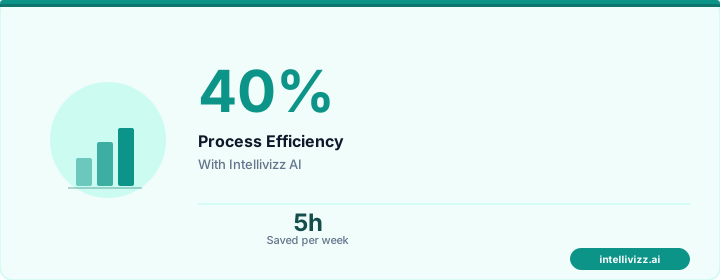
⚡ Zillow Leads Answered in Seconds, Not Hours
Platform-specific automation built for Premier Agent and Flex lead programs
Understanding Zillow's Lead Programs: Premier Agent vs. Flex
Zillow's lead generation operates through two distinct program structures with fundamentally different economics, lead quality profiles, and response requirements. Agents who treat them identically will underperform in both.
Zillow Premier Agent (ZPA)
Zillow Premier Agent is a paid advertising program where agents purchase impression share in specific ZIP codes. Lead quality in ZPA is highly variable: you are paying to be visible to everyone viewing Zillow listings in your coverage area, including early-stage researchers, out-of-market curiosity browsers, renters exploring ownership, and highly motivated buyers ready to make an offer. The same ZIP code coverage generates radically different lead quality depending on market conditions, time of year, and which specific properties are generating inquiry activity.
Because ZPA leads are paid and unvetted, volume is higher but conversion rates are lower — typically 1–3% from first contact to closed transaction for most agents. Response speed is the critical variable: Zillow's own research shows that agents who respond to ZPA leads within five minutes convert at 3–5x the rate of agents who respond within one hour, because Zillow simultaneously sends the inquiry to multiple agents and the buyer typically engages with whoever responds first.
Zillow Flex
Zillow Flex is a performance-based program where Zillow pre-screens leads and refers them to partner agents in exchange for a referral fee at closing (typically 25–40% of agent commission). Flex leads are higher quality by design — Zillow's screening process filters for buyers who have expressed strong purchase intent and engaged meaningfully with the platform before referral. Flex leads typically convert at 5–10% from referral to close, significantly above ZPA averages.
The tradeoff is the referral fee and Zillow's active monitoring of agent performance. Zillow tracks response time, contact rate, and client satisfaction for Flex agents. Agents who consistently fail to respond quickly or who generate poor client feedback are removed from the Flex program. This makes response automation not just a conversion optimization for Flex — it is a program participation requirement. Missed Flex leads do not just represent lost commissions; they jeopardize the entire program relationship.
Zillow Lead Data: What You Receive and How to Use It
Understanding exactly what information Zillow provides with each lead is essential for building effective auto-response templates. ZPA and Flex leads typically include:
| Data Field | Availability | Auto-Response Use |
|---|---|---|
| Buyer name | Always | Personalized greeting in first message |
| Phone number | Always | SMS auto-response trigger; agent call queue |
| Email address | Always | Email sequence enrollment |
| Property address inquired about | Always | Property-specific response template |
| Inquiry message text | Usually | Intent signal extraction; response personalization |
| Zillow user activity data (views, saves) | Flex only | Intent scoring; message urgency calibration |
| Pre-approval status | Flex only | Financing-stage-appropriate messaging |
| Timeline (when looking to buy) | Sometimes | Nurture cadence duration and intensity |
Property-Specific Auto-Response Templates
The most common failure in Zillow lead auto-response is the generic acknowledgment: "Thank you for your inquiry. I'll be in touch shortly." This message signals immediately that the agent is not paying attention to the specific property or the specific buyer — and it arrives at a moment when the buyer is still on Zillow, potentially clicking "Contact Agent" on a second or third listing simultaneously.
An effective Zillow property-specific auto-response uses the property address data included in the lead to generate a response that demonstrates specific knowledge of the property and the buyer's likely interest:
"Hi [First Name] — thanks for reaching out about [Property Address]. This is a great [property type] — [one specific feature relevant to the listing, e.g., 'the corner lot is rare for this neighborhood' or 'that kitchen renovation was just completed this year']. I have [X] years of experience in [neighborhood/area] and can tell you a lot about what this home compares to. Are you available for a quick call this [afternoon/evening]? I also have access to off-market inventory in this area that may match what you're looking for."
This template requires a data integration between the Zillow lead feed and your MLS or property database to pull listing-specific details automatically. The integration investment pays off immediately: property-specific responses generate response rates 2–3x higher than generic acknowledgments.
Instant Response Architecture for Zillow Leads
The response window for Zillow leads is measured in minutes, not hours. Zillow's platform design actively encourages buyers to contact multiple agents simultaneously. The agent who reaches the buyer first — not the agent with the best follow-up sequence — establishes the relationship that drives eventual transaction representation. Building a response system for Zillow leads requires the same architectural thinking as emergency dispatch: the system must respond within 90 seconds, 24 hours a day, 7 days a week, regardless of what the agent is doing.
The Three-Layer Instant Response Stack
- Immediate SMS acknowledgment (within 60 seconds): The moment a Zillow lead arrives via webhook or email parse, an automated SMS is sent to the buyer's phone. SMS is the highest-response channel for Zillow leads — buyers who just submitted an inquiry from their phone are almost certainly still on their phone. The SMS references the specific property, introduces the agent by name, and asks a low-friction question ("Are you looking for something in that price range, or would a bit higher or lower work too?").
- Simultaneous email (within 60 seconds): A parallel email with more detail: agent bio, recent neighborhood transactions, a direct calendar link for scheduling a showing, and links to comparable properties that may also match the buyer's interest profile. Email works for buyers who prefer it and ensures the lead is captured even if the SMS number is landline or otherwise unreachable.
- Agent phone alert (within 2 minutes): A push notification or call to the responsible agent with the lead details, prompting a live call attempt. If the agent calls within 5 minutes, the combination of the automated first touchpoints and the live follow-up achieves conversion rates 4–6x higher than any single-channel approach.
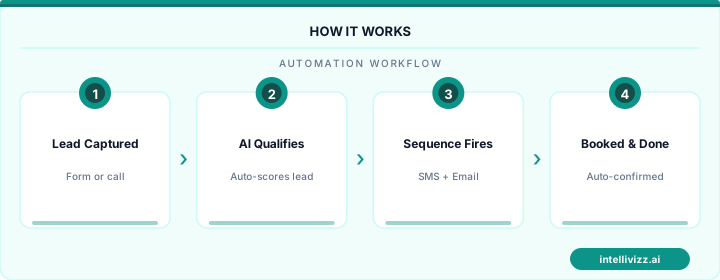
⏱️ Response Time Is Your Biggest Conversion Variable
Agents responding in under 5 minutes convert Zillow leads at 3–5x the rate of 1-hour responders
Agent Routing for Zillow Leads
For teams and brokerages receiving Zillow leads across multiple agents, routing logic is a critical piece of the auto-response infrastructure. Zillow itself assigns leads to Premier Agent accounts at the account level — the brokerage or team receives the lead, and then must route it to an individual agent. Routing decisions affect both response speed (can the routed agent respond quickly?) and conversion probability (is this the right agent for this buyer and property?).
Routing Logic Options
- Round-robin rotation: Leads cycle through agents in sequence. Simple to implement, ensures equitable lead distribution, but does not account for agent availability, expertise, or workload at the moment of lead arrival.
- Availability-based routing: Leads go to the agent who has most recently confirmed availability (via a status toggle in a CRM or team app). Improves response speed by ensuring leads go to agents who are ready to respond, but requires agents to actively manage their availability status.
- Geography/neighborhood-based routing: Leads for properties in specific neighborhoods or price tiers route to agents with demonstrated expertise in that area. Improves relevance and agent confidence on the call, but requires more sophisticated routing logic and risks lead accumulation for high-demand areas.
- Hybrid workload routing: Routes to the next available agent with fewer than a threshold number of active leads, in the priority order of geographic fit. Balances expertise matching with workload management.
For the broader framework of real estate lead automation — including CRM integration, drip campaigns, and long-cycle nurturing — our guide to real estate lead automation covers the full pipeline. Zillow-sourced leads integrate into the same CRM infrastructure as other sources but require the platform-specific first-response layer described above.
Zillow-Specific Follow-Up Cadence
After the instant first response, Zillow leads require a sustained follow-up cadence calibrated to the platform's buyer behavior. Zillow buyers tend to have longer decision timelines than leads from other sources: they are researching the market actively, often months before they are ready to transact. A follow-up sequence that pushes for an appointment aggressively in the first week loses the buyers who are not yet ready, which is a significant segment of the Zillow audience.
An effective Zillow-specific cadence has three phases:
- Phase 1 — Active engagement (Days 1–7): High-frequency, high-value contact. Days 1, 2, 4, and 7 each include a touchpoint combining different channels (SMS, email, call attempt). Each message references the specific property, offers new relevant information (price reductions in the area, comparable properties that just listed), and asks a low-friction question. The goal is to establish the agent as a valuable information source before asking for a commitment.
- Phase 2 — Regular nurture (Weeks 2–8): Weekly contact, primarily email, with market updates specific to the buyer's area of interest. Property alerts for new listings matching the buyer's search criteria. Occasional call attempts at varying times of day. The goal is maintaining top-of-mind presence without creating the "persistent agent" perception that drives unsubscribes.
- Phase 3 — Long-term nurture (Months 2–12+): Monthly market reports, quarterly check-ins, and property alerts. Many Zillow buyers who inquire today transact 6–12 months later. The agents who maintain appropriate-frequency contact throughout this period capture the transaction; agents who give up after 30 days are invisible when the buyer finally activates.
Zillow Review Optimization
Zillow reviews are a multiplier on Premier Agent lead quality. Agents with more and higher-quality Zillow reviews receive prominent placement in the Premier Agent program, which generates higher lead volume from the same impression share investment. The review collection system should be integrated into the post-transaction workflow for every Zillow-represented client: an automated request sequence sent three to five days after closing, with a direct link to the agent's Zillow profile review page and a mobile-optimized submission flow.
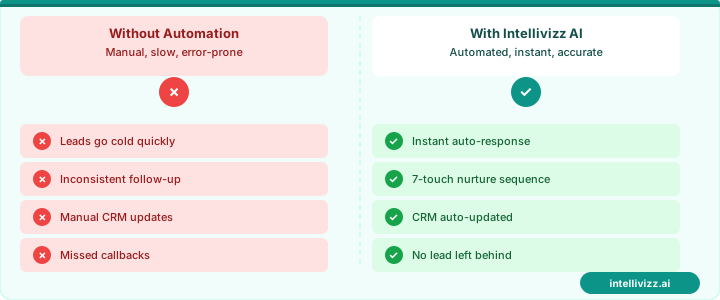
📊 Zillow Conversion Benchmarks by Response Strategy
Platform-specific automation consistently outperforms generic lead handling
Zillow Lead Conversion Benchmarks
| Metric | Industry Average | With Auto-Response System |
|---|---|---|
| ZPA lead contact rate (reach buyer within 5 min) | 20–35% | 75–90% |
| ZPA lead-to-appointment conversion | 3–6% | 8–14% |
| ZPA lead-to-close conversion | 1–3% | 3–6% |
| Flex lead contact rate | 40–55% | 85–95% |
| Flex lead-to-close conversion | 5–9% | 10–15% |
| Average follow-up touches before first response from buyer | N/A | 4–6 touches (multi-channel) |
For agents and teams serious about Zillow ROI, the platform-specific auto-response system described here is not a luxury — it is the baseline requirement for capturing the value of Premier Agent investment. Zillow CPL (cost per lead) is high enough that abandoning 35–50% of leads to competitor agents through slow response represents a direct, measurable financial loss. The automation infrastructure to prevent that loss is available, affordable, and directly measurable in converted transactions. The speed-to-lead automation guide covers the technical implementation of the instant-response layer in detail for agents ready to build the system.
Mastering the Zillow Premier Agent Ecosystem: Program Mechanics and Platform Optimization
Zillow's Premier Agent program is the most complex lead generation platform in residential real estate, with pricing mechanics, lead quality variations, and optimization levers that most agents and teams never fully understand. Building an effective auto-response system for Zillow leads requires understanding not just how to respond quickly, but how the Premier Agent program distributes leads, how lead pricing varies by geography and competition, and how profile optimization affects the quality and quantity of leads before they ever arrive in your CRM.
Premier Agent Program Tiers and Lead Distribution Logic
Zillow Premier Agent (ZPA) operates on a share-of-voice model in which agents and teams purchase a percentage share of lead impressions within defined zip codes. An agent who purchases 20% share of voice in a zip code will theoretically receive approximately 20% of the qualified leads generated from property searches and listing pages within that zip code. The share-of-voice model means that lead volume is not fixed — it scales with overall search activity within the zip code and with the number of leads generated relative to total impressions.
Premier Agent tier designations — Zillow Premier Agent, Premier Agent Plus — affect profile visibility on listing pages and in search results but do not directly determine lead distribution in the core share-of-voice model. Tier designations require maintaining minimum response time metrics (under 30 minutes average response time for Premier Agent, under 15 minutes for Premier Agent Plus), minimum monthly lead volume thresholds, and compliance with Zillow's connection requirements. Agents who fail to maintain response time SLAs experience tier downgrades that reduce profile prominence on listing pages, creating a secondary lead volume impact beyond the share-of-voice model.
Lead distribution within a zip code is not purely proportional to share-of-voice purchased. Zillow's internal routing algorithms incorporate agent performance signals — response rate, response time, connection rate (the percentage of leads that result in a verified phone conversation with the agent), and client satisfaction scores from past Zillow transactions — when distributing leads among agents who have purchased impressions in the same zip code. An agent with consistently high connection rates may receive a higher proportion of leads than their purchased share-of-voice would predict, while an agent with low connection rates may receive fewer. This performance-weighted distribution means that auto-response infrastructure that improves connection rates has a compound effect on lead volume beyond its direct impact on individual lead conversion.
Zillow Flex Program: Revenue-Share Lead Structure
Zillow Flex represents a fundamentally different commercial model than the Premier Agent pay-per-impression structure. Under Flex, Zillow provides leads at no upfront cost and instead collects a referral fee — typically 15-40% of the gross commission earned on transactions that close — from participating agents and teams. The referral fee percentage varies by market and is negotiated during the Flex agreement execution process.
Flex program eligibility is selective; Zillow restricts Flex participation to agents and teams who demonstrate a combination of high connection rates, strong client satisfaction scores, and sufficient transaction volume to provide Zillow confidence in eventual referral fee collection. Agents who have been accepted into Flex typically receive leads that Zillow has pre-screened for intent signals — search frequency, listing save behavior, mortgage calculator usage, and other platform engagement signals that correlate with near-term transaction intent.
Flex leads are delivered through the same Premier Agent app interface as standard ZPA leads, but they carry a Flex designation in the lead record. Response and follow-up protocols should be identical to standard ZPA leads, but CRM configuration should tag Flex leads distinctly for commission tracking and referral fee obligation management. Failing to attribute a closed transaction to a Flex lead can create legal and financial complications — Zillow's Flex agreements include transaction monitoring provisions and auditing rights.
The auto-response strategy for Flex leads must account for Zillow's connection monitoring. Flex agreement compliance requires demonstrating verified connection attempts — actual phone conversations, not just automated text messages — within defined windows. Auto-response infrastructure that triggers immediate SMS and email contact but also routes a live connection attempt through a team's ISA (Inside Sales Agent) workflow or through AI-assisted calling technology ensures that Flex connection requirements are met while minimizing the time-to-contact for the lead.
Lead Pricing by Zip Code: Understanding Cost Variability
Zillow Premier Agent pricing varies by zip code at a granularity that surprises most agents who have not closely analyzed their market's cost structure. The cost per lead impression in a given zip code is determined by overall property value in the zip code (higher-value homes generate more commission revenue and therefore justify higher advertising costs), the number of competing agents purchasing impressions in the zip code (more competition drives cost per impression higher through Zillow's auction-style pricing model), and the overall search volume for properties within the zip code (higher-searched zip codes generate more impressions, which Zillow prices at a premium).
In high-demand coastal markets, cost per lead in premium zip codes can reach $200-400 per qualified lead. The same investment in secondary zip codes within the same metro area might generate leads at $45-80 each. Sophisticated ZPA budget allocation distributes spend across primary and secondary zip codes to optimize cost per closed transaction, not cost per lead — because lead quality, measured by buyer intent and financial qualification, often varies significantly between zip code tiers.
Zip code lead pricing fluctuates seasonally and in response to competitive market entry. When a large team or brokerage enters a zip code by purchasing a significant share of voice, the competitive dynamics shift and cost per impression for remaining competitors typically increases. Monitoring your cost per lead on a monthly basis and investigating anomalies — sudden increases that don't correspond to seasonal patterns — can surface competitive intelligence about market entry activity in your target zip codes before it becomes visible through other channels.
Zillow Profile Optimization for Lead Quality and Volume
The Zillow Premier Agent profile is the primary trust and credibility signal that prospective leads evaluate before deciding whether to respond to an agent's outreach. Profile completeness, review count, review recency, and transaction history visibility all affect conversion rates from first agent impression to lead submission — meaning profile optimization is a lead generation lever, not just a branding exercise.
Profile photo and professional bio are the highest-impact optimization elements for agents who have not recently updated their profiles. Zillow's internal research indicates that profiles with professional headshots convert at 23% higher rates than those with casual or informal photos, and profiles with bios that specifically mention local expertise ("specializing in the Eastside neighborhoods of Kirkland, Redmond, and Bellevue") outperform generic bios that describe general real estate services without geographic specificity.
The "Past Sales" section of a Zillow profile is a frequently overlooked credibility builder. Connecting a Zillow profile to a transaction history through the agent's brokerage's MLS association imports closed transaction data that prospects use to evaluate an agent's local market experience. Profiles displaying 20+ closed transactions in the target zip codes generate significantly higher lead submission rates from property detail pages than profiles with sparse or unverified transaction histories. Ensuring that MLS transaction data flows correctly to the Zillow profile — a technical task that often requires coordination with the brokerage's technology team or Zillow's agent support — is a one-time investment with compounding lead quality impact.
Zillow Review Integration and Reputation Amplification
Zillow's review ecosystem is distinct from Google Reviews and operates under different review solicitation and display rules. Zillow reviews are tied to closed transactions verified through MLS data — a review from a client whose transaction does not appear in the agent's Zillow transaction history may be declined by Zillow's review verification process. This verification requirement means that review solicitation strategy must be synchronized with transaction data submission timing.
The optimal Zillow review request window is three to five days post-closing, after the transaction has been recorded and has had time to flow through the MLS into Zillow's data feeds. Review requests sent before the transaction is visible in Zillow's system may result in the client starting the review process but being blocked by verification requirements, reducing review completion rates. Automated review request workflows for Zillow leads should trigger from the closed status update in the CRM, with a delay rule of four to five business days, rather than triggering immediately upon close.
Review content quality affects lead conversion rates beyond just star rating averages. Reviews that mention specific neighborhood expertise, particular transaction challenges successfully navigated, and the agent's communication responsiveness — the factor most frequently cited in buyer and seller decision-making research — generate higher prospect confidence than generic positive reviews. Coaching clients on the elements of a useful review (without scripting specific language, which violates Zillow's review authenticity policies) produces a higher proportion of detailed, specific reviews that differentiate an agent's profile from competitors with similar star ratings but generic review text.
Zillow's AI-generated lead qualification chatbot, which engages property inquirers before connecting them to agents, has introduced a new dynamic into the lead flow: some prospects have already been partially qualified and have expressed specific preferences through chatbot interactions before arriving in the Premier Agent app. When this chatbot conversation history is included with a lead, auto-response messaging should reference the information already shared ("I saw you mentioned you're looking for a three-bedroom with a home office — I specialize in exactly that in the Eastside markets") rather than asking again for information the prospect has already provided, which signals inattention and undermines rapport in the critical first-contact moment.
Zillow Platform Mechanics and Premier Agent Optimization
Maximizing Zillow lead auto-response performance requires deep familiarity with Zillow's platform-specific mechanics — the billing models, program structures, and integrated tools that shape how leads are generated, distributed, and converted within the Zillow ecosystem.
Premier Agent billing tiers determine both lead volume and lead exclusivity. Zillow's Premier Agent program operates on a share-of-voice model within each ZIP code: the more an agent spends relative to other Premier Agents in the same ZIP, the larger their share of buyer leads from listings in that area. Agents purchasing a 25% share of voice in a ZIP code with 100 monthly leads can expect approximately 25 leads, but the actual distribution varies based on listing views, ad placement rotation, and Zillow's matching algorithm. Understanding the competitive landscape in each ZIP — how many agents are buying share, what their spend levels are — determines whether increasing spend produces linear or diminishing returns on lead volume.
The Flex program commission structure represents Zillow's alternative to the upfront Premier Agent model. Instead of paying for leads monthly, Flex agents pay nothing upfront and remit a referral fee (typically 25-40% of the gross commission) to Zillow at closing. Flex program leads tend to be higher intent because Zillow pre-screens them with a concierge team before routing to the agent. However, the commission split dramatically changes unit economics: on a $500,000 sale with a 2.5% buyer agent commission ($12,500), a 35% Flex referral fee reduces the agent's net commission to $8,125. Auto-response speed matters even more in the Flex program because Zillow monitors agent response times and re-routes leads from slow responders to faster ones — losing a Flex lead to slow response means losing a pre-qualified, high-intent prospect.
Zillow Home Loans integration creates a conversion pathway that agents can leverage or lose leads to. When a buyer inquiry on Zillow includes mortgage pre-qualification through Zillow Home Loans (formerly Zillow Mortgage), the lead arrives pre-qualified with a budget range, which dramatically improves the agent's ability to match properties and close. Agents whose auto-response sequences acknowledge the pre-qualification — "I see you're pre-approved up to $425K — here are three listings in your range available this weekend" — convert these leads at measurably higher rates than agents who ignore the financing context and send generic property links.
3D Home tour conversion data from Zillow's analytics shows that listings with Zillow 3D Home tours receive 50-75% more views than photo-only listings, and the leads generated from 3D-tour-enabled listings exhibit 2x higher intent as measured by response-to-showing conversion. Auto-response sequences that reference 3D tour availability — "I noticed you viewed the virtual tour of 123 Oak Street — would you like to schedule an in-person walkthrough this week?" — convert at higher rates because they acknowledge the prospect's existing engagement with the property rather than starting from zero context.
Zestimate accuracy discussions represent a recurring conversion obstacle in Zillow lead nurturing. Buyers frequently anchor their price expectations to Zillow's automated valuation model (the Zestimate), which can deviate 5-15% from actual market value depending on the property type, neighborhood data density, and recent comparable sales. Auto-response sequences that proactively address Zestimate accuracy — "The Zestimate shows $389K, but based on recent closings on this street, I'd estimate fair market value at $365-375K — let me pull the comps for you" — establish agent expertise and build trust. Agents who avoid the Zestimate topic lose credibility when buyers discover the discrepancy independently.
ShowingTime scheduling API integration enables auto-response sequences to offer instant showing appointments without agent intervention. When a lead expresses interest in a property, the auto-response can query ShowingTime's availability API, present three available time slots, and confirm the showing upon guest selection — all before the agent manually engages. This eliminates the back-and-forth scheduling friction that causes 30-40% of interested leads to disengage. Dotloop transaction management integration carries the automation forward past the showing stage: once a buyer decides to make an offer, dotloop's e-signature platform can generate the purchase agreement, route it for buyer signature, and submit it to the listing agent — all tracked within the same lead record that originated from the Zillow auto-response. Agents whose tech stack connects Zillow lead capture, ShowingTime scheduling, and dotloop transaction management into a single automated pipeline report 25-35% higher lead-to-close conversion rates than agents using disconnected tools with manual handoffs between stages.
Ready to build a lead system that works while you sleep? Explore our real estate automation solutions, or read our guide to Speed to Lead in Real Estate: Why Every Minute Costs....
Relevant AI Automations
AI Review Management
All-in-one review management: automated review requests, AI-powered responses, and review repurposing for web & social — 3 engines in 1.
AI Voice Agent — Property Inquiry Handler
AI voice agent answers inbound calls, qualifies buyer/seller intent, captures property preferences, budget, timeline, an
Website Property Search Lead Capture
Captures leads from website property search, IDX integration, or landing page forms