
Open House Follow-Up Automation: Convert Visitors Into Closed Transactions
The Open House Follow-Up Gap That Is Costing You Transactions
An open house represents one of the most concentrated lead generation events in residential real estate. In a single two-hour window, an agent may interact with 15, 30, or even 50 prospective buyers — people who took the time to visit a specific property, which signals far more purchase intent than someone who clicked on a listing online. Yet according to industry research, fewer than 20% of open house visitors receive any follow-up contact from the hosting agent after the event.
That gap is not a strategy. It is a lost business problem. The people who attend open houses are, by definition, actively looking. They are comparing properties. They are ready to make decisions on a timeline measured in weeks, not months. An agent who engages them systematically in the 24-72 hours after an open house captures a relationship that lazy competitors surrender. An agent who does nothing hands those warm leads to whoever happens to reach them next.
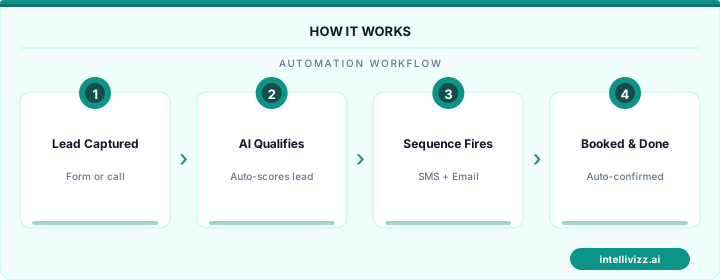
Automated open house follow-up systems close this gap. They capture visitor contact information during the event, trigger personalized communications within minutes of departure, segment buyers by readiness and interest level, and run intelligent drip sequences that keep your name in front of the right people at the right cadence — without requiring you to manually remember who came, what they said, and when to call them.
🏠 Speed wins in real estate — automate your lead response
The data speaks for itself
Sign-In Data Capture: The Foundation of Everything
You cannot automate follow-up for visitors whose contact information you do not have. The quality of your sign-in process determines the quality of your follow-up capability. Most agents still use paper sign-in sheets — a method that produces illegible handwriting, incomplete information, and zero integration with any automation system. Paper sign-in sheets must be manually transcribed into a CRM, and in practice, this step rarely happens promptly if it happens at all.
Digital Sign-In Options
Digital sign-in tablets replace paper while adding capabilities that paper cannot match. Platforms like Open Home Pro, Spacio, and BombBomb's open house tools present visitors with a simple form on an iPad or tablet. When a visitor submits their information, it flows directly into your CRM, triggering the follow-up sequence without any manual intervention.
The minimum information to capture is first name, last name, email address, phone number, and timeline ("When are you looking to buy?"). Optional fields can include financing status, price range, and whether they are working with an agent. Keep the form short enough that visitors will actually complete it — four to five fields is the practical maximum before abandonment rates climb.
QR Code Sign-In
QR codes printed on property flyers or a small table sign allow visitors to self-register on their own smartphones. This approach is increasingly popular because visitors are more comfortable entering information on their own device than on a shared tablet. QR code sign-in tools include Curb Hero (which generates a QR code linking to a custom open house registration page) and simple Google Form implementations with QR codes generated by any free QR tool.
The tradeoff with QR codes is that they require visitor initiative. Post-event data from multiple agents suggests that QR code capture rates are 10-20% lower than tablet-based capture, because some visitors simply walk past the QR code without engaging. A hybrid approach — tablet available at the entrance, QR code on the flyer — captures both the visitors who prefer digital self-registration and those who respond better to a direct prompt.
Manual Capture as Fallback
Even with digital systems in place, some visitors will decline to sign in. Train yourself and any team members hosting the event to verbally collect contact information during natural conversation — "I would love to send you the disclosure package and a list of comparable properties in this price range. What is the best email address for you?" This approach captures visitors who avoided the sign-in station and builds a personal connection that supports later follow-up.
The One-Hour Follow-Up: Why Speed Is the Decisive Variable
The single most important variable in open house follow-up conversion is speed. Research across real estate and adjacent industries consistently shows that follow-up within one hour of a prospect interaction produces dramatically higher conversion rates than follow-up the next day — and the day after that, the advantage compounds further.
The reason is psychological. In the hour after an open house, the property is vivid in the visitor's mind. They are comparing it against other properties they have seen. They are processing whether it could work for their family. An email or text from you during that window lands when they are already thinking about the property — when the decision-making process is active rather than dormant.
Manual follow-up within one hour is operationally impossible when you have hosted 30 visitors. You are still at the property, talking to the last few stragglers, packing up your signs, and coordinating with the seller. Automation solves this problem by triggering the initial follow-up the moment a visitor's sign-in form is submitted — not when you get back to your desk.
The Immediate Follow-Up Message
The first message should arrive while the visitor is still thinking about the property, or shortly after they leave. Keep it brief, personal in tone, and specific to the property they visited:
"Hi [First Name], thank you so much for stopping by [Address] today! I would love to hear your thoughts on it. I am attaching the full disclosure package and a list of recent comparable sales in the neighborhood. If this property sparked any interest — or if you are looking for something a bit different — I would be happy to set up some private showings for you this week. What works best for your schedule?"
This message accomplishes four things: it acknowledges the visit by name and property, it provides immediate value (disclosures and comps), it opens a conversation about fit, and it makes a specific ask for next steps. It reads as personal even when automated because the personalization tokens (name, address) make it feel written for the recipient.
Lead Segmentation: Not Every Visitor Is the Same
The most sophisticated open house follow-up systems do not treat every visitor identically. Visitors fall into distinct categories with very different follow-up needs:
Serious Buyers (Ready in 0-90 Days)
These visitors indicated they are actively looking, are pre-approved or working on financing, and have a defined timeline. They deserve the most aggressive follow-up — immediate text, same-day email, and a personal phone call within 24 hours. The sequence for serious buyers should prioritize scheduling a consultation or private showing above all else.
Lookers (Ready in 90+ Days or Timeline Unknown)
These visitors are genuinely interested in real estate but not yet at the decision stage. They may be building conviction, saving for a down payment, or waiting for a life event. They should enter a longer-horizon nurture sequence — monthly market updates, neighborhood appreciation reports, and periodic check-ins — that keeps your name in front of them until their timeline becomes active. Many agents neglect this segment entirely and lose the commission when these buyers finally decide to buy with whoever has been staying in touch.
Neighbors and Curious Visitors
Some open house visitors are neighbors who want to know what their house is worth. These people are potential future sellers, not buyers. Identify them through the sign-in conversation and route them into a seller-focused nurture sequence rather than buyer communications. A "What Is Your Home Worth?" follow-up message will resonate far more with this segment than property recommendations.
Already Working With an Agent
Visitors who disclose they are working with another agent deserve a respectful, brief acknowledgment — a thank-you for visiting and an offer to send the disclosure package if their agent has not already provided it. Do not aggressively pursue these visitors. Do maintain a positive relationship, because buyer's agent relationships change, and a good impression today may turn into a transaction later.
🏠 Speed wins in real estate — automate your lead response
Smart technology, better results
Drip Sequences by Buyer Readiness Level
Once visitors are segmented, automated drip sequences deliver the right messages at the right cadence for each group. The goal is to stay in front of buyers throughout their decision process without being annoying.
| Timeline | Day 1 | Day 3 | Week 2 | Monthly |
|---|---|---|---|---|
| Active (0-90 days) | Thank you + disclosures | Comparable listings | Price change alert | Market update |
| Future (90+ days) | Thank you + neighborhood guide | Financing pre-approval resource | — | Market report + new listings |
| Neighbor (potential seller) | Thank you + sold prices nearby | Home valuation offer | — | Local appreciation data |
Real estate teams that have invested in broader lead nurture automation will find open house follow-up slots naturally into their existing systems. For a complete picture of real estate lead automation strategy, AI for real estate lead follow-up covers the full technology stack and best practice sequences across all inbound lead sources. Related: learn how speed to lead directly impacts your listing and buyer conversion rates.
Property-Specific Follow-Up: Listings Change, So Should Your Messages
A strength of automated follow-up systems over manual approaches is the ability to trigger property-specific communications when listing status changes. If a visitor toured a property and it has not yet sold, these event-triggered messages keep them engaged without requiring the agent to manually monitor every listing:
Price Reduction Notifications
When a listing price drops, every registered visitor should receive an immediate notification. Price reductions often represent the moment a previously interested but price-hesitant buyer moves from considering to offering. "The property you visited at [Address] just had a $25,000 price reduction — now listed at $[New Price]. Would you like to take another look before it gets multiple offers?" is a high-converting message because it creates genuine urgency around a real event.
Comparable Property Alerts
When a similar property comes to market in the same neighborhood or price range, open house visitors who showed interest but did not offer on the original property are prime recipients for a new listing alert. This positions you as a proactive market expert rather than a passive order-taker.
Status Change Updates
When a property goes under contract, a brief notification to open house visitors who expressed strong interest ("The property at [Address] has gone under contract — let me know if you would like help finding similar homes") closes the loop on that specific property while maintaining the relationship for future opportunities.
Conversion Benchmarks: What Systematic Follow-Up Achieves
Agents who implement systematic open house follow-up automation report measurable improvements across the buyer pipeline. While results vary by market, price point, and individual agent skill, the following benchmarks represent outcomes achievable with consistent execution:
- Sign-in capture rate: 60-80% with digital systems (vs. 30-40% with paper)
- Same-day follow-up rate: 100% (automated) vs. 15-20% (manual)
- Consultation booking rate from serious buyer segment: 20-35%
- Overall visitor-to-transaction conversion: 8-18% for agents with systematic follow-up vs. 2-5% without
- Average time to transaction from open house: 45-90 days for active buyers, 9-18 months for future buyers
The ROI calculation is compelling. A single systematic follow-up process applied consistently across every open house — combined with the lead scoring capabilities in modern real estate CRMs — is one of the highest-return automation investments available to residential agents.
For agents looking to systematize their entire real estate marketing operation beyond open houses, real estate lead automation covers the complete inbound and outbound lead management stack. And for building out the database nurture programs that convert future buyers over 12-24 month timelines, real estate listing email automation provides the campaign architecture for staying in front of your sphere systematically.
Building the Habit: Systems Over Heroics
The agents who consistently outperform their markets in transaction volume are not necessarily better negotiators or more knowledgeable about their neighborhoods. They are better at systems. They build processes that remove reliance on memory, motivation, and available time — the three resources that are least reliable under the pressure of an active real estate practice.
Open house follow-up automation is one of the purest expressions of this principle. The event happens. The technology captures the leads, triggers the communications, segments the responses, and runs the nurture sequences. The agent shows up to host the event, reads the responses that come in, and handles the personal conversations that the automation identifies as high-priority. Everything else runs without intervention.
Set up this system once, refine the sequences over the first few months, and it compounds returns across every open house you host for the life of your practice. The agents who build this infrastructure in the next 24 months will own a structural advantage over those who do not for the decade that follows.
Ready to build a lead system that works while you sleep? Explore our real estate automation solutions, or read our guide to Real Estate Drip Campaign Automation: Nurture Leads....
Relevant AI Automations
AI Review Management
All-in-one review management: automated review requests, AI-powered responses, and review repurposing for web & social — 3 engines in 1.
AI Voice Agent — Property Inquiry Handler
AI voice agent answers inbound calls, qualifies buyer/seller intent, captures property preferences, budget, timeline, an
Website Property Search Lead Capture
Captures leads from website property search, IDX integration, or landing page forms