
Win-Back Campaign Automation: The Science of Re-Engaging Lost Customers
Win-Back vs Reactivation: What's the Difference?
While often used interchangeably, win-back and reactivation campaigns target different populations. Reactivation campaigns target dormant clients who gradually stopped engaging. Win-back campaigns target clients who actively left — they cancelled, switched providers, or explicitly chose a competitor. Understanding how much missed calls cost a business highlights why lapsed clients are so valuable to recover. Win-back campaigns work alongside cancelled appointment revenue recovery to fill gaps in your schedule from clients who left or cancelled.
Win-back is harder because there's an active reason for departure. But it's also more valuable: former clients who return after a win-back campaign are 40% more loyal than new acquisitions because they've compared alternatives and chosen to come back.
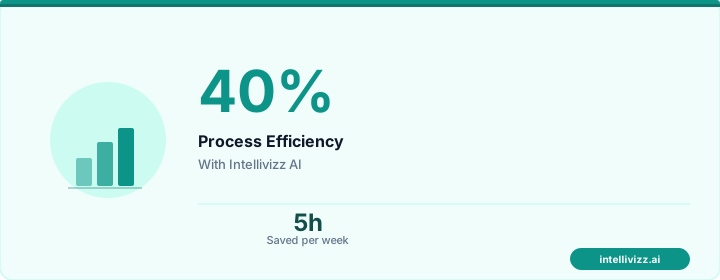
💡 Automation handles the routine — you handle the growth
From manual processes to automated excellence
The Psychology Behind Successful Win-Backs
The Endowment Effect
People overvalue what they've had before. Former clients have an existing mental model of your service — re-engaging that memory is easier than building awareness from scratch. Win-back messages that reference shared history ("When you were with us...") tap into this bias.
Loss Aversion
People feel losses more acutely than equivalent gains. Framing win-back offers around what the former client is missing ("You've missed 3 exclusive member events since you left") is more effective than highlighting what they'd gain by returning.
The Fresh Start Effect
People are motivated to try again after temporal landmarks — new year, new season, new month. Timing win-back campaigns around these moments increases response rates 15-25%.
Automated Win-Back Sequence
Phase 1: Acknowledgment (Month 1 post-departure)
"We're sorry to see you go. Your feedback matters — would you share why you left?" (Short survey: 2-3 questions max)
This accomplishes two things: gathers intelligence about why clients leave, and opens a dialogue that can lead to recovery. 20-30% of surveyed former clients express openness to returning.
Phase 2: Value Demonstration (Month 2-3)
Share improvements, new features, or changes that address common departure reasons. "Since you left, we've added [feature], reduced wait times by [X%], and expanded hours to [new hours]."
No hard sell — just information about why things are different now.
Phase 3: Targeted Offer (Month 4-6)
Based on their departure reason (from the survey), present a specific, relevant offer:
- Left for price: Special returning-client pricing for 3 months
- Left for convenience: Highlight new hours, locations, or digital access
- Left for quality: Share recent reviews, awards, or quality improvements
- Left for competitor: Comparison content showing your advantages
Phase 4: Last Effort (Month 8-12)
Final outreach with the strongest offer and emotional appeal. "We'd love one more chance to show you what [Company] can do. Here's an exclusive offer: [compelling offer with deadline]."
Phase 5: Long-Term Nurture (Ongoing)
Former clients who don't convert enter a quarterly nurture sequence — low-frequency, high-value content that keeps your brand top-of-mind for when circumstances change (insurance, location, needs).
Win-Back Metrics That Matter
| Metric | Industry Average | Top Performers |
|---|---|---|
| Survey response rate | 15-20% | 25-35% |
| Win-back conversion (overall) | 8-12% | 20-30% |
| Revenue per won-back client | 70% of pre-departure LTV | 90%+ of pre-departure LTV |
| Second churn rate (within 12 months) | 30-35% | 15-20% |
| Campaign ROI | 5-8x | 12-20x |
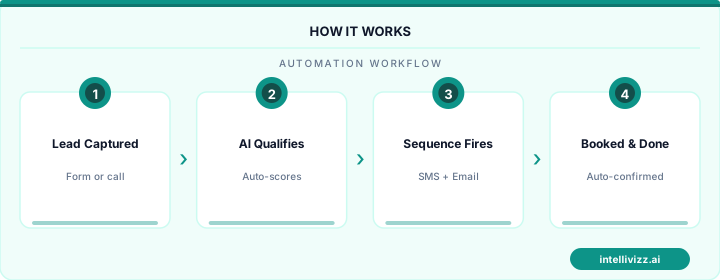
💡 Automation handles the routine — you handle the growth
See how automation transforms industry operations
Common Mistakes
- Ignoring the departure reason: Generic win-back messages to someone who left because of a specific issue just reinforces their decision
- Moving too fast: Sending a win-back offer the day after someone leaves feels desperate. Allow 30-60 days for the departure to settle.
- One-and-done: A single win-back attempt recovers 5-8%. A full automated sequence recovers 20-30%.
- Over-discounting: Deep discounts attract price-sensitive returners who'll leave again. Value-adds and service improvements create more loyal returners.
- No re-onboarding: Won-back clients need a re-engagement experience — don't just slot them back in as if nothing happened. Acknowledge their return and make them feel valued.
Personalizing Win-Back Offers Based on Exit Reason
Generic win-back campaigns — a broad discount sent to all churned customers — consistently underperform segmented campaigns that match the offer to the documented or inferred reason for departure. A customer who left due to price sensitivity requires a different message than one who churned due to product dissatisfaction, service friction, or simple neglect. Automation enables this segmentation at scale by combining exit survey data, cancel-flow input, and behavioral signals (feature usage at churn, support ticket history, purchase recency trend) to categorize each churned account and route it to the appropriate win-back sequence.
Price-sensitive churned customers respond to economics: a meaningful discount (not a token percentage), a flexible payment option, or a feature-bundling offer that reframes value relative to alternatives. Dissatisfied customers require acknowledgment of the issue that drove departure, evidence that the issue has been resolved, and a low-risk trial offer — a free month or a money-back commitment — that reduces the perceived risk of returning. Neglect-churned customers (those who simply became inactive without a triggering event) often respond well to a "we've been thinking about you" message that re-establishes relationship and highlights relevant new features or improvements since their last active period.
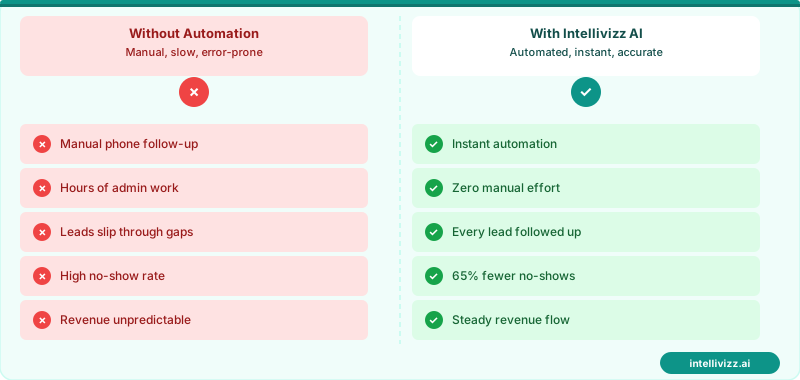
🔄 Match the Message to the Exit Reason
Segmented win-back sequences recover 2–3x more customers than generic blasts
Timing Windows and Sequence Architecture for Maximum Recovery
Win-back campaign effectiveness is highly sensitive to timing. Customer research consistently shows that the probability of successful reactivation follows a decay curve after churn: the first 30 days represent the highest recovery probability, with meaningful receptivity through 90 days, and rapidly declining returns beyond 6 months. Automated win-back sequences that initiate within 7 days of confirmed churn — rather than batching all churned customers into a monthly campaign — capture the full value of the early-window advantage.
The optimal win-back sequence for most subscription or recurring-revenue businesses follows a three-message architecture over the first 60 days, with a final long-tail attempt at 6 months. Message 1 (Day 7): genuine, low-pressure check-in acknowledging the cancellation and expressing a desire to understand the reason — this message functions as both an exit interview and an implicit win-back open. Message 2 (Day 21): direct win-back offer tied to the best available incentive for the identified segment. Message 3 (Day 45): social proof and new feature highlight — third-party validation and product evolution signal that the reasons for original churn may no longer apply. Message 4 (Month 6): a single low-pressure "door is always open" contact that maintains awareness without pestering.
| Win-Back Window | Recovery Rate (Segmented) | Best Message Type | Discount Sensitivity |
|---|---|---|---|
| 0–30 days post-churn | 18–28% | Empathy + offer | High — respond to 20–30% off |
| 31–90 days | 10–16% | New feature + trial | Medium — need value proof |
| 91–180 days | 5–9% | Social proof + upgrade | Lower — require product evidence |
| 180+ days | 2–4% | Long-tail awareness | Low — major barrier to return |
Businesses building comprehensive customer lifecycle automation that spans acquisition through win-back will find the framework in client reactivation campaign automation directly relevant — covering the broader reactivation architecture for service businesses where the customer relationship cadence differs from subscription models.
Measuring Win-Back Campaign Performance and Attribution
Win-back campaign attribution presents specific measurement challenges. A customer who returns after receiving a win-back email sequence may have also been influenced by a product update, a word-of-mouth recommendation, or a competitive situation at their alternative provider. Accurate attribution requires a controlled measurement approach: comparing the reactivation rate of customers who received the win-back sequence against a holdout group who did not, rather than attributing all returning customers to the win-back campaign regardless of actual causation. Most CRM and marketing automation platforms support holdout group testing for win-back campaigns — a feature that is underutilized but critical for accurate ROI assessment.
Beyond attribution, win-back campaign reporting should track the quality of recovered customers, not just the quantity. A win-back campaign that recovers 50 customers at an average lifetime value of $200 has performed differently than one that recovers 30 customers at an average LTV of $600. Segmenting recovered customer cohorts by their subsequent engagement patterns — do win-back returnees churn again faster than never-churned customers? Do they respond differently to upsell offers? — provides the data needed to continuously refine both the win-back offers extended and the segments prioritized for win-back investment. Customers who return from win-back and sustain engagement are among the most valuable in a customer portfolio; understanding what win-back conditions and offers produce this outcome is one of the highest-ROI analytical investments available to subscription and recurring-revenue businesses.
Win-back automation also serves a secondary competitive intelligence function. Customers who do not respond to a structured win-back sequence despite multiple well-designed contacts are signaling that their departure was driven by a factor that the current offer cannot address — typically a deep product or service fit problem, a strongly negative experience that requires a non-automated response, or an alternative relationship that is deeply entrenched. Identifying this non-responsive segment and routing it to a qualitative outreach — a direct, personal call from a senior relationship owner to understand why the customer chose not to return — generates insight that is unavailable from any other source and directly informs product and service improvement priorities. The win-back sequence thus becomes both a recovery mechanism and a continuous voice-of-lost-customer research program, with automation handling the economics-efficient mass recovery and human outreach focused on the strategic insights available from the most resolved non-responders.
Ready to get started with automation? Explore our AI automation solutions, or read our guide to Automated Client Onboarding: How to Create a Seamless....