
AI Automation for Small Business: Where to Start and What to Automate First
AI automation is no longer reserved for enterprises with six-figure technology budgets. In 2026, small businesses with 1-50 employees can automate their most time-consuming tasks for $100-$500/month — often recouping the investment within the first week through time saved and revenue captured.
But the biggest challenge isn't cost — it's knowing where to start. With hundreds of AI tools available, small business owners face analysis paralysis. This guide cuts through the noise: here are the 5 automations that deliver the fastest ROI for small businesses, ranked by impact and ease of implementation.
The 5 Highest-ROI Automations for Small Businesses
1. Missed Call Text-Back (ROI: Immediate)
What it does: When a call goes unanswered, an automatic text is sent to the caller within 60 seconds: "Sorry we missed your call! How can we help? Reply here or we'll call you back shortly."
Why it matters: 62% of calls to small businesses go unanswered, and 85% of callers who reach voicemail never call back. Missed call text-back recovers 30-40% of those lost opportunities by converting them into text conversations.
Setup complexity: Low. Most platforms activate this with a single toggle. No integration required.
Expected result: If your business misses 20 calls/week and 30% are revenue opportunities, recovering even half of those means 3 additional customers per week.
2. Lead Follow-Up Automation (ROI: 1-2 Weeks)
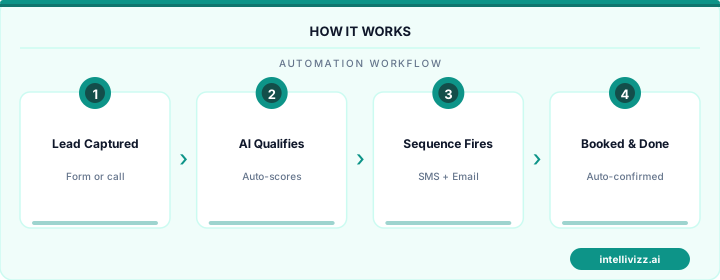
What it does: When a new lead comes in (website form, Facebook ad, Google ad, phone inquiry), an automated sequence fires: instant text acknowledgment, follow-up email at 1 hour, personal check-in at 24 hours, and a nurture sequence over the next 2 weeks.
Why it matters: Speed-to-lead is the #1 predictor of conversion. Businesses that respond within 5 minutes are 100x more likely to convert a lead than those that respond after 30 minutes. Manual follow-up can't compete with automation on speed.
Setup complexity: Medium. Requires connecting your lead sources (website forms, ad platforms) to the automation platform.
Expected result: Lead-to-customer conversion rate typically increases 25-50%.
3. Appointment Reminders (ROI: 1 Week)
What it does: Sends automated reminders at 7 days, 2 days, and 2 hours before every appointment via SMS and email. Includes a confirmation request ("Reply Y to confirm or R to reschedule").
Why it matters: No-shows cost businesses $150-$400 per missed appointment. Multi-channel reminders with confirmation requests reduce no-shows by 30-50%.
Setup complexity: Medium. Requires calendar integration (Google Calendar, scheduling software, or practice management system).
Expected result: If you see 30 appointments/week with a 15% no-show rate, reducing to 8% saves approximately 2 appointments per week — worth $300-$800/week in recovered revenue.
4. Review Generation (ROI: 2-4 Weeks)
What it does: After every completed transaction or appointment, sends an automated review request via text with a direct link to your Google Business Profile. A follow-up email fires 24 hours later for non-respondents.
Why it matters: Google reviews directly impact local search ranking and customer trust. Businesses that automate review requests collect 3-5x more reviews than those that don't. See our comprehensive guide on how to get more Google reviews.
Setup complexity: Low-Medium. Triggered by appointment completion or transaction close.
Expected result: 15-30 new reviews per month, leading to improved local search visibility within 3-6 months.
5. AI Receptionist / Phone Answering (ROI: 1 Week)
What it does: An AI-powered system answers every phone call 24/7. It can schedule appointments, answer FAQs, qualify leads, and route calls — all without human involvement.
Why it matters: It eliminates the missed call problem entirely while costing 90% less than a human receptionist. For a detailed comparison, see our article on virtual receptionist vs AI receptionist.
Setup complexity: Medium-High. Requires configuring call flows, FAQ answers, and calendar integration.
Expected result: 100% call answer rate, increased new customer acquisition from previously missed calls, and significant staff time savings.
Calculating Your Automation ROI
Before investing in AI automation, small business owners need a clear framework for measuring return. Vague promises of "efficiency" do not justify budget allocation. Here is how to build a concrete, numbers-driven business case for automation investment.
Time-Savings Quantification Frameworks
Start by auditing how your team currently spends time. Track every repetitive task for two weeks — responding to inquiries, scheduling appointments, sending follow-ups, entering data — and log the minutes per occurrence and frequency per week. Multiply to get monthly hours consumed. If a receptionist spends 12 minutes per appointment confirmation and handles 40 per day, that is 8 hours weekly on a single task. Automation that handles 90 percent of those confirmations recovers 7.2 hours per week, or roughly 375 hours per year. At a loaded labor cost of 25 dollars per hour, that single automation delivers over 9,000 dollars in annual value.
Customer Satisfaction Impact Metrics
Automation ROI extends beyond labor savings. Measure response time before and after implementation — businesses that respond to inquiries within five minutes are 21 times more likely to convert than those responding after 30 minutes. Track customer satisfaction scores, online review ratings, and repeat purchase rates as leading indicators of automation's impact on experience quality. These metrics often reveal that automation's revenue-generation value exceeds its cost-reduction value by a factor of three to five.
Exploring business workflow automation with AI helps you identify which processes deliver the highest return when automated, so you can prioritize your implementation roadmap accordingly.
Phased Implementation Budgeting
Resist the temptation to automate everything simultaneously. Phase your rollout by starting with the highest-ROI, lowest-complexity processes — typically review requests, appointment reminders, and lead follow-up. Allocate 60 percent of your automation budget to phase one, then reinvest documented savings into subsequent phases. This approach generates quick wins that build organizational confidence and creates a self-funding cycle where each phase's savings finance the next deployment.
For more on getting started, explore our guide on AI CRM automation or learn about workflow automation strategies for growing businesses.
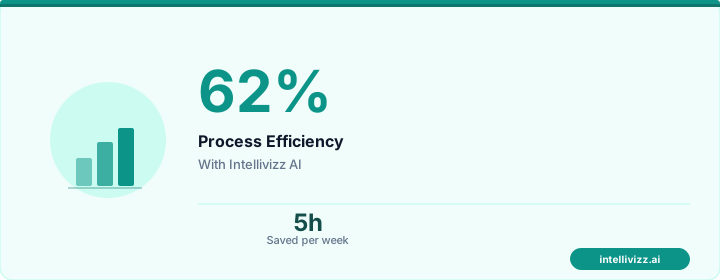
💡 Automation handles the routine — you handle the growth
From manual processes to automated excellence
The Implementation Roadmap
Don't try to automate everything at once. Follow this sequence:
Week 1: Implement missed call text-back (immediate ROI, zero complexity)
Week 2-3: Set up appointment reminders and review generation (moderate complexity, fast payback)
Week 3-4: Configure lead follow-up automation (requires connecting lead sources)
Month 2: Evaluate AI receptionist based on your call volume and missed call data
Choosing a Platform
Small businesses have two main platform options:
Point solutions: Separate tools for each automation (one for reviews, one for reminders, one for texting). Lower initial complexity but higher total cost and data silos between systems.
All-in-one platforms: A single platform (like Intellivizz) that handles all 5 automations from one dashboard. Higher initial setup effort but lower total cost, unified customer data, and simpler ongoing management.
For businesses implementing 2+ automations, the all-in-one approach almost always wins on total cost of ownership and operational simplicity.
What to Expect: Realistic Timelines
- Week 1: Missed call text-back starts recovering lost calls
- Month 1: Appointment no-shows decrease measurably
- Month 2: Lead follow-up automation improves conversion rates
- Month 3: Google reviews accumulate, local search rankings begin improving
- Month 6: Compound effect — more reviews + better response times + fewer missed calls = measurably more customers
AI automation for small business isn't about replacing your team. It's about amplifying them — handling the repetitive, time-sensitive tasks that fall through the cracks when humans get busy. Start with one automation, prove the ROI, then expand. The businesses that automate first build advantages that compound every month.
💡 Automation handles the routine — you handle the growth
See how automation transforms industry operations
Ready to get started with automation? Explore our AI automation solutions, or read our guide to AI Automation for Small Business: Where to Start (A....