
Virtual Receptionist vs AI Receptionist: Which Is Right for Your Business in 2026?
The "virtual receptionist" label now covers two fundamentally different services: traditional human-staffed virtual receptionist companies and AI-powered receptionist systems. Both answer your phones, take messages, and handle basic inquiries. But they differ dramatically in cost, availability, consistency, and scalability.
If you're evaluating phone answering solutions for your business, this comparison cuts through the marketing jargon and lays out exactly what each option delivers — and where each falls short.
What Is a Virtual Receptionist (Human)?
A traditional virtual receptionist is a real person employed by an answering service company who answers calls on behalf of your business. They typically work from a call center, follow scripts you provide, and can handle tasks like appointment scheduling, message taking, call transfers, and basic FAQ answering.
Popular providers include Ruby, Smith.ai, AnswerConnect, and PATLive. Pricing is typically per-minute ($1-2/minute) or per-call ($1-5/call), with monthly minimums ranging from $150-500.
💡 Automation handles the routine — you handle the growth
The data speaks for itself
What Is an AI Receptionist?
An AI receptionist is software that uses natural language processing and conversational AI to handle phone calls without human involvement. Modern AI receptionists can understand natural speech, respond conversationally, answer FAQs, book appointments by integrating with your calendar, qualify leads, transfer calls to the right person, and send follow-up texts or emails after the call.
Platforms like Intellivizz offer AI receptionists as part of broader business automation suites. Pricing is typically flat-rate monthly ($100-300/month) with unlimited calls.
Head-to-Head Comparison
Cost
Virtual (Human): $150-500/month base + per-minute overage. A business receiving 200 calls/month at 3 minutes average could pay $600-1,200/month. Cost scales linearly with call volume.
AI Receptionist: $100-300/month flat rate, regardless of call volume. A business receiving 200 or 2,000 calls pays the same. Cost is essentially fixed.
Winner: AI Receptionist. The cost advantage grows dramatically as call volume increases. At 500+ calls/month, AI costs 5-10x less than human virtual receptionists.
Availability
Virtual (Human): Most services offer 24/7 coverage, but quality drops during overnight and weekend shifts. Night staff are often handling multiple clients simultaneously, leading to longer hold times and less attentive service.
AI Receptionist: Truly 24/7/365 with zero degradation. Every call at 3 AM gets the same quality as a call at 10 AM. No holidays, no sick days, no shift changes.
Winner: AI Receptionist. Consistent quality at any hour is a significant advantage, especially for businesses receiving after-hours calls. See our guide on after-hours AI receptionist solutions for more.
Call Handling Quality
Virtual (Human): Humans excel at handling emotional callers, complex multi-part requests, and situations requiring empathy or judgment. They can improvise when a call goes off-script. However, quality varies by operator, and mistakes happen — wrong transfers, missed details, inconsistent script adherence.
AI Receptionist: AI follows scripts perfectly every time — no bad days, no forgotten steps. It excels at structured tasks: booking appointments, answering FAQs, qualifying leads with consistent criteria. However, it can struggle with heavy accents, background noise, complex multi-topic calls, and emotionally charged situations.
Winner: It depends. For structured, high-volume call handling → AI wins. For complex, emotionally nuanced calls → human wins.
Scalability
Virtual (Human): Scaling requires the answering service to hire and train more operators. During peak periods (seasonal rushes, marketing campaigns), you may hit capacity limits, longer hold times, or reduced quality.
AI Receptionist: Handles unlimited concurrent calls with no degradation. Whether you receive 5 calls at once or 50, every caller gets immediate attention. No hold times, no capacity planning.
Winner: AI Receptionist. The ability to handle unlimited concurrent calls is a game-changer for businesses with variable or high call volumes.
Integration and Automation
Virtual (Human): Limited integration capabilities. Most services can update a CRM via manual data entry or basic API calls, but they can't trigger complex automation workflows, send personalized follow-up sequences, or update multiple systems simultaneously.
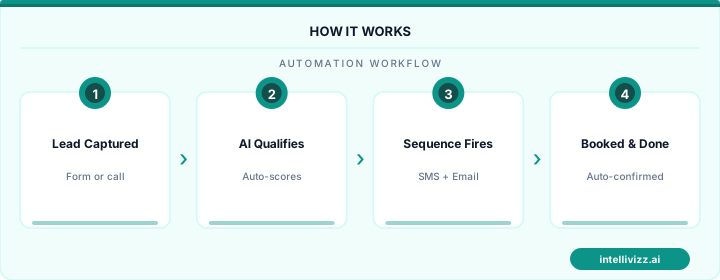
AI Receptionist: Natively integrates with CRMs, calendars, automation platforms, and communication tools. After a call, it can automatically: book an appointment, send a confirmation text, update the CRM, trigger a follow-up email sequence, and notify the appropriate team member — all within seconds.
Winner: AI Receptionist. The post-call automation capabilities alone justify the switch for many businesses.
Personalization
Virtual (Human): Can access caller history and notes to personalize conversations. Skilled operators build rapport and make callers feel valued. However, this depends on the individual operator's skill and attention.
AI Receptionist: Can greet returning callers by name, reference past appointments, and tailor the conversation based on CRM data. Personalization is consistent and data-driven, but may feel less "warm" than a skilled human operator.
Winner: Tie. Different types of personalization, both effective.
When to Choose a Human Virtual Receptionist
- Your calls frequently involve emotional or sensitive topics (crisis counseling, legal intake for sensitive cases)
- Your call volume is low (under 50/month) and doesn't justify the setup effort for AI
- Your callers skew older and strongly prefer human interaction
- You need bilingual support in languages not yet well-supported by AI
💡 Automation handles the routine — you handle the growth
Smart technology, better results
When to Choose an AI Receptionist
- You receive 100+ calls/month and cost-efficiency matters
- You need true 24/7 coverage without quality degradation
- Most calls follow predictable patterns (scheduling, FAQs, lead qualification)
- You want calls to trigger automated workflows (follow-ups, CRM updates)
- You experience peak periods where multiple calls come in simultaneously
- You're already using automation for other business processes and want unified workflows
The Hybrid Approach
Some businesses use both: AI handles the majority of calls (scheduling, FAQs, after-hours), while complex or VIP calls are routed to a human virtual receptionist. This hybrid model captures the cost efficiency and scalability of AI while preserving human touch for situations that warrant it.
The bottom line: for most small and mid-size businesses in 2026, an AI receptionist delivers better value — lower cost, higher consistency, 24/7 availability, and integrated automation. Human virtual receptionists still have a role for high-touch, complex scenarios, but they're increasingly the exception rather than the default.
Related Reading
- What Is an AI Receptionist?
- AI Answering Service for Small Business
- How Much Missed Calls Cost a Business
- After-Hours Answering Service Comparison
Ready to get started with automation? Explore our AI automation solutions, Voice AI Agents: The Complete Guide to Automating..., or The Real Cost of Missed Business Calls (And How to Fix....