
What Is an AI Receptionist for Medical Offices? Everything You Need to Know
If you've been researching ways to improve your medical office's phone handling, you've likely encountered the term "AI receptionist." But what exactly is it, how does it differ from a traditional answering service, and is it the right fit for your practice?
An AI receptionist is a software system powered by artificial intelligence that answers phone calls, interacts with callers using natural language, and performs tasks that a human receptionist would typically handle — scheduling appointments, answering common questions, routing calls, and capturing patient information. Unlike a basic phone tree or IVR system, modern AI receptionists use conversational AI to have natural, flowing dialogues that feel remarkably human.
How AI Receptionists Work
At a technical level, an AI receptionist uses three core technologies working in concert:
- Speech Recognition (ASR): Converts the caller's spoken words into text in real-time. Modern ASR engines achieve 95%+ accuracy even with accents, medical terminology, and background noise.
- Natural Language Understanding (NLU): Interprets the meaning behind the caller's words. When someone says "I need to see the doctor about my knee," the system understands this is an appointment request for an orthopedic concern.
- Natural Language Generation + Text-to-Speech: Formulates an appropriate response and speaks it back in a natural-sounding voice. The best systems are nearly indistinguishable from human agents.
These technologies are orchestrated by a conversation engine that manages the flow of the call — asking follow-up questions, handling interruptions, and escalating to a human when the situation requires it.
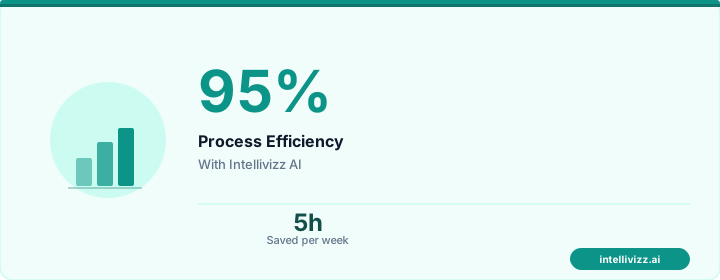
🏥 Patients expect instant responses — automation delivers
From manual processes to automated excellence
What an AI Receptionist Can Handle
For medical offices, AI receptionists typically manage these core functions:
- Appointment scheduling and rescheduling: Checks availability in your practice management system and books directly — no double-booking, no hold times.
- Common question answering: Office hours, directions, accepted insurance plans, provider information, pre-appointment instructions.
- Call routing: When a caller needs to speak to a nurse, billing department, or specific provider, the AI routes them appropriately.
- New patient intake: Collects basic demographic and insurance information from new callers and creates a preliminary record.
- Appointment reminders and confirmations: Outbound calls or texts to confirm upcoming appointments and reduce no-shows.
- Prescription refill requests: Captures the medication name, pharmacy, and patient information and routes the request to the clinical team.
- After-hours triage: Determines urgency and either provides instructions, schedules a callback, or directs the patient to urgent care or 911.
AI Receptionist vs. Traditional Answering Service
The differences between an AI receptionist and a traditional virtual receptionist or answering service are significant:
| Feature | AI Receptionist | Traditional Answering Service |
|---|---|---|
| Availability | 24/7/365, no hold times | Depends on staffing; hold times during peak |
| Cost | $200-$600/month flat rate | $800-$2,500/month (per-minute billing) |
| Scheduling | Direct EHR/PMS integration | Message-taking only; staff callbacks needed |
| Consistency | Same quality every call | Varies by operator |
| Scalability | Handles unlimited concurrent calls | Limited by operator availability |
| HIPAA | Built-in compliance protocols | Depends on service; BAA required |
HIPAA Compliance and Security
Any system handling patient information in a medical office must comply with HIPAA regulations. A properly configured HIPAA-compliant AI receptionist includes:
- End-to-end encryption for all voice and data transmissions
- Business Associate Agreement (BAA) between your practice and the AI vendor
- Access controls that limit what information the AI can retrieve and share
- Audit trails logging every interaction for compliance review
- Patient identity verification before sharing any PHI
- Data residency in HIPAA-compliant data centers (SOC 2 Type II certified)
When evaluating vendors, always confirm they provide a signed BAA and can demonstrate their compliance infrastructure. A healthcare-focused AI receptionist provider will have these safeguards built in from the ground up.
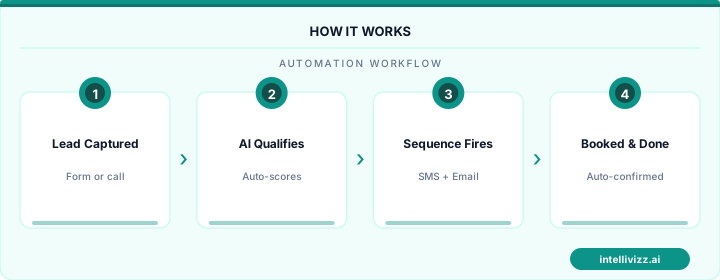
🏥 Patients expect instant responses — automation delivers
See how automation transforms industry operations
Integration With Practice Management Systems
The true value of an AI receptionist comes from deep integration with your existing systems. Key integrations include:
- EHR/PMS: Epic, athenahealth, eClinicalWorks, DrChrono, Kareo — for real-time scheduling, patient lookup, and record creation
- Phone systems: Works with your existing phone number via call forwarding or SIP integration
- Patient portals: Can direct patients to your portal for forms, results, and messaging
- Billing systems: Routes billing inquiries and captures payment information securely
Cost and ROI Analysis
For a typical medical practice, the economics of an AI receptionist are compelling:
- Average cost of a missed call: $200-$500 in potential revenue (considering new patient lifetime value)
- Average calls missed per day (busy practice): 15-25 calls
- Monthly revenue at risk from missed calls: $60,000-$250,000
- AI receptionist cost: $200-$600/month
- Typical ROI: 10-50x within the first month
The calculation becomes even more favorable when you factor in reduced staff overtime, lower turnover from decreased phone burden, and improved patient satisfaction scores. Read our detailed analysis of how much missed calls cost medical practices for a deeper dive into these numbers.
Is an AI Receptionist Right for Your Practice?
An AI receptionist is particularly valuable if your practice experiences any of these challenges: high call volume (100+ calls/day), frequent missed calls during lunch or peak hours, staff burnout from constant phone interruptions (learn how an AI front desk for medical offices addresses this), after-hours call management gaps, long hold times frustrating patients, or difficulty hiring and retaining front desk staff.
If you're ready to explore whether an AI receptionist fits your practice, book a free consultation to see a live demo tailored to your specialty and workflow.
Evaluating AI Receptionist Vendors
Choosing the right AI receptionist platform requires more than comparing price tags. A thorough vendor evaluation protects your practice from compliance risks, integration headaches, and hidden costs that surface months after deployment. Here is a structured approach to making the right selection.
Must-Have HIPAA Certifications
Any vendor handling patient communications must execute a Business Associate Agreement and demonstrate SOC 2 Type II compliance at minimum. Request documentation of encryption standards for data at rest and in transit — AES-256 and TLS 1.3 should be non-negotiable baselines. Verify that the vendor conducts annual penetration testing and maintains an incident response plan with defined breach notification timelines. Ask for their most recent audit report and confirm it covers the specific services your practice will use, not just their broader infrastructure.
Integration Compatibility Checklist
Before signing any contract, map every system the AI receptionist must connect with: your EHR, practice management software, payment processor, and patient portal. Confirm whether integrations are native, API-based, or require middleware — each carries different maintenance burdens. Test the scheduling integration specifically, because mismatched appointment types or provider availability rules cause the most post-deployment friction. Practices that skip integration testing during evaluation spend an average of 40 additional hours troubleshooting in the first quarter.
Understanding how a virtual medical receptionist handles complex scheduling logic helps you ask the right questions during vendor demos and proof-of-concept trials.
Total Cost of Ownership Calculation
Look beyond the monthly subscription fee. Calculate implementation costs including data migration, staff training hours, and workflow redesign time. Factor in per-call or per-minute charges that scale with volume — a practice handling 200 calls per day faces vastly different economics than one handling 40. Model the cost over three years, including anticipated price increases, and compare it against the fully loaded cost of the human equivalent: salary, benefits, turnover, training, and coverage gaps during PTO.
For a deeper comparison of solutions, explore our guide on after-hours answering services for medical offices or learn about virtual receptionist capabilities.
Ready to modernize your practice? Explore our healthcare automation solutions.