
AI Receptionist for Medical Offices: Cut Missed Calls by 90% and Recover Lost Revenue
An AI receptionist for medical offices is a voice-enabled artificial intelligence system that answers patient phone calls, understands their requests through natural conversation, and takes action — scheduling appointments, providing information, routing urgent calls, and sending confirmations — all without human intervention. It operates 24/7, handles unlimited simultaneous calls, and eliminates the hold times that drive patients to competing practices.
For medical offices, the stakes are uniquely high. Every missed call is a potential new patient worth $1,500-$3,000 in annual revenue, and research shows that 75% of callers who reach voicemail will not leave a message — they'll simply call the next practice on Google. An AI receptionist ensures that never happens.
The Medical Office Phone Problem
Medical offices face a phone crisis that's gotten worse every year. Call volumes are up — driven by an aging population, complex insurance questions, and patient expectations for immediate access — while front desk staffing is harder than ever. The result is a toxic cycle: understaffed front desks → long hold times → frustrated patients → negative reviews → fewer new patients → less revenue to hire more staff.
The numbers tell the story:
- 30-40% of calls are missed at the average medical practice during business hours
- 50%+ miss rate during peak hours (Monday mornings, lunch breaks, late afternoons)
- 25-35% of calls come after hours when no one is available to answer
- $150-$300 average revenue per call for new patient inquiries
- 4.2 minutes average hold time at practices without an AI system
An AI receptionist solves every one of these problems on day one.
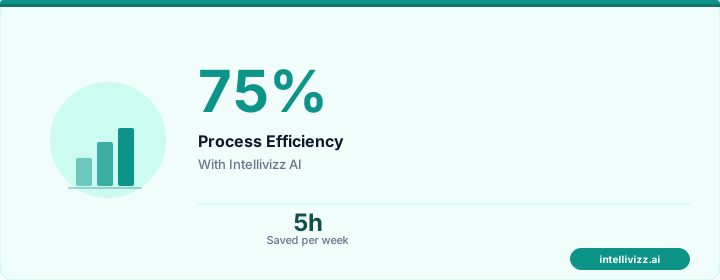
🏥 Patients expect instant responses — automation delivers
From manual processes to automated excellence
What an AI Receptionist Does for Medical Offices
Appointment Scheduling and Management
The AI connects to your practice management system and sees real-time provider availability. When a patient calls to schedule, the AI offers available slots, confirms the appointment, and sends a text or email confirmation — in under 90 seconds. It handles rescheduling and cancellation with the same efficiency, automatically opening slots for waitlisted patients when cancellations occur.
New Patient Intake
For new patient calls, the AI collects essential information — name, date of birth, insurance provider, reason for visit, and preferred appointment times — and creates a preliminary record. This saves 5-10 minutes of phone time per new patient and ensures no information is missed.
Insurance and Billing Inquiries
The AI handles common insurance questions: "Do you accept Blue Cross?" "What's the copay for a new patient visit?" "Can you verify my coverage?" For questions beyond its scope, it routes to the billing department with a detailed summary of the patient's query.
Prescription Refill Requests
The AI captures refill requests — medication name, pharmacy, patient name, date of birth — and routes them to the appropriate provider or pharmacy team. This eliminates a significant chunk of routine call volume that consumes staff time.
Emergency Triage and Routing
When the AI detects emergency keywords — chest pain, difficulty breathing, severe bleeding, loss of consciousness — it immediately routes the call to the on-call provider or instructs the caller to dial 911. Non-emergency but urgent calls (fever in a child, possible fracture, allergic reaction) are escalated according to your practice's triage protocols.
After-Hours Coverage
Between 6 PM and 8 AM, the AI handles the same call types as during business hours. It schedules appointments for the next available slot, provides pre-visit instructions, and routes genuine emergencies. Patients get answers instead of voicemail, and your team starts each morning with a clean list of overnight requests rather than a full voicemail box.
Real-World Impact: What Medical Offices See After Implementation
Based on aggregated data from medical practices using AI receptionist technology:
- Missed calls reduced by 90-95%: The AI answers every call instantly, eliminating hold-time abandonment.
- New patient conversion increased by 35-60%: Callers who previously went to voicemail (and then to a competitor) now book appointments on the first call.
- Front desk workload reduced by 40-50%: Staff handle only the calls that genuinely require human judgment — everything else is resolved by the AI.
- Patient satisfaction scores improved: Zero hold time and 24/7 availability consistently improve patient satisfaction metrics.
- Revenue recovery of $5,000-$15,000/month: From captured calls that would have been lost, plus reduced no-shows from automated reminders.
HIPAA Compliance Essentials
An AI receptionist for a medical office must be HIPAA compliant — full stop. This means:
- Signed Business Associate Agreement (BAA) between your practice and the AI vendor
- End-to-end encryption for all voice data, transcripts, and patient information
- Role-based access controls limiting who can view patient interaction data
- Audit logging of all data access and system interactions
- Data retention policies aligned with your state's medical records requirements
- Secure hosting on HIPAA-compliant cloud infrastructure
Intellivizz provides a signed BAA with every healthcare implementation, and all patient data is encrypted using AES-256 standards. For detailed compliance requirements, see our resource on HIPAA-compliant AI receptionists.
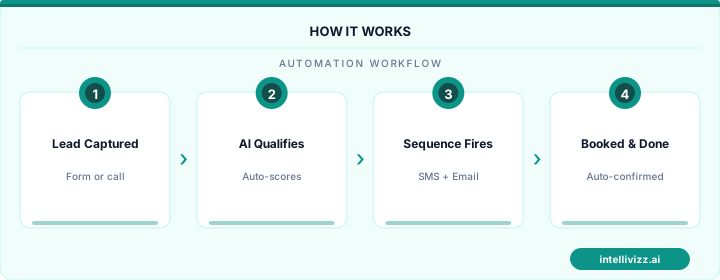
🏥 Patients expect instant responses — automation delivers
See how automation transforms industry operations
How to Choose an AI Receptionist for Your Medical Office
Must-Have Features
- HIPAA compliance with signed BAA
- Real-time scheduling integration with your PMS/EHR
- Emergency call detection and routing
- After-hours operation identical to business hours
- SMS appointment confirmations
- Call summary logs for staff review
Nice-to-Have Features
- Multilingual support (especially Spanish)
- Patient satisfaction surveys post-call
- Automated review requests after appointments
- Waitlist management for cancellation backfill
- Integration with automated appointment reminders to reduce no-shows
Red Flags to Watch For
- No BAA available or unwillingness to sign one
- Per-call pricing without volume caps (costs spiral with scale)
- Required long-term contracts before a trial period
- No fallback to human staff for complex calls
- Vague answers about data encryption and storage practices
Frequently Asked Questions
Does an AI receptionist replace our front desk staff?
No — it supplements them. The AI handles the phone (which consumes 40-60% of front desk time), freeing your staff to focus on in-person patient interactions, check-ins, and administrative tasks. Most practices don't reduce headcount; they reduce stress and improve the quality of face-to-face patient care.
How quickly can we be up and running?
Cloud-based AI receptionists like Intellivizz can be configured and live in under 15 minutes. You set up your practice profile, office hours, services, and routing rules through a guided setup wizard. More complex integrations with specific PMS/EHR systems may take 1-3 days for initial configuration.
What if a patient insists on speaking to a human?
The AI always provides a transfer option. If a patient says "I need to speak to a person," the call is immediately routed to your front desk or on-call staff. The goal is to handle routine calls automatically, not to trap callers in an AI loop.
Can the AI handle specialty-specific workflows?
Yes. Modern AI receptionists can be customized for different medical specialties — pediatrics, dermatology, orthopedics, mental health, primary care — with specialty-specific call scripts, scheduling rules, and triage protocols. A detailed implementation guide is available for each specialty.
What's the typical ROI timeline?
Most medical offices see positive ROI within the first month, driven by recovered missed calls (new patient revenue) and reduced no-shows. By month 3, the compounding effect of better online reviews (from post-visit automation) further accelerates patient acquisition.
Stop Losing Patients to Your Voicemail
Every call your medical office misses is a patient you'll never know about — someone who needed care, searched for a provider, called your number, and got silence instead of service. An AI receptionist ensures that every one of those patients gets an immediate, helpful response, 24 hours a day.
See exactly how it would work for your practice. Book a free 15-minute demo and we'll walk through your specific call volume, specialty workflows, and projected revenue recovery.
Ready to modernize your practice? Explore our healthcare automation solutions, What Is an AI Receptionist for Medical Offices?..., or How to Automate Medical Office Phone Calls Without....
Relevant AI Automations
AI Review Management (HIPAA-Compliant)
All-in-one HIPAA-compliant review management: automated review requests, AI-powered responses, and review repurposing for web & social.
HIPAA-Compliant AI Voice Agent — 24/7 Patient Call Handling
HIPAA-compliant AI voice agent answers every patient call 24/7 — triages urgency, books appointments, and sends encrypted follow-ups
Website Live Chat → Patient Booking Funnel
AI-powered live chat on the practice website engages visitors, answers questions about services/insurance, collects cont