
How to Reduce No-Shows in Your Medical Practice: Proven Strategies and AI Solutions
You've seen the data — no-show reduction strategies work. But knowing what to do and knowing how to implement it are different challenges entirely. This guide gives you a practical, week-by-week rollout plan to cut your no-show rate in half within 90 days.
Week 1-2: Foundation — Data and Baseline
Step 1: Establish Your Baseline
Pull 90 days of scheduling data and calculate your current no-show rate broken down by: overall practice rate, by provider, by day of week and time slot, by appointment type (new vs. follow-up vs. procedure), by insurance type, and by lead time (days between booking and appointment). This segmented data tells you exactly where to focus first.
Step 2: Audit Your Current Communication
Map every touchpoint in your current patient communication: How are appointments confirmed at booking? What reminders are sent, via what channel, at what timing? What happens when a patient doesn't confirm? What happens after a no-show? Most practices discover they have 1-2 reminder touchpoints when they need 4-5, and zero post-no-show recovery outreach.
Step 3: Choose Your Technology
Select an automated patient communication platform that integrates with your practice management system. Key requirements: two-way SMS capability, automated reminder scheduling with customizable timing, self-service rescheduling links, waitlist management, and reporting dashboards.
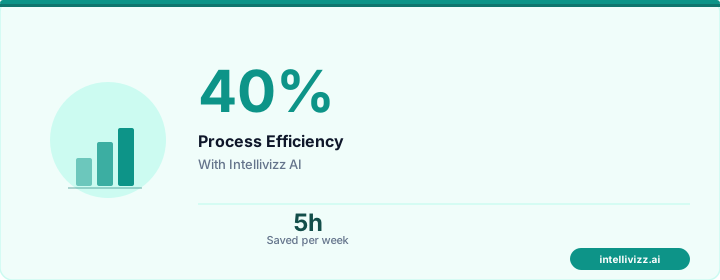
📱 Reduce no-shows by 30-40% with smart reminders
From manual processes to automated excellence
Week 3-4: Layer 1 — Automated Reminders
Step 4: Configure Your Reminder Sequence
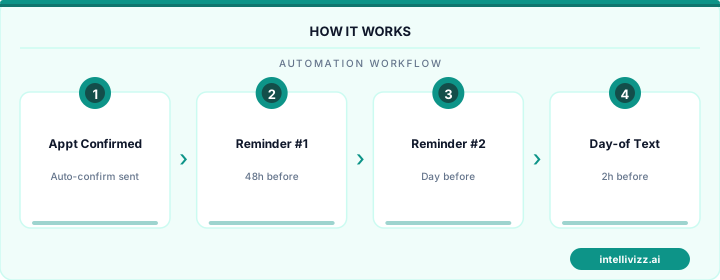
Set up a 4-touchpoint reminder sequence:
- Booking confirmation (immediate): "Your appointment with [Provider] is confirmed for [Date] at [Time]. Add to calendar: [link]. Need to change? Reply RESCHEDULE or call [phone]."
- 7-day reminder (for appointments booked 2+ weeks out): "Reminder: You have an appointment with [Provider] in one week on [Date] at [Time]. Reply C to confirm or R to reschedule."
- 48-hour reminder: "Your appointment with [Provider] is in 2 days — [Day, Date] at [Time]. Please remember to [prep instructions]. Reply C to confirm."
- Morning-of reminder: "See you today at [Time] with [Provider]! Address: [address]. Please arrive 10 minutes early. Tap for directions: [maps link]."
Step 5: Enable Two-Way Communication
Ensure patients can reply to any reminder to confirm, reschedule, or ask questions. Staff (or an AI receptionist system) should monitor and respond to incoming texts within 5 minutes during business hours.
Week 5-6: Layer 2 — Rescheduling and Recovery
Step 6: Self-Service Rescheduling
Include a direct rescheduling link in every reminder. The link should open a mobile-friendly scheduling page showing available slots for the next 2 weeks — no login required, no phone call needed. This one change converts 30-40% of potential no-shows into rescheduled visits.
Step 7: Post-No-Show Recovery Sequence
Configure an automated outreach for patients who miss appointments:
- 15 minutes post-appointment: "We missed you at your appointment today. We hope everything is okay! Would you like to reschedule? Reply YES or tap here: [link]"
- 24 hours later: "Following up from yesterday — we'd love to get you rescheduled with [Provider]. Here are this week's available times: [3 options]"
- 7 days later: "It's been a week since your missed appointment. Your [care type] is important — let's find a time that works. Schedule here: [link]"
Week 7-8: Layer 3 — Waitlist and Backfilling
Step 8: Build Your Waitlist
Train front desk staff to ask every patient: "Would you like us to notify you if an earlier appointment opens up?" Capture waitlist preferences: preferred days, time windows, and appointment types. An automated cancellation backfill system should notify waitlisted patients within minutes of a cancellation.
Step 9: New Patient Engagement
New patients are your highest no-show risk. Implement a new patient welcome sequence: automated welcome message within 1 hour of booking (what to expect, what to bring, parking info), a personal phone call within 24 hours from the office, and a separate reminder sequence with additional touchpoints compared to established patients. See how an AI receptionist for medical offices handles scheduling and reminders automatically.
📱 Reduce no-shows by 30-40% with smart reminders
See how automation transforms industry operations
Week 9-12: Layer 4 — Advanced Strategies
Step 10: No-Show Policy Implementation
If your data supports it, implement a no-show fee policy. Key elements: clear written policy given at first visit and included in patient paperwork, reminder in every appointment confirmation, grace period (typically first no-show is a warning), fee amount ($25-$50 is standard), and compassionate exceptions for emergencies and illness.
Step 11: Schedule Optimization
Use your no-show data to optimize your template: reduce lead time by offering more same-day and next-day slots, avoid scheduling high-risk patients in premium time slots (Monday morning, Friday afternoon), batch similar appointment types to minimize disruption from individual no-shows, and build buffer slots specifically designed for overbooking high-risk periods.
Ongoing: Measurement and Iteration
Step 12: Weekly Tracking
Review these metrics weekly: no-show rate (overall and segmented), reminder confirmation rate, self-service rescheduling utilization, waitlist backfill rate, post-no-show recovery rate, and revenue impact (recovered revenue from reduced no-shows).
Share the dashboard with your team. When staff see the direct connection between their communication efforts and practice revenue, engagement with the process increases dramatically.
Expected Results Timeline
- Weeks 1-4: 15-20% reduction in no-shows (from automated reminders alone)
- Weeks 5-8: Additional 10-15% reduction (from rescheduling + recovery)
- Weeks 9-12: Additional 5-10% reduction (from advanced strategies)
- Total 90-day improvement: 30-45% reduction in no-show rate
A practice starting at 20% no-shows should reach 11-14% by week 12. Top-performing practices using all strategies consistently achieve 7-10% no-show rates — less than half the industry average.
Ready to implement? Book a free consultation to get a customized no-show reduction plan based on your practice's data.
Building a No-Show Prevention Culture
Technology alone does not eliminate no-shows. Lasting reduction requires a cultural shift where every team member understands the financial impact of empty slots and actively participates in prevention. Here is how to embed no-show prevention into your practice's daily operations.
Front-Desk Staff Training Protocols
Train front-desk staff to confirm appointments using language that reinforces commitment rather than offering an easy exit. Instead of asking "Do you still want to come in Tuesday?" — which invites cancellation — use "We have you confirmed for Tuesday at 2 PM; is there anything you need to prepare?" Teach staff to identify high-risk appointments during scheduling by checking the patient's attendance history and flagging accounts with two or more prior no-shows for enhanced follow-up. Role-play these conversations quarterly so the phrasing becomes second nature rather than scripted and awkward.
Patient Communication Preference Surveys
Patients ignore reminders sent through channels they do not use. During intake, ask each patient their preferred communication method — text, email, phone call, or patient portal message — and their preferred reminder timing. Some patients want a reminder one week out; others only pay attention to same-day alerts. Capturing these preferences takes 30 seconds during registration and can increase reminder engagement rates by 45 percent. Update preferences annually, since patients' habits shift as they adopt new devices and communication platforms.
Automating reminders across preferred channels is central to an effective AI-driven no-show reduction strategy that adapts to each patient's behavior patterns. Make sure your AI is compliant — read about HIPAA compliance for AI voice agents.
Transportation Barrier Solutions
Up to 10 percent of no-shows stem from transportation difficulties, particularly among elderly patients, those in rural areas, and patients without reliable personal vehicles. Partner with ride-share services to offer discounted or subsidized rides for appointments above a certain revenue threshold. Include transportation resources in appointment reminders — a simple "Need a ride? Reply RIDE for options" can recover appointments that would otherwise become empty chairs. Track transportation-related no-shows as a separate category so you can measure the impact of these interventions.
For more strategies, explore our guide on patient appointment reminder automation or learn about how AI reduces no-shows for doctors.
Ready to modernize your practice? Explore our healthcare automation solutions, or read our guide to No-Show Recovery Automation: Turn Missed Appointments....
Relevant AI Automations
AI Review Management (HIPAA-Compliant)
All-in-one HIPAA-compliant review management: automated review requests, AI-powered responses, and review repurposing for web & social.
HIPAA-Compliant AI Voice Agent — 24/7 Patient Call Handling
HIPAA-compliant AI voice agent answers every patient call 24/7 — triages urgency, books appointments, and sends encrypted follow-ups
Website Live Chat → Patient Booking Funnel
AI-powered live chat on the practice website engages visitors, answers questions about services/insurance, collects cont