
How to Automate Medical Office Phone Calls Without Losing the Human Touch
The Phone Call Burden on Medical Offices
The average medical office receives 80-120 phone calls per day, and front desk staff spend 60% of their working hours answering them. That's 4-5 hours per staff member per day on a task that pulls them away from the patients standing right in front of them.
The result is a lose-lose situation: patients in the waiting room feel ignored while staff rush through phone calls, and callers endure hold times averaging 2+ minutes — if they get through at all. 30% of calls go unanswered, representing both lost revenue and frustrated patients.
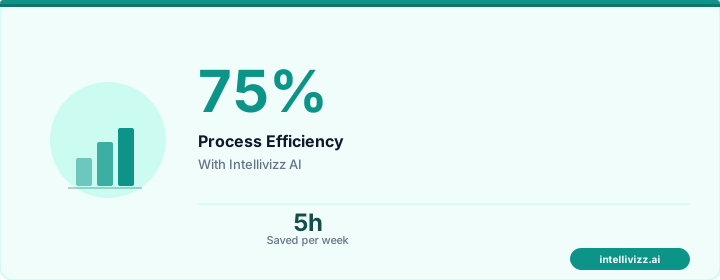
🏥 Patients expect instant responses — automation delivers
Smart technology, better results
What Types of Calls Can Be Automated?
Not all medical phone calls need a human touch. Analysis of call data across thousands of medical practices shows a consistent pattern:
| Call Type | % of Volume | Automatable? |
|---|---|---|
| Appointment scheduling/rescheduling | 35% | ✅ Fully |
| Appointment confirmations/reminders | 15% | ✅ Fully |
| Prescription refill requests | 12% | ✅ Fully |
| Office hours, directions, insurance questions | 10% | ✅ Fully |
| Test result inquiries | 8% | ⚠️ Partially (routing) |
| Billing questions | 8% | ⚠️ Partially (basic balance info) |
| Clinical questions for providers | 7% | ⚠️ Triage + routing |
| Urgent/emergency triage | 5% | ⚠️ Triage + escalation |
The data reveals that 70-75% of medical office phone calls can be fully or substantially automated. The remaining 25-30% — clinical questions, complex billing disputes, and urgent triage — still benefit from AI triage that routes them to the right person faster.
How AI Phone Automation Works
Modern AI phone answering services use natural language understanding to hold conversational interactions with patients. Unlike the robotic IVR systems ("Press 1 for scheduling, press 2 for billing"), AI understands natural speech:
Patient: "Hi, I need to reschedule my appointment with Dr. Chen next Tuesday. Something came up at work."
AI: "I'd be happy to help you reschedule. I see your appointment with Dr. Chen on Tuesday, April 21st at 2:30 PM. What day works better for you?"
Patient: "Any time Thursday afternoon would work."
AI: "Dr. Chen has openings at 1:00 PM and 3:15 PM on Thursday the 23rd. Which would you prefer?"
The entire interaction takes 45-60 seconds, the appointment is rescheduled in the practice management system in real time, and the patient receives a confirmation text — all without a human staff member being involved.
The Technology Stack
Natural Language Processing (NLP)
AI systems are trained on millions of medical office phone interactions, understanding medical terminology, regional accents, background noise, and conversational context. Modern systems achieve 95-99% comprehension rates — exceeding many human operators.
Practice Management Integration
Direct integration with your PMS allows the AI to check real-time schedule availability, access patient records (within HIPAA bounds), verify insurance, and confirm appointment types. Without this integration, the AI can only take messages — with it, the AI can take action.
Intelligent Escalation
When the AI encounters a situation requiring human judgment — a clinical question, an upset patient, a complex billing issue — it seamlessly transfers to the appropriate staff member with a complete summary of the conversation so far. The patient doesn't repeat themselves; the staff member picks up where the AI left off.
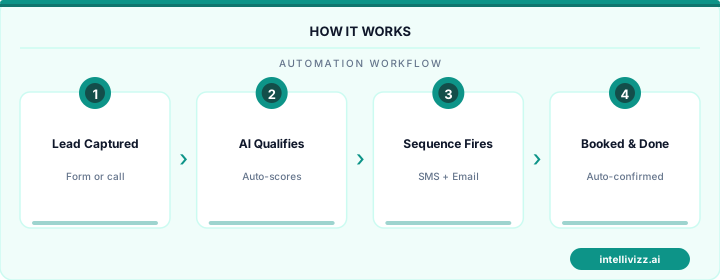
🏥 Patients expect instant responses — automation delivers
The data speaks for itself
Implementation Without Disruption
The biggest concern practices have is "what if it doesn't work and we lose patients?" The answer is a phased rollout:
Phase 1: After-Hours Only (Weeks 1-2)
Route after-hours calls to AI while staff handles all daytime calls. This captures the easiest win (after-hours calls currently going to voicemail) with zero impact on daytime operations. Staff reviews AI call summaries each morning to verify quality.
Phase 2: Overflow During Peak Hours (Weeks 3-4)
When hold times exceed 30 seconds, calls overflow to AI. This addresses the highest-frustration moments (patients on hold) without removing human handling as the default. Staff monitors AI performance and provides feedback for tuning.
Phase 3: First-Ring AI with Routing (Months 2-3)
AI answers all calls on the first ring and handles what it can (scheduling, refills, FAQs). Calls requiring human attention are routed to staff with context. Staff now spends phone time only on calls that genuinely need their expertise.
Preserving the Human Touch
The goal isn't to eliminate human interaction — it's to elevate it. When front desk staff aren't buried in phone calls, they can:
- Greet arriving patients warmly instead of holding up a "one moment" finger while on the phone
- Spend time explaining treatment plans and insurance benefits in person
- Handle complex patient concerns with full attention
- Manage clinical workflows and provider coordination
- Focus on patient experience rather than call volume metrics
Practices that implement phone automation report that staff satisfaction increases alongside patient satisfaction — because both groups benefit from fewer interrupted interactions.
Measuring Success
Track these metrics to evaluate your phone automation ROI:
- Call answer rate — should reach 99%+ (from typical 70%)
- Average speed to answer — should drop to under 3 seconds (from 45+ seconds)
- Calls requiring human transfer — should be 25-30% of total volume
- Patient satisfaction scores — should improve within 30 days
- Staff overtime — should decrease as phone burden lifts
- Appointments booked via AI — tracks direct revenue generation
Combined with a comprehensive workflow automation strategy, phone automation becomes the centerpiece of a modern medical office that runs efficiently without sacrificing the personal relationships that keep patients coming back.
Frequently Asked Questions
Will older patients be frustrated talking to AI?
Modern AI sounds natural and conversational, not robotic. In blind tests, 65% of patients over 65 couldn't distinguish AI from a human receptionist. For patients who explicitly request a human, the AI transfers immediately.
What about HIPAA compliance?
Leading HIPAA-compliant AI platforms offer BAAs, end-to-end encryption, and SOC 2 certification. AI systems are actually more HIPAA-secure than humans in many respects — they don't gossip, leave notes on desks, or discuss patient information in elevators.
How long does it take for the AI to learn our practice's specifics?
Initial configuration takes 1-2 weeks, including setting up appointment types, provider schedules, common FAQs, and triage protocols. The AI continues to improve over 60-90 days as it processes more calls specific to your practice.
Ready to modernize your practice? Explore our healthcare automation solutions, or read our guide to AI Receptionist for Medical Offices: Cut Missed Calls....
Relevant AI Automations
AI Review Management (HIPAA-Compliant)
All-in-one HIPAA-compliant review management: automated review requests, AI-powered responses, and review repurposing for web & social.
HIPAA-Compliant AI Voice Agent — 24/7 Patient Call Handling
HIPAA-compliant AI voice agent answers every patient call 24/7 — triages urgency, books appointments, and sends encrypted follow-ups
Website Live Chat → Patient Booking Funnel
AI-powered live chat on the practice website engages visitors, answers questions about services/insurance, collects cont