
AI Receptionist for Medical Offices in Silver Spring, MD: A Guide for Montgomery County Practices
Silver Spring and the broader Montgomery County, Maryland medical market is one of the most diverse and competitive healthcare corridors in the DC metro area. With a population of over 1 million people, dozens of languages spoken, and proximity to major research institutions (NIH, Walter Reed), patients expect world-class healthcare access — starting with the first phone call.
For medical offices in Silver Spring, Bethesda, Rockville, and Germantown, an AI receptionist ensures no patient call goes unanswered — regardless of call volume, time of day, or language preference.
Montgomery County Healthcare Dynamics
Medical practices in Montgomery County face distinct challenges: an incredibly diverse patient population (Silver Spring alone has significant communities speaking Spanish, French, Amharic, Mandarin, Korean, and Vietnamese), high patient expectations driven by proximity to NIH, Johns Hopkins, and Walter Reed, commuter patients who work in DC and can only call outside standard business hours (a challenge shared by practices across the metro, including those using AI patient scheduling in Alexandria, VA), competition from both independent practices and major health systems (Holy Cross, Adventist, Suburban Hospital/Johns Hopkins), and high operating costs in the DC metro area requiring operational efficiency.
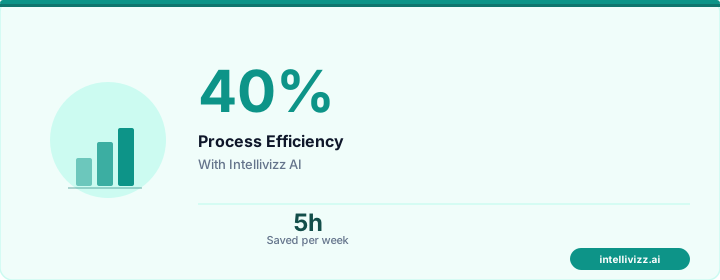
🏥 Patients expect instant responses — automation delivers
See how automation transforms industry operations
How AI Receptionists Serve Montgomery County Practices
Multi-Language Patient Access
AI receptionists conduct calls in 10+ languages, ensuring that the diverse Montgomery County population receives the same quality service regardless of language preference. This expands your practice's accessible patient base without the cost and complexity of hiring multilingual staff.
Metro-Accessible Scheduling
For practices near Silver Spring, Bethesda, or Rockville Metro stations, the AI provides station-specific transit directions and scheduling that accounts for Metro commute times. Patients calling from their DC office can book and receive transit-aware appointment confirmations.
After-Hours Coverage
35-40% of patient calls in the DC metro come outside traditional business hours. An AI receptionist for healthcare handles these calls with the same quality as peak-hour service — scheduling appointments, answering questions, and triaging urgent concerns to on-call providers.
Local Integration
Montgomery County practices commonly use Epic (Holy Cross/Johns Hopkins affiliated), athenahealth, and eClinicalWorks. The AI integrates with all major EHR platforms for real-time scheduling and patient data access.
Getting Started
Implementation typically takes 1-2 weeks with no disruption to current operations. Your existing phone number remains the same — patients notice only that their calls are answered faster and more consistently.
Ready to modernize your Silver Spring-area practice? Book a free consultation for a demo customized to Montgomery County healthcare.
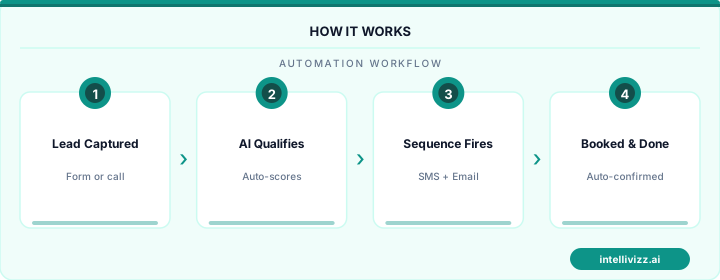
🏥 Patients expect instant responses — automation delivers
From manual processes to automated excellence
Neighborhood-Level Demographics Shaping Silver Spring Healthcare Demand
Silver Spring's zip codes span dramatically different patient populations. The 20901 and 20902 corridors skew toward established suburban families with employer-sponsored insurance, while 20903 and 20904 include higher concentrations of Medicaid recipients and uninsured patients — creating a mixed payer environment that demands billing automation alongside scheduling. East Silver Spring and Long Branch are among the most linguistically diverse neighborhoods in Maryland, with census data showing over 60 languages spoken at home. Practices serving these areas report that over 40% of incoming calls benefit from bilingual or multilingual intake.
The Forest Glen and Woodside neighborhoods attract federal employees commuting to NIH and the FDA's White Oak campus. These patients are accustomed to technology-forward healthcare experiences and are more likely to abandon a practice for a competitor offering online scheduling or AI-assisted phone access. An AI receptionist captures these high-value, tech-savvy patients who would otherwise call during their lunch breaks and hang up when they hit voicemail.
Wheaton and Glenmont — both Metro-accessible sub-markets adjacent to Silver Spring — are underserved relative to their population density. Practices extending their effective coverage area into these zip codes via aggressive after-hours phone availability and multilingual AI intake gain a significant first-mover advantage in patient acquisition.
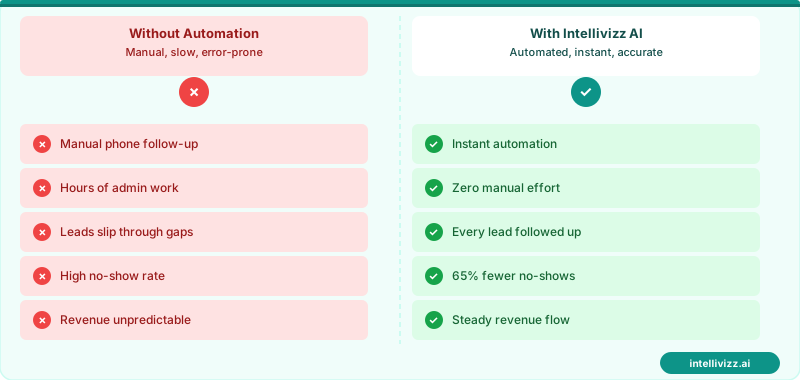
🌍 60+ languages spoken — your AI receptionist speaks them too
Montgomery County practices using multilingual AI see 28% higher new patient conversion from underserved communities.
Competitive Landscape: Independent Practices vs. Health Systems
The Silver Spring medical market is bifurcated between large health system affiliates (Holy Cross, Adventist, Johns Hopkins) and independent or small-group practices. Health systems have invested millions in Epic MyChart patient portals and 24/7 nurse lines — giving patients instant access regardless of time of day. Independent practices that rely on voicemail alone are effectively conceding market share to these better-resourced competitors.
AI receptionist technology levels the playing field. An independent internal medicine group in the Fenton Street corridor can now offer the same 24/7 phone coverage and instant scheduling confirmation that Holy Cross Health provides through its call center — at a fraction of the cost. The key differentiator for independent practices is the personal touch: AI handles the logistics while your physicians and staff provide the relationship-driven care that large health systems cannot replicate.
| Capability | Health System Call Center | AI Receptionist (Independent Practice) |
|---|---|---|
| 24/7 availability | ✓ Yes | ✓ Yes |
| Multilingual support | Limited (2-3 languages) | 10+ languages |
| Average hold time | 8-14 minutes | 0 seconds |
| Monthly cost | $15,000–$40,000+ | $300–$800 |
| Personalization to practice | Generic scripts | Fully customized to your practice |
Implementation Case Study: A Montgomery County Primary Care Group
A four-physician primary care group with locations near the Silver Spring Metro and in Aspen Hill deployed an AI receptionist in Q3 2024. Before implementation, the practice averaged 22% missed call rate during peak hours (8–10 a.m. and 4–6 p.m.) and zero coverage after 5 p.m. Front desk staff spent an estimated 3.2 hours per day returning voicemails — time taken directly from in-office patient interaction.
Within 60 days of deployment: the missed call rate dropped to under 3%, after-hours appointment bookings accounted for 18% of all new monthly appointments, front desk staff reclaimed approximately 2.8 hours daily (redirected to billing reconciliation and patient flow management), and the practice captured an estimated 14 additional new patients per month who had previously been lost to unanswered calls. At an average new patient value of $320 per year, that represents over $53,000 in annualized recovered revenue.
The multilingual capability proved especially valuable: Spanish-language call handling increased Spanish-speaking patient retention by 34%, as patients who previously switched practices due to language barriers no longer had a reason to leave. For practices near Silver Spring's growing Ethiopian and Central American communities, similar results are achievable with Amharic and Spanish-language AI configurations. Explore more about AI automation for medical practices to understand the full scope of workflow improvements available beyond phone answering.
Getting Started with AI Reception in Your Silver Spring Practice
For practices ready to explore AI receptionist technology, the process begins with a workflow audit: documenting your current call volume, call categories, peak hours, and existing phone system. Most AI receptionist platforms can integrate with your current phone number via call forwarding — patients dial the same number they always have, and calls are handled by the AI until a live transfer or after-hours routing is needed. Setup typically takes 1–2 weeks and requires no hardware changes.
Onboarding involves configuring the AI with your practice's specific information: provider schedules, appointment types, insurance accepted, locations, and any custom questions your front desk typically asks new patients. The more detail you provide during configuration, the more accurate and helpful the AI's responses will be from day one. Most platforms allow ongoing refinement — listening to call recordings and adjusting scripts based on real patient interactions during the first 30 days produces the fastest improvement curve.
Silver Spring-area practices can typically expect to see measurable results within the first 30 days: fewer missed calls, more after-hours appointments on the books, and relieved front desk staff. The most common feedback from practices after their first quarter is that they can't imagine going back to voicemail. Patient satisfaction scores often improve alongside operational metrics, as patients respond positively to always reaching a helpful system rather than an answering machine.
Next Steps for Silver Spring and Montgomery County Medical Practices
Implementing AI receptionist technology in a Montgomery County medical practice is a strategic investment with measurable financial returns and significant quality-of-life benefits for physicians and staff. The Silver Spring market rewards practices that demonstrate operational excellence -- patients experiencing long hold times or unanswered calls have abundant alternatives in a market this competitive. Practices that move first to deploy AI reception in their specific sub-market gain a compounding advantage: better scheduling utilization leads to better Google reviews, which leads to more inquiries, which the AI handles without additional overhead. The growth cycle becomes self-sustaining. For practices interested in understanding their specific ROI potential, a structured 30-day pilot comparing AI-handled calls to historical baseline metrics is the most reliable path to a compelling business case tailored to your practice's unique call patterns and patient demographics. The investment is modest, the risk is low, and the competitive advantage is real and measurable.
The combination of Silver Spring's market diversity, competitive density, and technology-forward patient expectations makes it one of the highest-opportunity markets in the DC metro for AI receptionist deployment. Practices that act on this opportunity in the next 12 months will be the ones establishing the review profiles, the patient panel stability, and the operational reputation that define market leaders in the next decade of Montgomery County healthcare.
Ready to modernize your practice? Explore our healthcare automation solutions, or read our guide to Medical Office Automation in Reston, Virginia:....