
AI Automation for Medical Practice: A Practical Roadmap from Quick Wins to Full Transformation
The conversation around AI in healthcare often focuses on moonshot applications — AI diagnosing diseases, predicting epidemics, or reading radiology scans. But for the typical medical practice, the highest-impact AI applications are far more practical: answering the phone faster, reducing no-shows, collecting payments more efficiently, and eliminating the administrative overhead that consumes 30-40% of your operating budget.
This roadmap helps you implement AI automation strategically — starting with quick wins that generate immediate ROI and building toward comprehensive practice transformation.
Phase 1: Quick Wins (Weeks 1-4)
AI Phone Handling
The single highest-ROI automation for any medical practice. An AI phone answering service ensures every call is answered 24/7, schedules appointments directly in your EHR, handles common questions, and routes complex issues to staff. Impact: 40-60% reduction in missed calls, $5,000-$20,000/month in recovered revenue.
Automated Appointment Reminders
Multi-channel reminders (text, email, phone) sent at optimized intervals reduce no-shows by 29-39%. Implementation time: 1-2 days. Impact: immediate, measurable reduction in empty appointment slots.
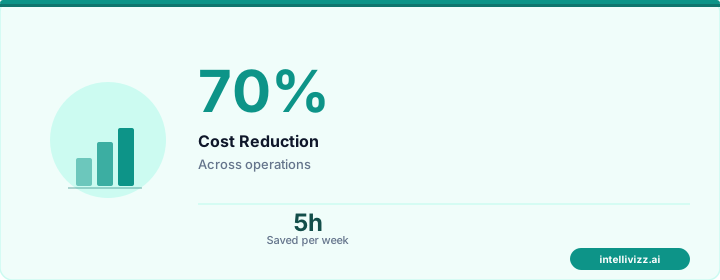
🏥 Patients expect instant responses — automation delivers
Smart technology, better results
Phase 2: Operational Efficiency (Weeks 5-12)
Digital Patient Intake
Replace paper forms with digital intake sent 48 hours before appointments. Patients complete on their phones, data flows directly to your EHR. Impact: 60-70% reduction in check-in time, elimination of data entry errors.
Payment Automation
Automated billing with text-to-pay, digital statements, and automated payment plans. Impact: 20-35% improvement in patient collections, 50-60% reduction in billing staff time.
Insurance Verification
Automated eligibility checks 48 hours before each appointment catch coverage issues before the patient arrives. Impact: 30-40% reduction in eligibility-related claim denials.
Phase 3: Patient Engagement (Weeks 13-24)
Follow-Up Automation
Automated post-visit follow-up, referral tracking, and preventive care recall. Impact: 25-35% better treatment adherence, 40% increase in referral completion, 60-70% recall scheduling rate.
Reputation Management
Automated review requests after positive visits, response monitoring, and sentiment analysis. Impact: 300-500% increase in review volume, 0.2-0.5 star rating improvement within 6 months.
Cancellation Recovery
Automated waitlist backfilling and rescheduling sequences. Impact: 40-60% of cancelled slots recovered, representing $10,000-$30,000/month per provider in recaptured revenue.
Phase 4: Full Transformation (Months 6-12)
Predictive Analytics
AI models that predict no-shows, identify at-risk patients, forecast revenue, and optimize scheduling templates based on historical patterns.
Clinical Workflow Support
AI-assisted documentation, order management, and care gap identification that augment clinical staff rather than replace them.
Strategic Growth
Data-driven marketing optimization, patient lifetime value analysis, and speed-to-lead optimization that compound your practice's growth advantages over time.
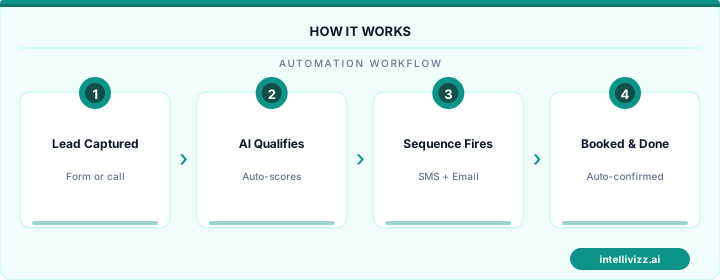
🏥 Patients expect instant responses — automation delivers
The data speaks for itself
Expected Cumulative Impact (12 Months)
- Revenue increase: 15-30% from recovered missed calls, reduced no-shows, and improved collections
- Cost reduction: 20-35% in administrative overhead from automation
- Patient satisfaction: 15-25% improvement in satisfaction scores
- Staff satisfaction: Reduced burnout from elimination of repetitive tasks
- Competitive position: Structural advantages in response time, patient experience, and operational efficiency that compound over time
For a detailed workflow-by-workflow breakdown, see our guide to medical practice workflow automation. The practices that start today build an automation foundation that gets stronger — and harder for competitors to replicate — over time. Book a free consultation to get a customized automation roadmap for your practice.
The Administrative Cost Crisis in Medical Practices
US medical practices spend an average of $82,975 per physician per year on administrative costs — a figure that has grown 3x faster than clinical costs over the past decade, driven by insurance complexity, regulatory compliance requirements, and patient communication demands. For small and mid-sized independent practices, administrative overhead typically consumes 25-35% of total revenue, compared to 15-20% for large health systems with economies of scale. This cost disparity is a primary driver of the ongoing consolidation of independent practices into health systems — practices cannot compete when their overhead structure is inherently disadvantageous.
AI automation for medical practices directly attacks this cost structure. By automating the highest-volume, lowest-complexity administrative tasks (scheduling, reminders, insurance verification, routine patient communications), practices can reduce administrative labor costs by 30-45% without reducing quality. The freed capacity allows remaining staff to focus on complex cases, billing disputes, and patient relationship management — work that genuinely requires human judgment and empathy.
The clinical impact is equally significant. Physicians in practices with higher administrative burdens report higher burnout rates, shorter appointment times, and less time for continuing education. When AI handles the administrative load, physicians gain back an average of 45-60 minutes per day — time that can be redirected to patient care, documentation quality, or simply reducing the unsustainable workload that drives burnout and early retirement from the profession.
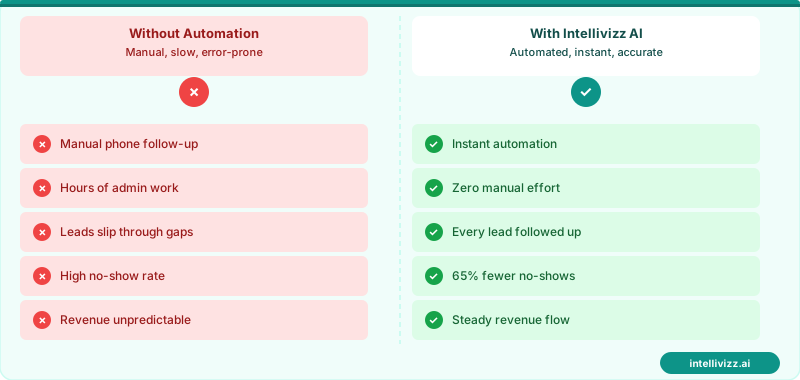
🏥 Practices spend $83K per physician on administration — AI cuts that by 40%
Automation reduces administrative overhead while improving patient experience and physician satisfaction.
Specialty-Specific Automation Workflows
While the broad categories of medical practice automation apply across specialties (scheduling, reminders, insurance verification), the specific workflows vary significantly. Primary care automation focuses on chronic disease management: automated HbA1c monitoring reminders for diabetic patients, blood pressure follow-up sequences, annual wellness visit recall campaigns, and preventive care gap identification. These workflows alone can increase practice revenue by $150,000-$400,000 per year in a mid-sized primary care practice by improving chronic disease management quality scores (which drive value-based care bonuses) and increasing preventive care visit volume.
Cardiology practices benefit from automated monitoring data integration — devices like home blood pressure monitors, Holter monitors, and implantable cardiac monitors generate data that must be reviewed and acted upon. AI systems that automatically flag out-of-range readings and generate clinical alerts reduce the manual review burden while ensuring no critical readings are missed. Orthopedics practices benefit from post-surgical follow-up automation: wound check reminder sequences, PT adherence tracking, and return-to-activity clearance workflows that keep patients on protocol without requiring manual staff outreach for each patient.
| Specialty | Top Automation Use Case | Est. Annual Revenue Impact |
|---|---|---|
| Primary Care | Chronic disease management + preventive recall | +$150,000–$400,000 |
| Dermatology | Cosmetic inquiry capture + recall | +$80,000–$200,000 |
| Orthopedics | Post-surgical follow-up + PT coordination | +$60,000–$150,000 |
| Cardiology | Remote monitoring + medication adherence | +$100,000–$250,000 |
| Mental Health | No-show reduction + reactivation campaigns | +$40,000–$120,000 |
HIPAA Compliance in Automated Medical Practice Workflows
Every AI automation tool used in a medical practice that handles Protected Health Information (PHI) must be HIPAA-compliant. This means the vendor must sign a Business Associate Agreement (BAA), the system must encrypt PHI in transit and at rest, access controls must limit PHI access to authorized users, and audit logs must track all PHI access and modifications. When evaluating automation vendors, practices should request BAA templates, SOC 2 Type II audit reports, and documentation of their encryption standards before signing any agreement. Related: learn how automated patient intake forms can eliminate clipboards and cut check-in time by 70%.
Common HIPAA pitfalls in medical practice automation include: using general-purpose SMS platforms (like standard Twilio integrations) for appointment reminders without a BAA in place, storing patient data in cloud spreadsheets or project management tools without appropriate access controls, and sending bulk email communications through consumer email platforms (Gmail, Outlook) rather than HIPAA-compliant email services. Each of these represents a potential breach risk and regulatory exposure. Purpose-built healthcare automation platforms handle these requirements by default, which is one reason why purpose-built solutions are preferable to custom-configured general-purpose tools for medical offices. For after-hours phone coverage — a common compliance concern — see the dedicated guide on after-hours answering services for medical offices.
Building a Culture of Automation in Your Medical Practice
Successful AI automation adoption in a medical practice requires more than technology implementation — it requires a cultural shift in how administrative work is conceptualized. Practices where physicians and managers actively champion automation, communicate its benefits to staff, and connect it to the practice's broader mission (more time for patients, better work-life balance for staff, higher quality care) achieve faster adoption and better outcomes than practices that treat automation as a purely operational initiative led by IT or administration.
The most effective champions of practice automation are typically physicians who have personally experienced the relief of reduced administrative burden. When a physician shares with staff that they spent 45 fewer minutes per day on phone tag because of AI scheduling, and that those 45 minutes went back to patient care and documentation quality, it carries more weight than any business case document. Identifying these physician champions early in the implementation process and giving them a platform to share their experience creates internal momentum that sustains adoption through the inevitable friction of the transition period.
Long-term, the practices that extract the most value from automation are those that develop ongoing automation literacy — staff and physicians who understand what automation can do, actively identify new opportunities for automation, and advocate for expanding the automation stack as new needs emerge. This literacy develops through training, through exposure to what automation has achieved in the practice, and through a culture that rewards initiative in operational improvement. Practices with this culture evolve from early automation adopters into genuinely technology-enabled organizations that can attract and retain both top clinical talent (who want to work in well-run practices) and sophisticated patients (who value the experience that operational excellence produces).
Medical practices that invest in AI automation today are positioning themselves for sustained competitive advantage in an increasingly technology-driven healthcare marketplace. Patients increasingly choose providers based on the convenience and quality of the entire care experience -- from the first phone call through the payment process -- not solely on clinical reputation. Practices that deliver excellent administrative experiences alongside excellent clinical care will attract and retain the patients who drive long-term practice success. The automation infrastructure required to deliver this experience is available, affordable, and proven. The only variable is the decision to start, and the sooner that decision is made, the greater the compounding advantage relative to slower-moving competitors in your local market.
Ready to modernize your practice? Explore our healthcare automation solutions.
Relevant AI Automations
AI Review Management (HIPAA-Compliant)
All-in-one HIPAA-compliant review management: automated review requests, AI-powered responses, and review repurposing for web & social.
HIPAA-Compliant AI Voice Agent — 24/7 Patient Call Handling
HIPAA-compliant AI voice agent answers every patient call 24/7 — triages urgency, books appointments, and sends encrypted follow-ups
Website Live Chat → Patient Booking Funnel
AI-powered live chat on the practice website engages visitors, answers questions about services/insurance, collects cont