
What Is Speed to Lead in Healthcare? Why Response Time Makes or Breaks Patient Acquisition
Speed to lead is the time between when a potential patient first reaches out and when your practice responds. In healthcare, this metric is the single strongest predictor of whether an inquiry becomes a booked appointment. Yet most medical practices take hours or even days to respond to new patient inquiries — and the data shows this delay is catastrophic for growth.
The Data: Why Minutes Matter
Research consistently shows an exponential decay in conversion probability as response time increases:
- Responding within 5 minutes of an inquiry makes you 400% more likely to qualify the lead compared to responding at 10 minutes (InsideSales/Drift research).
- After 30 minutes, your odds of qualifying that lead drop by 21x.
- After 5 hours, the probability of ever connecting with that lead approaches zero — they've already booked with another provider.
In healthcare, the urgency is even more pronounced. When someone is searching for a new doctor, dentist, or specialist, they're often dealing with a health concern that feels time-sensitive. They're calling 2-3 practices simultaneously and booking with whichever one picks up first or calls back fastest.
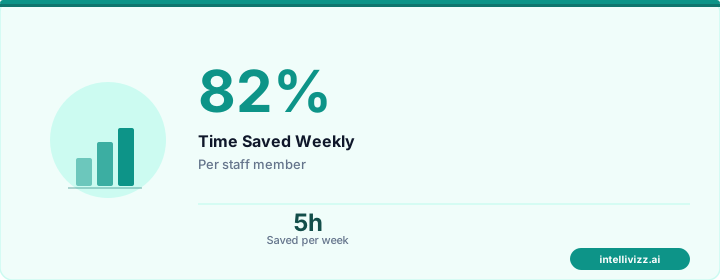
🏥 Patients expect instant responses — automation delivers
The data speaks for itself
Current Healthcare Speed to Lead Benchmarks
How do most practices actually perform? The numbers are sobering:
- Average medical practice response time: 2+ hours for web form inquiries
- Phone answer rate during business hours: 70-80% (meaning 20-30% of calls go unanswered)
- After-hours inquiry response: Next business day (12-36+ hour delay)
- Weekend inquiry response: Monday morning (up to 48-60 hour delay)
Compare this to consumer expectations: 82% of healthcare consumers expect a response within 1 hour, and 60% expect a response within 30 minutes (Zendesk Customer Experience Trends Report).
Why Healthcare Practices Are Slow
The response time gap isn't due to negligence — it's structural:
- Front desk overload: Receptionists are juggling in-person check-ins, phone calls, insurance verifications, and scheduling simultaneously. New inquiries get deprioritized.
- Phone system limitations: When all lines are busy, calls go to voicemail. Callbacks happen when staff get to them.
- After-hours gap: Most practices don't have any response mechanism outside business hours. Inquiries from 5 PM to 9 AM sit in a queue.
- Web form black holes: Contact form submissions land in a shared inbox that nobody monitors in real-time.
- Weekend and holiday voids: Friday evening inquiries don't get responses until Monday.
Calculating the Cost of Slow Response
For a medical practice receiving 20 new patient inquiries per week:
- With a 5-minute response time: 60% conversion rate = 12 new patients/week
- With a 2-hour response time: 20% conversion rate = 4 new patients/week
- Gap: 8 new patients per week lost to slow response
At an average new patient lifetime value of $3,000-$5,000 (for a primary care or dental practice), that's $24,000-$40,000 per week — or $1.2-$2 million annually — in lost revenue attributable entirely to response time. See our deeper analysis of how much missed calls cost medical practices.
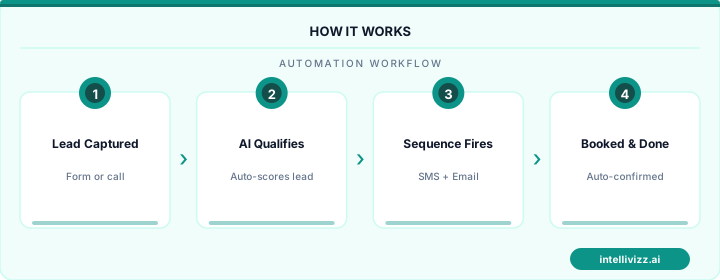
🏥 Patients expect instant responses — automation delivers
Smart technology, better results
How to Achieve Sub-5-Minute Response Times
1. AI-Powered Phone Handling
The most impactful change is ensuring every phone call is answered instantly — 24/7/365. An AI receptionist for healthcare answers calls within 2 rings, handles scheduling, answers common questions, and captures new patient information. There's no hold time, no voicemail, and no missed calls.
2. Automated Web Form Response
When a patient submits a web form, an automated response should fire within 60 seconds: acknowledging receipt, providing a direct scheduling link, and offering a phone number for immediate help. This alone can recover 40% of web leads that would otherwise be lost to slow follow-up.
3. Smart Routing for Urgency
Not all inquiries require the same speed. AI triage can identify high-value inquiries (new patient requests, procedure inquiries, referrals from physicians) and route them with higher priority than general questions. This ensures your fastest response goes to your highest-value leads.
4. After-Hours Coverage
Implement after-hours AI answering that can schedule appointments, answer FAQs, and capture leads even at 2 AM. 35% of healthcare web searches happen outside business hours — if you're not available, your competitor down the street is.
5. Real-Time Monitoring Dashboard
Track speed-to-lead metrics in real-time: average response time by channel (phone, web, chat), response time by hour of day and day of week, conversion rate by response time bucket, and staff response performance. What gets measured gets managed.
The Competitive Moat
Speed to lead is one of the few patient acquisition strategies that actually gets harder for competitors to copy. While any practice can run Google Ads or post on social media, building the infrastructure for consistent sub-5-minute response requires systematic investment in technology and process. Once you achieve it, you create a structural advantage that compounds over time — every month, you're capturing patients that slower-responding competitors are losing.
Ready to eliminate response time as a bottleneck in your practice growth? Book a free consultation to see how AI-powered patient communication can get your response time under 5 minutes — 24 hours a day.
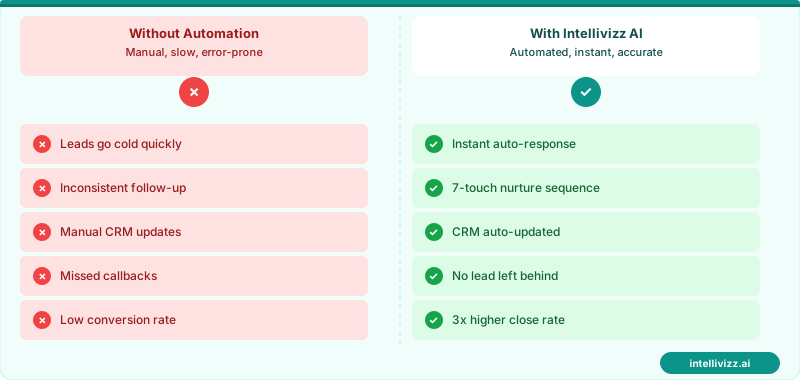
⚡ Healthcare patients don't wait — they call the next practice on the list.
First to respond wins the patient. Always.
Why Healthcare Speed to Lead Is More Urgent Than Any Other Industry
In e-commerce, a slow response loses a sale. In healthcare, a slow response loses a patient — and potentially affects their health outcome. A patient searching for an orthopedic surgeon, a primary care physician accepting new patients, or a therapist with immediate openings is typically in an urgent situation. They're not comparison shopping in a leisurely way. They're in pain, anxious, or facing a time-sensitive health need. The practice that responds first doesn't just win the appointment — they earn profound loyalty from a patient who felt cared for at a vulnerable moment.
Research from the Healthcare Financial Management Association found that patients who receive a response within 5 minutes of contacting a practice schedule appointments at a 3.4x higher rate than patients who wait more than an hour. For specialty practices where patient acquisition is competitive, this rate differential translates directly to revenue.
Implementing Speed to Lead in a HIPAA-Compliant Environment
Healthcare practices face constraints that other industries don't — patient communication must be HIPAA-compliant, and automated messaging must be carefully designed to avoid inadvertent disclosure of health information. The good news: speed to lead doesn't require disclosing health information. An automated first response can acknowledge the inquiry, confirm the practice received their message, and invite the prospective patient to call or schedule a time to speak — all without touching PHI.
HIPAA-safe first response template: "Hi [First Name], this is [Practice Name]. We received your inquiry and want to make sure you get connected with our team quickly. Reply to this message or call us at [number] — we're available [hours]. Looking forward to speaking with you."
| Response Time | Appointment Schedule Rate | Patient Experience Rating |
|---|---|---|
| < 5 minutes | 68% | 4.7/5 |
| 5–30 minutes | 41% | 4.1/5 |
| 30 min – 2 hours | 23% | 3.4/5 |
| > 2 hours | 11% | 2.6/5 |
For the automation infrastructure behind these response times, see our guide to speed-to-lead automation.
Ready to modernize your practice? Explore our healthcare automation solutions, AI Patient Scheduling in Alexandria, VA: How DC-Area..., or AI Receptionist for Medical Offices: Cut Missed Calls....