
AI Patient Scheduling in Alexandria, VA: How DC-Area Medical Practices Are Eliminating Phone Wait Times
Alexandria, Virginia's medical practices serve one of the most demanding healthcare markets in the country. Situated between DC and the Northern Virginia suburbs, practices compete for patients who work federal government hours, commute on Metro and I-395, and expect the same digital convenience from their healthcare providers that they get from every other service.
AI patient scheduling is how forward-thinking Alexandria practices meet these expectations — providing 24/7 appointment booking, instant phone response, and frictionless rescheduling that keeps schedules full and patients satisfied.
The Alexandria Healthcare Market
Alexandria and the surrounding DC metro area present unique scheduling challenges: government workers with rigid schedules who can only call during narrow windows, a transient population (military families, federal contractors) that needs quick access to new providers, high expectations for digital-first healthcare experiences, competition from major health systems (Inova, Virginia Hospital Center, MedStar) alongside independent practices, and multi-language needs (Spanish, Amharic, Arabic are commonly spoken in Old Town, Arlandria, and West End).
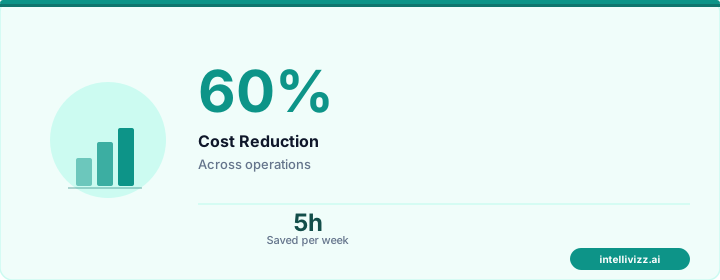
🏥 Patients expect instant responses — automation delivers
From manual processes to automated excellence
How AI Scheduling Solves These Challenges
24/7 Booking Access
An AI scheduling system books appointments at any hour — critical when 35% of Alexandria healthcare searches happen outside business hours. A patient searching for a doctor at 9 PM can call your office, interact with the AI, and walk away with a confirmed appointment in under 3 minutes.
Multi-Language Support
AI scheduling in Spanish, Amharic, and other languages removes barriers for Alexandria's diverse community. Parents in Arlandria can schedule their child's appointment in their preferred language without waiting for a bilingual staff member to become available.
Metro-Area Commuter Optimization
The AI can factor in commute patterns: offer appointment times that align with Metro schedules (King Street, Braddock Road, Van Dorn stations), suggest the nearest office location for multi-site practices, and provide parking and transit directions specific to your Alexandria location.
Integration With Local Systems
Alexandria medical practices commonly use Epic (Inova-affiliated), athenahealth, and eClinicalWorks. AI scheduling integrates with all major platforms for real-time availability and direct booking. Dental practices in the area are seeing similar results — read about dental practice automation in Fairfax, VA.
Results for DC-Area Practices
Alexandria practices implementing AI scheduling report: 40-60% reduction in missed calls, 25-35% improvement in new patient conversion, 30-45% reduction in no-shows through integrated reminders, and staff time savings of 3-5 hours/day redirected to in-person patient care.
Ready to modernize scheduling at your Alexandria practice? Book a free consultation for a demo tailored to DC-metro healthcare operations.
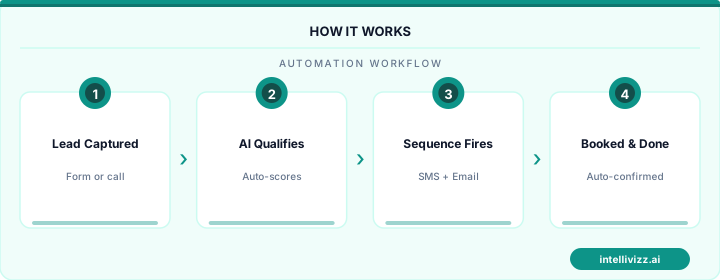
🏥 Patients expect instant responses — automation delivers
See how automation transforms industry operations
Alexandria's Healthcare Market: Competitive Pressures and Patient Expectations
Alexandria, Virginia sits at the intersection of three distinct healthcare markets: the DC metro federal employee population, the rapidly growing Potomac Yard and Carlyle district professional demographic, and the historically established Del Ray and Old Town residential communities. Each segment brings distinct scheduling expectations. Federal employees covered by FEHB plans expect seamless coordination between scheduling and insurance verification. Young professionals in the Potomac Yard corridor are mobile-first and are more likely to book an appointment on their phone at 11 p.m. than call during business hours.
The presence of major healthcare anchors — INOVA Alexandria Hospital, Kaiser Permanente's Alexandria location, and Virginia Hospital Center nearby in Arlington — creates intense competition for primary care and specialist appointments. Independent practices that cannot match the 24/7 digital scheduling of these larger systems consistently lose new patients during the critical first-contact moment. AI patient scheduling eliminates this gap without requiring the capital investment of a hospital system.
Alexandria's Route 1 corridor, particularly the Mount Vernon and Hybla Valley areas, includes a significant Spanish-speaking and immigrant population underserved by traditional English-only phone scheduling. Practices serving these neighborhoods with bilingual AI scheduling report 25-35% increases in appointment conversion among this demographic within the first quarter of deployment.
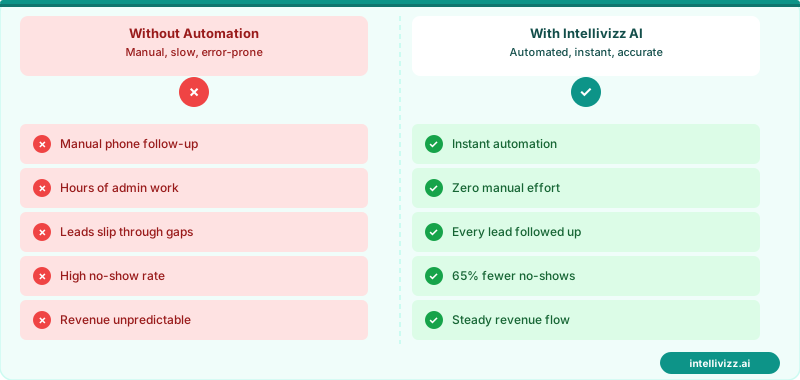
📅 Alexandria patients book after hours — is your practice ready?
AI patient scheduling captures the 38% of appointment requests that arrive outside business hours.
Specialty-Specific Scheduling Workflows in Alexandria
Patient scheduling complexity varies dramatically by specialty. Primary care practices primarily manage established patient follow-ups, new patient intakes, and acute sick visits — three appointment types with very different duration and priority requirements. An AI scheduling system configured for primary care in Alexandria must distinguish between a routine annual wellness visit (40 minutes, any provider, advance booking) and a same-day sick visit (20 minutes, first available, urgent triage).
Specialty practices face additional layers of complexity. A gastroenterology group in the Landmark area must manage colonoscopy prep instructions and equipment room scheduling. An orthopedics practice near the Eisenhower Metro must coordinate X-ray suite availability with physician schedules. AI scheduling platforms integrate with practice management systems including Kareo, AdvancedMD, and INOVA-affiliated Epic installations to pull real-time provider availability and room allocation before confirming any appointment.
| Specialty | Avg. Call Volume/Day | % AI-Handleable | Top AI Use Case |
|---|---|---|---|
| Primary Care | 60–90 | 72% | Annual wellness + same-day triage |
| Dermatology | 100–150 | 78% | Medical vs. cosmetic routing |
| Pediatrics | 80–120 | 68% | Sick child same-day slots |
| OB/GYN | 70–100 | 65% | Prenatal scheduling sequences |
| Orthopedics | 55–80 | 60% | Pre-op/post-op coordination |
ROI Calculation for an Alexandria Practice
Consider a two-physician internal medicine practice on Duke Street with approximately 1,400 active patients and 75 calls per day. At a 25% missed call rate (typical without AI), the practice misses roughly 19 calls daily. Industry data suggests 30-40% of missed calls represent new patient inquiries. At a conservative 30%, that is 5-6 lost new patient opportunities per day. With an average new patient annual value of $380 and a conversion rate of 60%, each missed call day costs approximately $1,140 in lost lifetime patient revenue.
AI patient scheduling eliminates virtually all missed calls. At a typical monthly cost of $400-600 for a small practice, the system pays for itself within the first week of recovered new patient bookings — with the ongoing benefit of reduced front desk labor, lower no-show rates through automated reminders, and higher patient satisfaction scores that drive referrals. For practices that are part of the patient referral program automation ecosystem, combining AI scheduling with referral tracking creates a compounding revenue engine.
Transitioning to AI Scheduling: What Alexandria Practices Should Expect
Transitioning to AI patient scheduling in an Alexandria practice is a low-disruption process when managed correctly. The key to success is a phased rollout that starts with after-hours coverage (where there is no existing staff to displace) and expands to overflow coverage during peak hours before moving to primary call handling. This sequence gives staff time to develop confidence in the system and allows the practice to identify any configuration gaps before full deployment.
Patient acceptance of AI scheduling is consistently higher than practice administrators expect. In healthcare consumer surveys, 68% of patients report preferring immediate AI-handled scheduling to waiting on hold for a human staff member. The remaining 32% who prefer human interaction can be accommodated through a seamless transfer option — the AI identifies that a patient wants to speak with a person and connects them to a staff member or schedules a callback. No patient needs to be served exclusively by AI against their preference.
The financial case for Alexandria practices is straightforward. The average AI scheduling platform costs $300–$600 per month for a small-to-midsize practice. If that investment produces just 4-5 additional new patient appointments per month — which is a conservative estimate for after-hours scheduling alone — the cost is covered at the lowest average new patient value levels in primary care. Any additional recovered appointments, reduced no-shows, and front desk efficiency gains are pure margin improvement. Most practices find the system pays for itself in the first two weeks of operation.
The Compounding Effect of AI Scheduling on Alexandria Practice Growth
AI patient scheduling creates a compounding growth dynamic that manual scheduling cannot replicate. Every captured after-hours call that would have gone to voicemail produces a new patient who may stay with the practice for decades, generating thousands of dollars in lifetime value and potentially referring additional patients. Each prevented no-show preserves a slot that would otherwise have been wasted revenue. Each insurance verification automated is a billing dispute avoided and a cash flow improvement realized. These individual improvements, each modest in isolation, compound into transformational practice economics over 12-24 months. Alexandria practices that implement AI scheduling and measure results consistently report being surprised by the magnitude of impact -- the combined effect of multiple simultaneous improvements exceeds what any single metric analysis would predict. The practice that starts this compounding cycle first in their competitive sub-market generates structural advantages that later adopters cannot easily overcome.
Alexandria's combination of federal employee density, professional demographics, and Metro accessibility makes it an ideal market for AI patient scheduling. The practices that thrive in this market over the next five years will be those that match patient expectations for immediate, 24/7 access with the clinical quality that the Alexandria community demands. AI scheduling is the infrastructure that makes this combination achievable without the overhead burden that would otherwise make it economically untenable for independent and small-group practices competing against larger health system competitors.
Ready to modernize your practice? Explore our healthcare automation solutions, or read our guide to AI Receptionist for Medical Offices in Silver Spring,....