
Patient Referral Program Automation: Turn Your Best Patients Into Your Best Marketing Channel
Patient referrals are the highest-converting, lowest-cost new patient source for medical and dental practices. Referred patients convert at 3-5x the rate of paid advertising leads, have 25% higher lifetime value, and are 18% less likely to churn. Satisfied patients who refer others are also prime candidates for leaving Google reviews that reinforce your practice's online reputation. Yet most practices leave referrals entirely to chance — hoping satisfied patients will organically spread the word.
Automated referral programs replace hope with a system: identifying your happiest patients, making it effortless for them to refer, tracking every referral through to conversion, and rewarding advocacy that drives practice growth.
The Referral Program Framework
Step 1: Identify Promoters
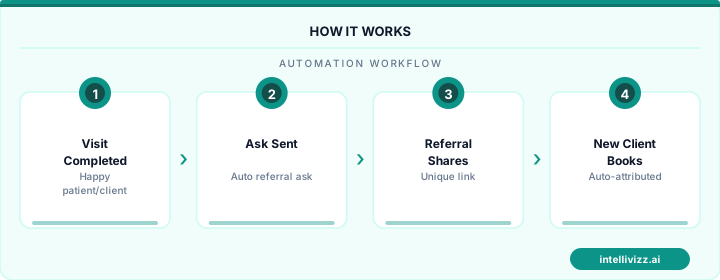
Not every patient is a good referral source. Use automated satisfaction surveys (NPS or simple star rating) sent 24 hours after each visit to identify promoters — patients who rate their experience 9-10 out of 10. These are the patients most likely to refer and most credible when they do.
Step 2: Make Referring Effortless
Send promoters a personalized referral message within 24 hours of their positive survey response: "[Name], thank you for the wonderful rating! If you know anyone looking for [service type], we'd love to help them too. Share your personal referral link: [unique URL]. They'll get [incentive for new patient], and you'll receive [reward]."
The referral link is unique to each patient, enabling tracking and proper attribution. The landing page is pre-filled with the referrer's information and provides a simple form for the new patient to request an appointment.
Step 3: Track and Nurture the Referral
When a referred prospect submits the form: immediate automated response with scheduling link and practice information, the referring patient receives a notification ("Your referral [first name] has contacted us! We'll take great care of them."), if the prospect doesn't book within 48 hours, an automated follow-up sequence encourages scheduling, and the entire journey is tracked from referral to first appointment to conversion.
Step 4: Reward and Reinforce
When the referred patient completes their first visit: automatic reward fulfillment for the referrer (gift card, account credit, or charitable donation in their name), thank-you message to the referrer with the reward details, and a prompt for the new patient to leave a review and enter the referral program themselves.
🏥 Patients expect instant responses — automation delivers
The data speaks for itself
Reward Structures That Work
The best referral rewards are: immediate (fulfilled automatically when the referral is completed), meaningful (minimum $25-$50 value), relevant (account credit, free services, or gift cards to local businesses), and compliant with your state's healthcare referral regulations. Note: some states restrict patient incentives for healthcare referrals. Consult your compliance advisor on permissible reward structures.
Ongoing Referral Campaigns
Beyond individual post-visit requests, run periodic campaigns: quarterly "refer a friend" emails to your promoter list with seasonal incentives, milestone-based requests (after a patient's 5th visit, 1-year anniversary, etc.), event-driven outreach (back-to-school for pediatric/dental, new year health resolutions), and referral contest campaigns ("The patient who refers the most new patients this month wins [grand prize].").
Measuring Referral Program ROI
Track monthly: total referrals generated, referral-to-appointment conversion rate (target: 40-60%), cost per referred patient (reward cost / new patients), referred patient lifetime value vs. average patient, referral program revenue vs. cost (target: 10-20x ROI), and top referrers (your MVP patients who deserve extra appreciation).
🏥 Patients expect instant responses — automation delivers
Smart technology, better results
Technology Requirements
Your referral automation stack needs: unique referral link generation and tracking, automated messaging (SMS + email), CRM integration to connect referrals to patient records, reward management and fulfillment, and analytics dashboard for ROI tracking.
Many practices integrate referral automation with their broader patient follow-up system so referral requests are part of the overall post-visit engagement sequence rather than a separate, siloed outreach.
Ready to systematize your patient referral program? Book a free consultation to see how referral automation integrates with your practice workflow.
Why Most Medical Practice Referral Programs Fail
The majority of medical practices that attempt to build patient referral programs abandon them within 6-12 months. The reasons are consistent: the program is entirely manual (staff must remember to ask patients for referrals, send thank-you notes, and track referral sources), it lacks systematized incentives (ad hoc appreciation feels less meaningful to patients than a defined program), and there is no feedback loop (patients who refer never know whether their referral resulted in a visit, creating a black box that discourages continued referral behavior). These structural failures are not intrinsic to referral programs — they are the predictable results of attempting to run a systematic marketing program through manual effort.
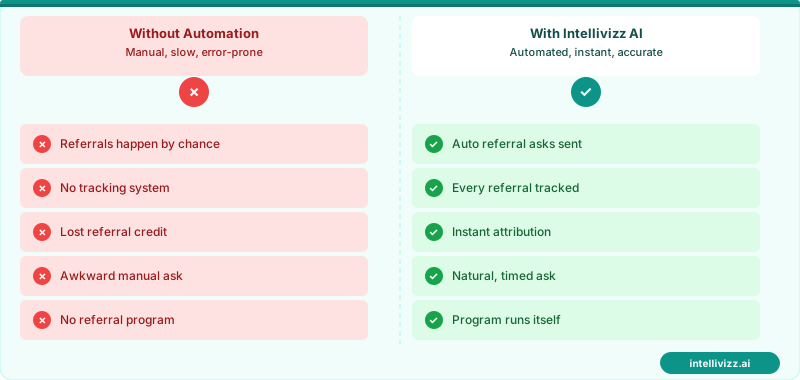
Automated patient referral programs eliminate all three failure modes. They systematically trigger referral asks at the optimal moment (post-positive outcome, not at random), they deliver consistent, defined appreciation, and they close the feedback loop by notifying referring patients when their referral has scheduled and attended their first appointment. This last element — the thank-you for a completed referral — is among the most powerful drivers of repeat referral behavior, yet it requires tracking that is impossible to do manually at scale across hundreds or thousands of patient relationships.
Healthcare referral programs also benefit from a structural advantage over many other industries: patients who have had genuinely positive healthcare experiences are highly motivated referrers. They feel they are doing their friends and family members a favor by connecting them with a trusted provider. Unlike referrals for consumer products (where the referrer gets a discount code), healthcare referrals feel altruistic to the patient — which makes them emotionally rewarding to make, independent of any formal incentive structure.
🏥 Referred patients have 4x higher lifetime value — automation scales this advantage
Practices with automated referral programs generate 3x more referral patients with zero additional staff time.
HIPAA-Compliant Referral Marketing
Patient referral program automation in healthcare must navigate HIPAA constraints carefully. The primary concern is the referral disclosure itself: a referral program cannot reveal that the referring party is a patient at the practice without that patient's explicit consent. The standard workflow that handles this correctly is: when the referred new patient contacts the practice and schedules an appointment, the system triggers a notification to the referring patient — not the other way around. The notification is sent to the referring patient (who has already consented to receive communications from the practice) confirming that their referral has been received.
Referral incentives must also be structured carefully. Under the federal Anti-Kickback Statute and various state equivalents, offering incentives to patients in exchange for referring other patients to a federal healthcare program (Medicare, Medicaid) is prohibited if the incentive is conditioned on the referral resulting in services billed to federal programs. However, incentive programs that are genuinely available to all patients (not just Medicare/Medicaid patients) and are not conditioned on the referral completing a covered service are generally permissible under applicable safe harbors. Practices should review their incentive structure with healthcare counsel before launch.
| Referral Incentive Type | Compliance Status | Typical Conversion Lift | Recommended For |
|---|---|---|---|
| Thank-you gift card (non-medical) | Generally permissible (counsel review advised) | +22% | Private pay / cosmetic practices |
| Charitable donation in patient name | Generally permissible | +14% | All practice types |
| Formal thank-you + recognition | Always permissible | +8% | All practice types |
| Fee discount on next visit | Complex — avoid for Medicare/Medicaid patients | +30% | Private pay only |
Measuring and Optimizing Referral Program Performance
Referral program automation enables measurement that manual programs cannot provide. Key metrics to track: referral rate (percentage of active patients who have referred at least one person in the past 12 months), referral conversion rate (percentage of referred prospects who schedule and attend a first appointment), referral patient lifetime value (do referred patients have higher lifetime value than non-referred patients — they typically do, because they come pre-sold on the practice by someone they trust), and referral source attribution (which patients are your most prolific referrers).
Understanding which patients are your most prolific referrers is particularly valuable. Practices consistently find that 10-15% of their patient base drives 60-70% of their referrals. Identifying and nurturing these "superfan" patients — giving them premium treatment, inviting them to patient advisory panels, sending them early information about new services — generates disproportionate referral returns. Automated systems that flag prolific referrers and trigger VIP engagement sequences for them can double referral volume from this key segment. Combining patient referral automation with the broader AI automation strategy for medical practices creates a fully integrated patient acquisition and retention engine.
Connecting Referral Programs to Patient Satisfaction Measurement
Patient referral programs perform best when integrated with patient satisfaction measurement — specifically when the practice can identify satisfied patients and time referral asks to coincide with positive experience moments. The net promoter score (NPS) survey, widely used in healthcare, is a natural complement to referral program automation: patients who respond with high NPS scores (9-10 out of 10, "promoters") are immediately ideal targets for referral ask sequences. Patients who respond with low scores (detractors) should be routed to service recovery workflows, not referral asks.
Automated NPS measurement after each visit — a simple 2-question survey delivered via SMS within 24 hours of the appointment — provides real-time satisfaction data at scale. Practices that generate 500 visits per month collect 500 data points monthly, giving them statistically robust feedback to identify trends, compare satisfaction by provider, and flag service quality concerns before they generate negative reviews. When this data feeds directly into the referral program (high NPS scores trigger referral invitations; low scores trigger service recovery), the referral program self-selects for patients most likely to refer and most primed to do so positively.
The long-term compound effect of integrated satisfaction measurement and referral automation is a continuously improving referral rate. As service recovery workflows address the issues causing low NPS scores, the proportion of high-satisfaction patients in the practice grows. As high-satisfaction patients receive well-timed referral asks, referral rates rise. As referred patients (who arrive with positive expectations set by their trusted referrer) have positive first experiences and become high-satisfaction patients themselves, the cycle reinforces. Practices that implement this integrated approach consistently report referral rate growth of 25–40% per year for the first three years of operation, compounding into a referral engine that eventually becomes the practice's primary patient acquisition channel.
Referral Program Design: Gamification, Incentive Tiers, and Compliance
Patient referral program automation delivers maximum enrollment impact when the underlying program is designed using behavioral incentive principles — gamification mechanics, tiered reward structures, and compliance-safe engagement frameworks that transform passive word-of-mouth into a structured, measurable growth channel.
Gamification mechanics applied to patient referral programs borrow from the loyalty-program design playbook used by airlines, credit cards, and mobile apps. Points-based systems — where referring patients earn points redeemable for teeth whitening credits, free hygiene visits, or branded merchandise — create ongoing engagement that one-time referral bonuses cannot match. A patient who has accumulated 150 of the 200 points needed for a free whitening treatment is psychologically invested in making one more referral to reach the reward threshold. Progress bars, milestone badges ("Bronze Referrer," "Silver Referrer," "Gold Ambassador"), and periodic "double points" promotions sustain referral momentum across months rather than generating a single burst of activity after the program launches.
Tiered reward structures escalate incentives as referral volume increases, recognizing that a small percentage of patients — typically 5-8% of the active base — generate the majority of referrals. A three-tier structure might offer a $25 account credit for the first referral, a $50 credit for the second and third, and a $100 credit plus a complimentary service for the fourth and beyond. The escalating structure motivates high-referrers to continue while keeping the average cost-per-acquisition manageable. Practices running tiered referral programs report 40-60% lower patient acquisition costs compared to Google Ads and 3x higher lifetime values for referred patients versus digitally acquired ones.
Referral tree visualization gives practice managers real-time insight into how referrals cascade through social networks. A visual tree showing that Patient A referred Patients B and C, and Patient B subsequently referred Patients D, E, and F, reveals the practice's organic growth topology. Second-generation referrals (patients referred by patients who were themselves referred) indicate a healthy referral culture; practices where referral trees rarely extend past the first generation may need to strengthen the new-patient onboarding experience to convert referral recipients into referral generators.
Ambassador program qualification criteria formalize the relationship with top referrers. Patients who refer five or more new patients within a 12-month period can be invited into a named ambassador program offering exclusive benefits: priority scheduling, first access to new services, an annual appreciation event, and co-branded marketing collateral featuring their testimonial. The ambassador designation transforms the referral relationship from transactional (refer for a reward) to identity-based (I am an ambassador for this practice), which behavioral science research consistently shows generates higher and more sustained engagement than transactional incentives alone.
Co-branded marketing collateral — business cards, social media graphics, and email templates pre-loaded with the ambassador's name and a unique referral link — makes it effortless for top referrers to share the practice with friends, family, and colleagues. Automated systems can generate personalized referral landing pages for each ambassador that track click-through, form submission, and appointment-booking attribution, giving both the ambassador and the practice full visibility into referral performance.
HIPAA-compliant testimonial collection requires explicit written authorization (separate from the general HIPAA consent) before any patient's name, image, or health-related statement can be used in marketing materials. Automated referral systems can embed the testimonial authorization form into the post-appointment feedback workflow, capturing written consent, the approved testimonial text, and the permitted usage scope (website, social media, print, video) in a single digital interaction. Storing signed authorizations in the practice management system creates an auditable compliance record.
NPS-triggered referral prompts represent the highest-conversion referral automation tactic. When a patient completes a post-visit survey and gives a Net Promoter Score of 9 or 10 (promoter category), the system immediately presents a referral prompt: "You rated us a 10 — would you like to share us with someone who needs a great dentist?" Promoters asked at the moment of peak satisfaction convert to referral action at 3-5x the rate of patients who receive a generic referral request via email days after their visit. The timing — capturing the patient while positive emotions are fresh — is the critical variable that automated NPS-triggered workflows optimize.
Ready to modernize your practice? Explore our healthcare automation solutions, How to Get More Patient Referrals: 10 Strategies That..., or Physician Referral Tracking System: Close the Loop and....