
Physician Referral Tracking System: Close the Loop and Stop Losing Patients Between Practices
The Referral Completion Crisis
When a primary care physician refers a patient to a specialist, everyone assumes the patient will follow through. The reality is startling: 25-40% of physician referrals are never completed. When referral-related claims are denied by insurance, insurance claim denial follow-up automation prevents that revenue from being written off. The patient either forgets to schedule, can't get through to the specialist's office, faces insurance barriers, or simply decides the issue isn't urgent enough to pursue.
This referral leakage has consequences across the care continuum:
- Patient health: Delayed specialist care leads to disease progression, missed diagnoses, and worse outcomes
- Referring physician: Loses visibility into patient care, can't coordinate treatment effectively
- Specialist: Misses new patient revenue from incomplete referrals
- Practice network: Referral relationships weaken when completion rates are unknown
🏥 Patients expect instant responses — automation delivers
Smart technology, better results
Why Referrals Fall Through the Cracks
The referral process has multiple failure points:
At the Referring Office
- Referral is discussed verbally but no formal order is placed
- Staff forgets to send records or prior authorization
- No follow-up system to check if the patient scheduled
During the Handoff
- Faxed referrals are lost or delayed
- Patient receives a phone number and is told to "call to schedule" with no support
- Insurance authorization delays create a window where patients lose momentum
At the Patient Level
- Patient is overwhelmed with information and doesn't act
- Specialist's office is hard to reach (hold times, missed calls)
- Financial concerns about copays or out-of-network costs
- Symptoms improve temporarily, reducing perceived urgency
What a Referral Tracking System Does
An automated referral tracking system monitors every referral from initiation through completion, alerting staff when action is needed:
- Referral creation — Logged in the system with all necessary details (diagnosis, urgency, preferred specialist, insurance authorization status)
- Patient notification — Automated message to the patient with specialist information, scheduling link, and preparation instructions
- Scheduling confirmation — System checks whether the patient has scheduled with the specialist (via direct integration or patient confirmation)
- Appointment completion — Tracks whether the patient actually attended the specialist visit
- Results received — Monitors for specialist notes and results returning to the referring physician
- Gap alerts — At each stage, if the process stalls for a defined period, staff is alerted for intervention
The Patient-Side Automation
The highest-impact component of referral tracking is patient-facing automation that removes friction from the scheduling process:
Immediate Post-Referral Message
Within hours of the referral: "Dr. Smith has referred you to Dr. Chen (Cardiology) for further evaluation. Schedule your appointment directly: [Link]. Questions? Reply to this message."
3-Day Follow-Up
If the patient hasn't scheduled: "Reminder: Dr. Smith recommended you see a cardiologist. This is important for your health. Schedule now: [Link] or call [Number]."
7-Day Escalation
If still unscheduled: "We want to make sure you get the care Dr. Smith recommended. Would you like us to schedule the appointment for you? Reply YES and we'll find a time that works."
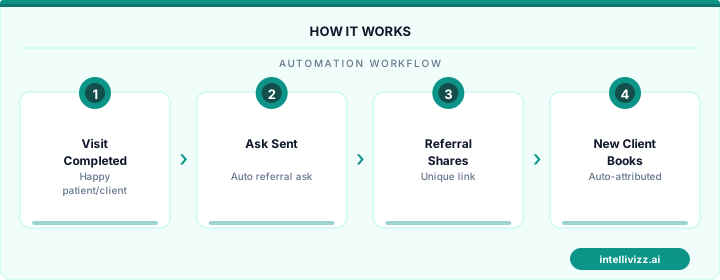
This sequence completes 60-70% of referrals that would otherwise be lost. The offer to schedule on the patient's behalf (Touch 3) is particularly effective — many patients want the appointment but struggle with the logistics.
🏥 Patients expect instant responses — automation delivers
The data speaks for itself
The Provider-Side Dashboard
For referring physicians, a referral tracking dashboard provides:
- Real-time referral status — pending, scheduled, completed, or stalled
- Completion rates by specialist — identify which specialists have scheduling barriers
- Average time to completion — flag referrals that are taking too long
- Results tracking — has the specialist's report been received and reviewed?
- Patient communication log — see all automated and manual touchpoints
Integration Points
Effective referral tracking requires integration with:
- EHR system — to capture referral orders and receive specialist reports
- Patient communication platform — for automated outreach sequences
- Insurance verification — to proactively identify authorization requirements
- Specialist scheduling systems — for direct booking (when available) or scheduling status checks
Practices using AI follow-up automation can extend the same platform to handle referral tracking, creating a unified system for all post-visit patient engagement.
Impact on Practice Performance
- Referral completion rates increase from 60-75% to 85-95%
- Time-to-specialist-visit decreases from 28 days average to 14 days
- Care quality metrics improve as closed-loop referrals are increasingly tied to value-based payment
- Referral relationships strengthen as specialists see consistent, well-prepared patient flow
- Malpractice risk decreases — documented referral follow-up is a significant liability protector
Frequently Asked Questions
Does referral tracking work across different EHR systems?
Modern platforms use HL7/FHIR standards to communicate across EHR systems. Even when direct integration isn't available, fax-to-digital conversion and patient-reported confirmation can maintain tracking. Full interoperability is improving rapidly as healthcare adopts FHIR-based APIs.
How does this affect specialist relationships?
Specialists appreciate referral tracking because it sends them better-prepared, more committed patients. Completion rates improve, no-show rates for referred patients decrease, and the specialist receives relevant clinical information before the visit. It strengthens the referral network rather than creating friction.
What about patient privacy in referral tracking?
Referral tracking falls under treatment operations, which is a permitted use of PHI under HIPAA. Automated messages should follow minimum necessary principles — share the referral type and scheduling logistics, not detailed clinical information, via SMS or email.
Measuring Referral Network ROI
Tracking referrals is only the beginning. The real value emerges when you analyze referral data as a revenue driver and use it to strengthen partner relationships. A structured ROI measurement framework turns anecdotal impressions into actionable business intelligence for your practice.
Referral-to-Appointment Conversion Metrics
Start by measuring the percentage of referrals that convert into completed appointments within 30, 60, and 90-day windows. Industry benchmarks show top-performing practices convert 78-85 percent of inbound referrals, while the average hovers around 55 percent. Track drop-off points — whether patients fail to schedule, cancel before the visit, or no-show — to identify where your funnel leaks. Assign a revenue value to each referral source by multiplying conversion rate by average case value, giving you a clear dollars-per-referral metric for every partner in your network.
Identifying High-Value Referral Partners
Not all referring physicians deliver equal value. Segment your referral sources by volume, conversion rate, case complexity, and average revenue per referred patient. You may discover that a specialist who sends only five referrals per month generates more revenue than one sending twenty, because the cases are higher acuity. Use this data to prioritize relationship-building efforts — schedule quarterly lunches, share outcome reports, and create dedicated communication channels with your top-tier partners.
Combining referral analytics with patient retention strategies ensures referred patients stay engaged long after their initial visit, compounding the lifetime value of each referral relationship.
Quarterly Network Health Assessments
Block time every quarter to review your referral network holistically. Look for declining referral volumes from previously active sources, which may signal relationship erosion or competitive encroachment. Evaluate new referral opportunities by analyzing patient ZIP codes and identifying underserved corridors. Set specific targets — such as increasing referral conversion by five percent or onboarding two new referring providers — and assign ownership for each initiative. This disciplined cadence turns referral management from a passive process into a strategic growth engine.
For more on streamlining clinical operations, explore our guide on medical practice workflow automation or learn about proven patient retention strategies.
Ready to modernize your practice? Explore our healthcare automation solutions, How to Get More Patient Referrals: 10 Strategies That..., or Patient Referral Program Automation: Turn Your Best....