
Patient Retention Strategies for Medical Practices: Keep More Patients, Grow Without More Marketing
The Economics of Patient Retention
Medical practices spend $200-$500 acquiring each new patient through marketing, advertising, and staff time. Yet 15-20% of those patients leave within the first year — often not because of dissatisfaction but because of preventable friction in the experience.
The math is stark: retaining existing patients is 5-7x less expensive than acquiring new ones, and a 5% increase in retention can boost revenue 25-95% depending on specialty and patient lifetime value. For a practice losing 20% of patients annually, cutting that attrition to 10% is worth more than doubling the marketing budget.

🏥 Patients expect instant responses — automation delivers
See how automation transforms industry operations
Why Patients Leave (And It's Usually Not What You Think)
Exit surveys and industry research reveal that clinical quality is rarely the primary reason patients leave:
- Access and convenience (40%) — Can't get timely appointments, long hold times, inconvenient hours
- Communication gaps (25%) — Feeling unheard, lack of follow-up, poor post-visit communication
- Administrative friction (18%) — Billing confusion, insurance hassles, difficult scheduling processes
- Provider departure (10%) — Their specific doctor leaves the practice
- Clinical dissatisfaction (7%) — Actual concerns about care quality or outcomes
This means 83% of patient attrition is addressable through operational improvements — not clinical changes.
Strategy 1: Eliminate Access Barriers
The #1 retention driver is making it easy for patients to get care when they need it:
- Same-day or next-day sick visits — Reserve 15-20% of daily slots for acute needs. Patients who can't get a same-day appointment call urgent care and may never return.
- Online self-scheduling — 68% of patients prefer booking online. Practices offering 24/7 self-scheduling retain patients at 2x the rate of phone-only offices.
- AI phone answering — An AI receptionist ensures every call is answered instantly, even during peak hours and after hours. No patient should ever hear "all representatives are busy."
- Extended hours — Even one early morning (7 AM) or evening (6 PM) slot per week dramatically reduces attrition among working patients.
Strategy 2: Proactive Communication
Patients shouldn't have to chase your office for information. Proactive communication transforms the patient experience:
Post-Visit Follow-Up
An automated message 24-48 hours after a visit: "How are you feeling after your appointment with Dr. Kim? Any questions about your treatment plan?" This simple touchpoint catches complications early, surfaces concerns before they become complaints, and makes patients feel cared for between visits.
Test Result Notifications
Proactively notifying patients when results are available — rather than making them call — eliminates a major frustration point. "Your lab results are in and look normal. Dr. Kim has reviewed them and has no concerns." No phone tag, no anxiety-filled waiting.
Recall and Preventive Reminders
Systematic reminders for annual physicals, screenings, and vaccinations keep patients engaged with preventive care. AI follow-up systems personalize these reminders based on the patient's health history and risk factors.
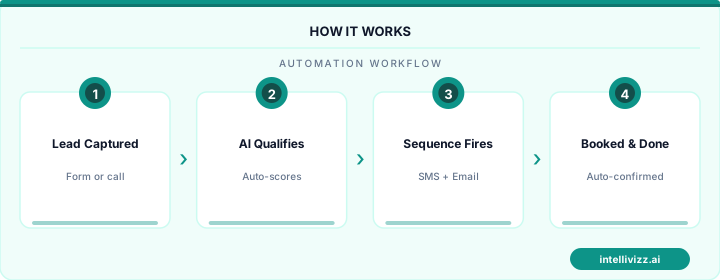
🏥 Patients expect instant responses — automation delivers
From manual processes to automated excellence
Strategy 3: Streamline the Financial Experience
Billing is the most common source of patient frustration after access. Fix it with:
- Upfront cost estimates — Before the visit, tell patients what they'll owe. Surprise bills are the #1 driver of billing-related attrition.
- Easy digital payments — Text-to-pay links, online portals, and in-office tap-to-pay eliminate check-writing and statement-mailing friction.
- Payment plans — Automated payment plans for balances over $200 keep patients from abandoning care due to cost anxiety.
- Insurance transparency — Verify benefits before the visit and communicate coverage clearly. "Your insurance covers this visit at 80%. Your estimated copay is $45."
Strategy 4: Build Provider Relationships
Patients stay with doctors, not practices. When patients feel a personal connection with their provider, retention rates exceed 90%. Tactics to strengthen this bond:
- Ensure continuity — patients see the same provider whenever possible
- Personal notes on milestones — birthday messages, "hope your knee is feeling better," new baby congratulations
- Provider availability — even brief phone or portal messages from the actual doctor create loyalty
- Care team introductions — when a provider leaves, personally introduce patients to their new provider
Strategy 5: Measure and Act on Patient Feedback
Implementing NPS (Net Promoter Score) or satisfaction surveys after each visit creates an early warning system for attrition:
- Patients scoring 9-10: Promoters — ask for Google reviews
- Patients scoring 7-8: Passive — identify and address specific improvement opportunities
- Patients scoring 0-6: Detractors — immediate personal outreach from a practice leader to resolve concerns
Practices with real-time feedback loops reduce attrition by 30-40% because problems are caught and resolved before patients silently leave.
Strategy 6: The Annual Retention Audit
Once per year, run a comprehensive retention analysis:
- Calculate your retention rate: (Patients who visited in both Year 1 and Year 2) ÷ (Patients who visited in Year 1)
- Segment attrition by provider, insurance type, age group, and appointment type
- Identify patterns — is one provider losing patients faster? Are Medicaid patients leaving at higher rates?
- Calculate the revenue impact of attrition improvements using patient lifetime value
- Set specific, measurable retention targets for the next 12 months
Practices that treat retention as a measurable KPI — not just a vague goal — consistently outperform those that focus exclusively on new patient acquisition. Combined with workflow automation, retention strategies become systematic rather than ad hoc.
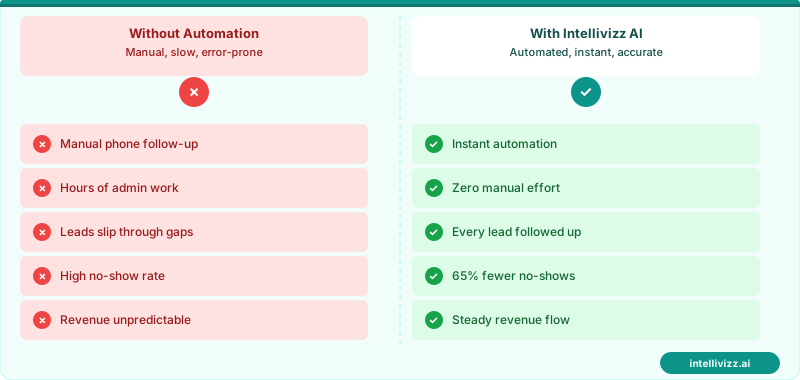
💙 Acquisition is expensive. Retention is profitable. Build your retention engine first.
Medical practices with strong retention systems grow 2.3x faster than those without.
The Retention Metrics That Actually Matter
Most practices track patient counts but not patient retention rates — a critical measurement gap. Patient retention rate is the percentage of patients who return for a second visit within 18 months of their first. Industry averages hover around 68% for primary care and 55% for specialty practices. High-performing practices achieve 80–85% first-visit retention through intentional systems, not luck.
The math on this matters: a practice with 500 new patients per year at 68% retention retains 340 patients. At 82% retention, that number is 410 — 70 additional retained patients per year, each worth multiple future visits, referrals, and reviews. Over five years, the compounding effect of a 14-point retention improvement creates hundreds of thousands of dollars in additional practice value.
The Post-Visit Communication Gap
The single most common retention failure point is the communication void between visits. Patients who feel forgotten between appointments are significantly more likely to switch to a competitor when their next health need arises — particularly if the competitor responds to their inquiry faster. A structured post-visit communication plan fills this void without requiring significant staff time:
- 24-hour check-in: Automated message asking how the patient is feeling after their visit
- Care plan reminders: Scheduled messages tied to follow-up instructions given at the visit
- Recall notices: Proactive scheduling prompts tied to the patient's care calendar
- Health content: Monthly educational email relevant to the patient's conditions or interests
| Retention Strategy | Implementation Effort | Retention Lift |
|---|---|---|
| 24-hour post-visit check-in | Low | 6–9% |
| Automated recall campaigns | Medium | 10–15% |
| Patient satisfaction surveys | Low | 4–7% |
| Referral program integration | Medium | 8–12% |
Patient retention and recall work together — see how a structured patient recall system keeps your schedule consistently full.
Ready to modernize your practice? Explore our healthcare automation solutions, or read our guide to Inactive Patient Reactivation Campaign: Templates,....