
How to Get More Google Reviews for Your Medical Practice: A Doctor's Playbook
Why Healthcare Reputation Management Operates Under Different Rules
Medical practices cannot approach online reputation the way restaurants or retail businesses do. Every interaction with a patient reviewer — whether responding to praise, addressing a complaint, or soliciting feedback — must navigate HIPAA's prohibition against acknowledging the patient-provider relationship without written authorization. A single misstep in a public review response can trigger an Office for Civil Rights investigation, result in fines ranging from $100 to $50,000 per violation, and generate the kind of publicity that compounds the reputational damage it was meant to address.
This playbook covers HIPAA-safe response protocols for ten specific review scenarios, the connections between online reputation and malpractice exposure, electronic health record integrations for automated feedback triggers, specialty-specific benchmarking, and the broader healthcare platform ecosystem beyond Google.

⭐ Your online reputation is your #1 marketing asset
The data speaks for itself
HIPAA-Compliant Review Response Templates
The cardinal rule: never confirm or deny that the reviewer is a patient, even if they identify themselves. Below are ten scenario-specific templates that maintain HIPAA compliance while addressing the reviewer's concern substantively.
| # | Review Scenario | Compliant Response Template | What to Avoid |
|---|---|---|---|
| 1 | Positive review praising a specific doctor | "Thank you for sharing your experience. Our team is dedicated to providing excellent care, and your feedback means a great deal to our practice." | Do not say "We're glad Dr. Smith took great care of you" — confirms the relationship |
| 2 | Negative review about wait times | "We understand how valuable your time is, and we continuously work to minimize wait times. We welcome the opportunity to discuss your experience privately — please contact our office at [phone]." | Do not say "We apologize for your long wait on [date]" — confirms visit details |
| 3 | Complaint about billing or insurance | "Billing concerns are important to us. We encourage you to contact our billing department at [phone/email] so we can review the details in a private and secure setting." | Do not reference specific charges, insurance plans, or account balances |
| 4 | Allegation of misdiagnosis or treatment error | "Patient safety and quality of care are our highest priorities. We take all feedback seriously and encourage you to contact our patient relations coordinator at [phone] to discuss your concerns confidentially." | Do not defend clinical decisions, reference test results, or dispute the reviewer's account |
| 5 | Review mentioning a specific procedure | "Thank you for taking the time to share feedback. We are committed to the highest standards of care and welcome direct conversations about your experience at [phone]." | Do not confirm the procedure occurred or discuss clinical outcomes |
| 6 | Review from a family member about a minor's care | "We appreciate families sharing their perspective. Our team strives to provide compassionate care to every individual. Please reach out to our office if you'd like to discuss your experience further." | Do not acknowledge treating the minor or reference the family relationship |
| 7 | Fake or spam review (no patient relationship) | "We have no record of this experience. We encourage anyone with genuine feedback to contact our office directly. We have flagged this review for the platform's review." | Do not access patient records to verify — if no match exists, state it plainly |
| 8 | Review mentioning staff by name negatively | "We value every team member and hold all staff to high standards of professionalism. We would like to understand more about your experience — please contact us at [phone]." | Do not confirm the named staff member works at the practice or discuss personnel actions |
| 9 | Review praising telehealth experience | "We're glad to hear about a positive telehealth experience. Our practice is committed to providing accessible, high-quality virtual care options." | Do not confirm the reviewer used your telehealth service specifically |
| 10 | Competitor or disgruntled former employee review | "This review does not appear to reflect a genuine patient experience at our practice. We are committed to transparency and welcome authentic feedback from the community." | Do not name the competitor or former employee; do not make accusations |
Critical HIPAA Boundary
Even if a patient posts their full name, diagnosis, and treatment details in a review, your response cannot acknowledge any of those facts. The patient waived their own privacy voluntarily — but the practice has an independent legal obligation not to confirm protected health information. Treat every response as if the reviewer is a stranger.
Malpractice Insurance Implications of Online Reputation
Medical malpractice insurers are increasingly incorporating online reputation metrics into risk assessments and premium calculations. Understanding this connection changes how practices should prioritize reputation management:
- Claims correlation data: Practices with average ratings below 3.5 stars experience malpractice claims at 1.8x the rate of practices rated 4.5+. The causation is bidirectional — poor outcomes generate both claims and negative reviews — but insurers use the correlation regardless.
- Premium adjustment triggers: Some carriers now include "material adverse change in online reputation" as a reportable event. A sustained drop of 0.5+ stars within 90 days may trigger underwriting review.
- Review response as risk mitigation: Carrier risk management departments increasingly recommend documented response protocols. A practice that responds to negative reviews within 48 hours using compliant templates demonstrates proactive risk management — which can be cited during renewal negotiations.
- Litigation discovery exposure: Review responses are discoverable in malpractice litigation. Plaintiff attorneys routinely screenshot practice responses and present them alongside medical records. A response that says "we always provide excellent care" can be reframed as arrogance if the clinical outcome was poor.
EHR/PM System Integration for Automated Feedback Triggers
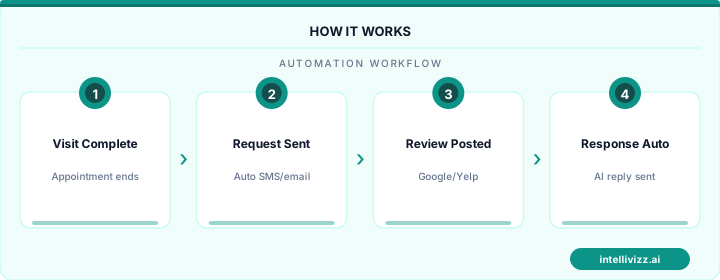
Manual review solicitation — handing a patient a card and asking them to leave a review — captures 3–5% of visits. Automated triggers embedded in the clinical workflow capture 15–25%. The integration architecture depends on your EHR/PM platform:
| EHR/PM Platform | Trigger Event | Integration Method | Implementation Complexity |
|---|---|---|---|
| Epic (MyChart) | Visit encounter closed + checkout complete | Epic App Orchard marketplace; BPA rule fires webhook on encounter close | Medium — requires Epic analyst + vendor app approval |
| Cerner (Oracle Health) | Discharge event or appointment status = completed | Cerner Open API (FHIR R4); subscription to encounter resource | Medium — FHIR endpoint configuration + OAuth2 setup |
| athenahealth | Appointment checked out in athenaClinicals | athenahealth Marketplace Partner API; webhook on appointment status change | Low — well-documented API with robust partner ecosystem |
| eClinicalWorks | Visit note signed by provider | eCW API v2; polling endpoint for signed encounters | Medium-high — API documentation gaps require vendor support |
| NextGen | Appointment status = completed in NextGen Office | NextGen FHIR API or Mirth Connect integration engine | Medium — Mirth Connect adds flexibility but requires HL7 expertise |
| Practice Fusion / Greenway | Chart note finalized | Limited API; typically requires CSV export + scheduled import | High — manual or semi-automated workaround |
Timing Optimization
The feedback request should arrive 2–4 hours after visit completion — long enough for the patient to leave the office and reflect on their experience, but before the visit fades from memory. For surgical procedures, extend the delay to 48–72 hours to allow recovery before soliciting feedback. Never send requests while the patient is still in the building.
⭐ Your online reputation is your #1 marketing asset
Smart technology, better results
Medicare and Medicaid Patient Dynamics
Government payer populations present unique reputation management considerations that commercial-payer-focused strategies miss entirely:
- CMS Star Ratings crossover: Medicare Advantage plans publish their own quality ratings. Patients enrolled in MA plans often conflate their plan's star rating with the provider's Google rating, leading to misattributed reviews ("one star because my insurance didn't cover it").
- CAHPS survey interaction: Practices participating in MIPS or ACO quality programs administer Consumer Assessment of Healthcare Providers and Systems (CAHPS) surveys. Patients receiving both a CAHPS survey and a Google review request within the same week experience survey fatigue. Coordinate timing to separate requests by at least 14 days.
- Dual-eligible complexity: Patients eligible for both Medicare and Medicaid navigate exceptionally complex billing. Billing-related negative reviews from this population are disproportionately high and require dedicated response protocols that redirect to benefits counseling rather than billing dispute resolution.
Specialty-Specific Reputation Benchmarks
A 4.2-star rating means very different things depending on specialty. Benchmarking against the wrong peer group leads to either false complacency or unnecessary alarm.
| Specialty | Median Google Rating | Review Volume (Median/Practice) | "Good" Threshold | Key Risk Factor |
|---|---|---|---|---|
| Family Medicine / Internal Medicine | 4.3 | 85 – 150 | 4.4+ | Wait time complaints dominate |
| Pediatrics | 4.5 | 60 – 120 | 4.5+ | Parental anxiety amplifies negative sentiment |
| Orthopedics / Sports Medicine | 4.2 | 70 – 130 | 4.3+ | Outcome expectations after surgery |
| Dermatology | 4.4 | 90 – 200 | 4.5+ | Cosmetic outcome dissatisfaction |
| OB/GYN | 4.1 | 55 – 100 | 4.2+ | Emotional intensity of care experiences |
| Psychiatry / Behavioral Health | 3.9 | 25 – 60 | 4.0+ | Low volume + high emotional intensity = volatile ratings |
| Oral Surgery / Dental Specialty | 4.3 | 80 – 180 | 4.4+ | Pain and recovery expectations |
| Ophthalmology | 4.2 | 70 – 140 | 4.3+ | LASIK/cataract outcome expectations |
| Urgent Care / Walk-In Clinic | 3.8 | 150 – 400 | 4.0+ | High volume + low relationship = harsh reviews |
| Pain Management | 3.6 | 30 – 70 | 3.8+ | Opioid policy frustration drives negative reviews |
Psychiatry and pain management carry structurally lower ratings — not because care quality is inferior, but because patient populations include individuals managing chronic frustration, medication disputes, and outcomes that are inherently harder to measure. Benchmarking these specialties against dermatology or pediatrics produces misleading conclusions.
Healthcare Review Platform Ecosystem Beyond Google
Google captures the largest share of healthcare review searches, but specialty-specific platforms influence patient acquisition in ways that Google Business Profile alone cannot address.
| Platform | Monthly Unique Visitors | Primary Audience | Claim/Management Cost | SEO Weight | Priority Level |
|---|---|---|---|---|---|
| Google Business Profile | ~5B+ (search) | General public | Free | Dominant | Essential |
| Healthgrades | ~50M | Patients seeking specialists | Free (basic) / $3,000+/yr (premium) | High (often ranks page 1) | High |
| Vitals | ~10M | Insurance-aware patients | Free | Medium | Medium |
| ZocDoc | ~6M | Appointment-ready patients | $300+/month per provider | Medium-high | High if accepting new patients |
| RateMDs | ~4M | Price and quality researchers | Free | Low-medium | Low (monitor only) |
| WebMD (Physician Directory) | ~75M (total site) | Health information seekers | Free (listing) / paid (ads) | High (domain authority) | Medium — claim listing |
| Yelp (Healthcare) | ~30M | Younger demographics, urgent care | Free (claim) / paid (ads) | High | Medium-high for urgent care, low for specialists |
Multi-Platform Management Strategy
Claim and verify your profile on Google, Healthgrades, and ZocDoc at minimum. Set up monitoring alerts for Vitals and RateMDs. Respond to reviews on Google and Healthgrades within 48 hours. For platforms you don't actively manage, check monthly and respond to negative reviews only. Spreading effort across every platform dilutes the quality of responses on the platforms that matter most.
State Medical Board Complaint Correlation
Negative reviews occasionally cross the line from reputation issue to regulatory risk. Understanding the correlation helps practices identify when a review requires legal counsel rather than an IR response:
- Complaint trigger patterns: Reviews that mention specific clinical details (medication names, test results, procedure complications) are 3.4x more likely to be accompanied by a medical board complaint than vague dissatisfaction reviews.
- Investigation visibility: In 28 states, medical board complaints and investigation outcomes are public record. A sustained pattern of negative reviews citing similar issues (e.g., multiple reviews mentioning over-prescribing) can create a public trail that board investigators reference during preliminary review.
- Proactive documentation: When a review alleges a specific clinical failing, document the timeline: review posted date, patient last visit date, any complaint filed date, and practice response date. This documentation is invaluable if the matter escalates to a board inquiry or malpractice claim.
For practices managing complex reputation scenarios across multiple providers, integrating review monitoring with healthcare-specific response protocols and specialty reputation strategies creates a defensible, documented system that protects both the practice's public image and its regulatory standing.
Connect your reputation infrastructure to patient retention workflows and revenue leakage analysis to close the loop: satisfied, retained patients generate the positive reviews that drive new patient acquisition.
HIPAA Penalty Structure and Enforcement Trends
Understanding the financial exposure from review-related HIPAA violations provides the business case for investing in compliant reputation management infrastructure rather than ad hoc responses:
| Violation Tier | Description | Penalty per Violation | Annual Maximum | Review-Related Example |
|---|---|---|---|---|
| Tier 1 | Unaware / could not have avoided | $100 – $50,000 | $25,000 | Staff member accidentally confirms patient status in a Google response |
| Tier 2 | Reasonable cause, not willful neglect | $1,000 – $50,000 | $100,000 | Practice responds to multiple reviews with treatment details before training staff |
| Tier 3 | Willful neglect, corrected within 30 days | $10,000 – $50,000 | $250,000 | Practice knowingly references PHI in responses but corrects after OCR notice |
| Tier 4 | Willful neglect, not corrected | $50,000 | $1,500,000 | Practice continues disclosing PHI in review responses after receiving complaint |
The Office for Civil Rights (OCR) resolved 885 enforcement actions in 2024, with an increasing number originating from patient complaints about social media and review platform disclosures. Three enforcement trends are reshaping how practices must approach online reputation:
- Expanded definition of "acknowledgment": OCR has signaled that even thanking a reviewer "for being a loyal patient for 5 years" constitutes a PHI disclosure because it confirms a treatment relationship and approximate duration.
- Screenshot-based complaints: Patients increasingly file complaints by screenshotting a practice's review response and submitting it directly through the OCR complaint portal. Resolution time has decreased from 18 months to 8-12 months.
- Corrective action plans: Settlements now routinely include mandatory privacy training, written response policy documentation, and 2-year monitoring periods — operational costs that far exceed the fine itself.
Provider Credentialing and Privileging Implications
Online reputation intersects with provider credentialing in ways most practice administrators overlook:
- Hospital privileging committees: 34% of hospitals now include an online reputation screening component in their credentialing process. Providers with sustained ratings below 3.0 stars or unresolved negative review patterns may face additional scrutiny during privilege renewal.
- Insurance panel acceptance: Selective insurance networks — particularly narrow-network Medicare Advantage plans — use patient satisfaction proxies including online ratings to evaluate provider inclusion. A persistent gap between a provider's online rating and the network's median can trigger removal review.
- Group practice recruitment: Physician recruitment firms report that 72% of candidates research a potential employer's online reputation before accepting an offer. Practices with ratings below 4.0 stars experience 40% longer time-to-fill for open positions and must offer 8-15% higher compensation to attract equivalent candidates.
- Academic affiliation: Teaching hospitals and academic medical centers evaluate affiliated practice reputations as part of their network integrity assessments. A consistently poor-performing affiliated practice may lose its academic designation, impacting both referral volume and recruitment appeal.
State-Level Patient Privacy Laws Beyond HIPAA
HIPAA sets the floor, not the ceiling. Several states impose additional restrictions that affect how practices manage online reputation:
| State | Relevant Statute | Additional Restriction | Impact on Review Management |
|---|---|---|---|
| California | CMIA (Confidentiality of Medical Information Act) | Broader definition of medical information; covers more data types than HIPAA | Responses cannot reference appointment scheduling details that HIPAA might allow |
| Texas | Texas Medical Records Privacy Act | Requires patient authorization for any disclosure, even if patient initiated the review | Even acknowledging receipt of a complaint in a response may trigger obligations |
| New York | NY Public Health Law §18 | Patients have broader access rights to their records; information asymmetry complicates responses | Patients may quote specific record contents in reviews that the practice cannot address |
| Virginia | VCDPA (Virginia Consumer Data Protection Act) | Consumer data rights extend to patient feedback data collected through review platforms | Review solicitation data (who was asked, when, response) may be subject to data access requests |
| Colorado | Colorado Privacy Act | Opt-out rights apply to "profiling" — automated review solicitation based on visit data may qualify | Automated feedback triggers may require separate opt-out mechanism beyond standard communication preferences |
Multi-state practice groups and telehealth providers must navigate the most restrictive applicable law for each patient interaction. A Virginia-based practice treating a California resident via telehealth must comply with CMIA's broader definitions when managing that patient's potential review interactions.
Reputation Management Governance Framework
Practices managing reputation at scale need a formal governance structure — not just a marketing intern monitoring Google alerts:
📋 Reputation Governance Roles
| Role | Responsibility | Escalation Authority |
|---|---|---|
| Reputation Manager (Marketing/Ops) | Monitor platforms daily, draft response templates, track velocity metrics | Escalates clinical allegations to Compliance Officer |
| Compliance Officer (Legal/Privacy) | Review all responses mentioning clinical care before publication, audit response archive quarterly | Escalates potential PHI breaches to Privacy Officer |
| Privacy Officer (HIPAA) | Investigate potential PHI disclosures in published responses, file breach notifications if warranted | Escalates to outside counsel if OCR complaint received |
| Clinical Leadership (CMO/Medical Director) | Review patterns in negative clinical feedback, implement quality improvement actions | Escalates systemic quality concerns to Board/Governance |
| Outside Legal Counsel | Advise on defamation claims, OCR response strategy, state law compliance | Manages litigation and regulatory defense |
This governance structure ensures that a negative review alleging a medication error doesn't get a marketing-drafted response that inadvertently creates discoverable admissions. Each response passes through the appropriate filter based on content severity before publication.
Integration with Clinical Quality Improvement
The most sophisticated healthcare organizations treat online reputation data as a clinical quality signal — not just a marketing metric. Negative review themes often surface operational and clinical issues months before they appear in formal quality metrics:
- Sentiment analysis pipelines: Aggregate review text across all platforms, extract themes using NLP, and map themes to department-level quality indicators. "Long wait" mentions correlating with specific days or providers triggers scheduling analysis.
- PDSA cycle integration: Feed reputation trend data into Plan-Do-Study-Act quality improvement cycles. When review data shows a sustained decline in "communication" sentiment, initiate a structured improvement project with measurable outcomes.
- Provider-level dashboards: Anonymize and aggregate review sentiment by provider to identify individuals who may benefit from communication skills coaching — a proactive intervention that improves both patient experience and malpractice risk profile.
This closed-loop approach transforms reputation management from a reactive public relations function into a proactive quality improvement engine that generates measurable clinical and financial outcomes.
Build Your HIPAA-Compliant Reputation Engine
Healthcare reputation management is not a marketing exercise — it is a compliance-governed operational function that intersects with risk management, clinical quality, and patient experience. To design a reputation management system that integrates with your EHR, satisfies HIPAA requirements, and benchmarks against your specialty peers, schedule a consultation with our healthcare automation team.
Ready to modernize your practice? Explore our healthcare automation solutions, or read our guide to Google Reviews for Doctors: How Automation Drives 5x....
Relevant AI Automations
AI Review Management (HIPAA-Compliant)
All-in-one HIPAA-compliant review management: automated review requests, AI-powered responses, and review repurposing for web & social.
HIPAA-Compliant AI Voice Agent — 24/7 Patient Call Handling
HIPAA-compliant AI voice agent answers every patient call 24/7 — triages urgency, books appointments, and sends encrypted follow-ups
Website Live Chat → Patient Booking Funnel
AI-powered live chat on the practice website engages visitors, answers questions about services/insurance, collects cont