
Google Reviews for Doctors: How Automation Drives 5x More Patient Reviews
The average medical practice receives about 4-6 Google reviews per month through organic, unprompted feedback. Practices that deploy automated review request systems average 20-35 reviews per month. That's not a marginal improvement — it's a fundamental shift in online visibility.
For doctors competing in local search, automated review collection has become as essential as having a website. Manual review requests rely on staff memory and motivation, which degrades over time. For a step-by-step technical setup, see our complete guide to automated review requests for medical practices. Automation runs consistently, regardless of how busy the day gets or whether the front desk is short-staffed.
This guide compares the leading approaches to automated review generation for doctors, breaks down how each works, and provides a clear path to implementation.
Why Manual Review Requests Fail for Medical Practices
Every practice starts with good intentions. The office manager sends a few text messages, the doctors mention reviews during appointments, and results trickle in. Then a busy week hits, and nobody asks. The pattern repeats until review generation effectively stops.
The data confirms this. Practices relying on manual processes see an 80% drop in review request volume within 90 days. Staff turnover, seasonal rushes, and the inherent awkwardness of asking for favors all conspire against consistency.
Automation solves this by removing human forgetfulness from the equation entirely. Every patient appointment triggers a review request — no exceptions, no lapses.

⭐ Your online reputation is your #1 marketing asset
See how automation transforms industry operations
How Automated Review Systems Work
Modern review automation platforms follow a consistent workflow:
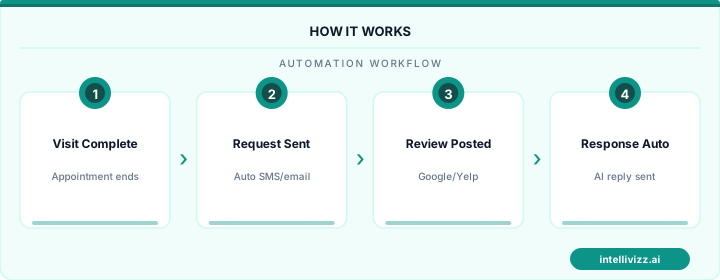
Trigger event: A patient completes an appointment, which is detected through a calendar integration, EHR export, or manual check-out action.
Delay period: The system waits a configurable amount of time (typically 1-3 hours) to allow the patient to leave the office.
Initial outreach: An SMS or email is sent with a personalized message and a direct link to the Google review form.
Follow-up sequence: If no review is detected within 24 hours, additional reminders are sent via alternate channels.
Monitoring: New reviews are tracked and the practice is alerted for timely responses.
The best systems handle this entire cycle without any staff involvement after the initial setup. The patient experience feels personal, but the backend is fully automated.
Comparing Review Automation Approaches
There are three main categories of tools that doctors use for review automation:
1. Standalone Review Platforms
Tools like Podium, Birdeye, and Reputation.com focus exclusively on review management. They typically offer SMS and email campaigns, review monitoring dashboards, and multi-location support. Pricing ranges from $250-$500/month per location.
Strengths: Purpose-built interfaces, strong analytics, multi-platform support (Google, Yelp, Healthgrades). Weaknesses: High cost, limited integration with broader practice automation, often locked into annual contracts.
2. Practice Management Add-Ons
Some EHR and practice management systems offer built-in review request features. These are convenient because they're already integrated with your patient data, but they're typically basic — a single email after each appointment with limited customization.
Strengths: No additional software, patient data already connected. Weaknesses: Minimal customization, often email-only (no SMS), no multi-step sequences, poor analytics.
3. All-in-One Automation Platforms
Platforms like Intellivizz combine review automation with broader business automation — missed call text-back, appointment reminders, patient reactivation campaigns, and lead follow-up. Review requests are one component of a complete patient communication system.
Try our Free Google Review Link Generator
Strengths: Unified platform for all patient communications, lower total cost than buying separate tools, sophisticated multi-step sequences, CRM integration. Weaknesses: Requires initial setup time to configure workflows.
Key Features to Evaluate
When choosing a review automation system for your medical practice, evaluate these capabilities:
SMS support: Text messages outperform email by 4-5x for review requests. Any system without SMS is immediately handicapped.
HIPAA compliance: The platform must offer a Business Associate Agreement (BAA) and ensure no PHI is included in outgoing messages. Learn more about compliance requirements in our HIPAA-compliant AI receptionist guide.
Direct Google link: The review request should link directly to your Google review form, not to an intermediate page.
Multi-step sequences: A single request captures some patients; a 3-step sequence captures significantly more without being annoying.
Personalization: Messages that include the patient's name and provider name convert at higher rates than generic templates.
Analytics: You need to track send volume, open rates, conversion rates, and review trends over time.
Negative feedback routing: Good systems detect dissatisfied patients and route their feedback privately before they leave a public negative review.
⭐ Your online reputation is your #1 marketing asset
From manual processes to automated excellence
Implementation: From Zero to Automated in 5 Steps
Step 1: Claim and optimize your Google Business Profile. Ensure your name, address, phone, hours, and categories are accurate. Add photos and respond to any existing reviews.
Step 2: Choose your automation platform. For practices wanting review automation alongside broader patient communication, an all-in-one platform offers the best value. For practices that only need reviews, a standalone tool works.
Step 3: Configure your trigger. Connect your scheduling system so that completed appointments automatically trigger the review request sequence. If a direct integration isn't available, most platforms offer a Zapier connection or manual check-out trigger.
Step 4: Write your messages. Keep them short, personal, and direct. Include the patient's first name and a direct link. Here's a template that consistently performs well:
"Hi [Name], thanks for visiting [Practice]. If you had a positive experience, a quick Google review helps other patients find quality care: [link]. Thank you!"
Step 5: Set your sequence timing. We recommend: initial SMS at 2 hours, follow-up email at 24 hours, final SMS reminder at 72 hours. After 72 hours, stop — more messages become counterproductive.
Real Results: What Automation Actually Delivers
Based on aggregated data from medical practices using automated review systems:
Average monthly reviews before automation: 4-6
Average monthly reviews after automation (90 days): 22-35
Average rating maintained: 4.6-4.8 stars
Review request conversion rate: 12-18% (industry benchmark: 5-8%)
Staff time saved per month: 15-20 hours (no manual follow-ups)
The compounding effect is significant. After 6 months of consistent automation, practices typically accumulate 100+ new reviews. This volume creates a durable competitive advantage in local search rankings that competitors without automation cannot match.
Pitfalls to Avoid
Even with automation, some practices undermine their own results:
Review gating: Filtering out patients likely to leave negative reviews violates Google's Terms of Service. Send the request to everyone.
Ignoring negative reviews: Automation generates more reviews — including occasional negatives. Respond professionally within 24 hours.
Over-messaging: More than 3 touchpoints per appointment crosses from persistent to annoying. Respect the patient's time.
Forgetting to update templates: If your practice name, provider, or location changes, update your templates immediately.
For practices ready to move beyond manual review requests, automation isn't just more efficient — it's the only approach that produces consistent, scalable results. The practices dominating local search in 2026 are the ones that automated their review collection in 2024 and 2025. The best time to start was yesterday; the second best time is today.
Multi-Platform Review Distribution: Beyond Google to Healthgrades, Vitals, and Zocdoc
Google Reviews dominate search result visibility, but patient acquisition for medical practices operates across a diverse ecosystem of healthcare-specific review platforms that are consulted by distinct patient segments at different stages of their provider search. A practice that focuses exclusively on Google Reviews leaves meaningful portions of its potential patient base uninfluenced by social proof. A comprehensive review distribution strategy ensures that platforms serving different patient demographics and search intents all reflect the practice's quality of care.
Platform-by-Platform Review Landscape
Healthgrades is the most widely consulted healthcare-specific review platform, with over 11 million physician reviews and more than 280 million unique annual visitors. Healthgrades carries particular weight with patients over 50 — a demographic that disproportionately uses healthcare services and whose platform trust patterns favor established medical-specific sites over general-purpose platforms. Healthgrades aggregates malpractice history, board certifications, hospital affiliations, and patient reviews in a single profile, providing a level of credential verification that patients find reassuring when selecting a new specialist or primary care physician. Review solicitation for Healthgrades requires directing patients to claim or create a Healthgrades account, which introduces a friction step that reduces completion rates compared to direct-link review flows available on Google.
Vitals.com reaches a somewhat younger, more digitally native patient demographic and places particular emphasis on wait time, bedside manner, and appointment ease as distinct rating dimensions — factors that patients in this demographic weight heavily in provider selection decisions. Vitals reviews carry less SEO impact than Google Reviews but contribute to the overall volume of positive sentiment visible in Google search results through Knowledge Panel aggregation. Practices with strong care experience metrics but historically long wait times should be cautious about which platforms they prioritize for review solicitation — a high volume of Vitals reviews that prominently highlight wait time dissatisfaction can create a negative impression that contradicts positive clinical quality signals on other platforms.
Zocdoc serves as both a review platform and an appointment booking system, meaning reviews on Zocdoc are directly adjacent to patient acquisition conversion actions. A provider with 50+ Zocdoc reviews and consistently high ratings receives algorithmic promotion within Zocdoc's search results for patients searching in their specialty and geographic market. Zocdoc reviews can only be submitted by patients who have booked and attended an appointment through the Zocdoc platform, which creates a verified review quality advantage but limits the universe of patients who can contribute reviews. Practices that use Zocdoc for a significant share of appointment bookings should implement review solicitation specifically targeting post-visit Zocdoc communication, since Zocdoc's own post-visit review request emails have historically low open and completion rates.
RateMDs maintains a substantial archive of historical physician reviews and ranks well in Google searches for physician names in many markets. Unlike Healthgrades and Vitals, RateMDs allows anonymous reviews without account creation, which reduces friction for reviewers but also reduces verification. Practices that have accumulated negative or inaccurate reviews on RateMDs before implementing a proactive review strategy may find that improving their RateMDs profile requires a sustained effort to generate new positive reviews that push older negative content down the platform's default sort order.
WebMD's physician directory and review integration reaches patients who are researching symptoms and treatment options before selecting a provider — a high-intent audience who may be in active care-seeking mode. A positive review presence on WebMD physician profiles positions a practice favorably at the exact moment patients transition from health information search to provider selection search, representing a distinct patient acquisition opportunity from the platforms that serve patients who have already decided to seek care.
HIPAA Considerations in Review Solicitation
Medical practice review solicitation operates in a uniquely regulated environment because the patient-provider relationship is covered by HIPAA, and review solicitation communications must be designed to avoid creating regulatory risk. While review solicitation is broadly permissible for healthcare providers, specific implementation details can create HIPAA compliance exposure if not carefully managed.
The core HIPAA risk in review solicitation is Protected Health Information (PHI) disclosure. A review request that references a patient's specific appointment, diagnosis, or treatment detail in the solicitation message constitutes disclosure of PHI in a marketing communication and requires specific patient authorization. A review request text message reading "Thank you for your appointment with Dr. Sharma for your knee evaluation — we'd love your feedback" has disclosed PHI (the appointment date and clinical context) without appropriate authorization, regardless of whether the patient consented to appointment-related communications.
HIPAA-compliant review solicitation messages avoid any clinical specificity. The message should reference only that the practice values patient feedback and provide a link or instructions for leaving a review, without referencing the nature, date, or provider of the patient's care. Some practices choose to send review solicitation through a generic communication pathway (a system with no PHI access that receives only a patient name and contact information, with no clinical context) rather than through their practice management system, as an architectural control that prevents inadvertent PHI inclusion in templated messages.
Business Associate Agreement (BAA) requirements apply when a third-party review solicitation platform receives PHI from the practice's systems. If the review platform vendor receives appointment data, provider attribution, or any other PHI to enable personalized or timed review requests, they must execute a BAA with the practice that confirms their HIPAA compliance obligations. Practices evaluating review automation vendors should request BAA execution as a standard contract requirement and should treat vendors who resist BAA execution as disqualified from consideration for HIPAA-covered clinical communication workflows.
Negative Review Response: Legal Implications and Risk Management
Responding to negative online reviews in a healthcare context carries legal risks that do not apply to other industries. The fundamental constraint is that any response to a negative review that confirms the reviewer is a patient or that references any aspect of the reviewer's care constitutes PHI disclosure, even if the information disclosed appears in the patient's own public review.
The legally safe response framework for medical practice negative reviews acknowledges the reviewer's concern without confirming any clinical facts, expresses general commitment to quality care and patient experience, and invites the reviewer to contact the practice directly to discuss their concern through a confidential channel. A response along the lines of: "Thank you for sharing your feedback. Providing excellent care to every patient is our highest priority. If you'd like to discuss your experience directly, please contact our patient relations team at [phone number]" meets legal safety standards while demonstrating responsiveness to potential patients reading the exchange.
Legal counsel involvement becomes necessary when negative reviews contain false factual claims about clinical events, when reviews appear to be submitted by competitors or individuals who were never patients of the practice, and when review content creates liability exposure related to specific clinical outcomes. Practices should establish a pre-defined escalation protocol for negative reviews that meet these criteria, with clear criteria for when the practice manager handles response independently versus when the response must be reviewed by legal counsel before posting.
Platform-specific review removal policies provide a legitimate avenue for addressing fraudulent or policy-violating reviews. Google, Healthgrades, and Zocdoc all maintain policies against reviews from non-patients, competitor-submitted reviews, and reviews containing personally identifying information about third parties. Submitting a flagging request through the platform's review dispute mechanism — not responding publicly with accusations — is the appropriate first step when a review appears to violate platform policies. Success rates for review removal vary by platform and specific violation type; Healthgrades has historically been more responsive to removal requests with supporting documentation than Google, where the removal process can take weeks and is subject to opaque algorithm decisions.
Review Content Quality Analysis: Sentiment Scoring and Patient Experience Intelligence
Reviews are not just reputation assets — they are a structured feedback channel that, when analyzed at scale, provides actionable intelligence about patient experience drivers that surveys may miss. Medical practices that implement systematic review content analysis beyond star rating averages extract operational intelligence that directly improves care delivery and reduces the root causes of negative reviews.
Sentiment scoring at the review level classifies each review on a positive-negative spectrum using natural language processing models trained on healthcare review language. Basic sentiment scoring is now available through commercial APIs (Google Natural Language API, AWS Comprehend Medical, and healthcare-specific NLP platforms like Symplur and Treato) that return sentiment scores without requiring machine learning expertise from the practice. Review batches exported monthly from each platform can be analyzed to identify trending sentiment shifts — if sentiment scores for appointment scheduling and wait time begin declining across multiple platform reviews in the same quarter, the signal may indicate a staffing or scheduling system change that is generating patient friction not yet visible in satisfaction survey scores.
Keyword density analysis in patient reviews reveals which care experience dimensions patients describe most frequently and with what emotional valence. A practice receiving 40 new reviews per month that discovers the word "rushed" appearing in 22% of reviews has identified a care experience problem (perceived appointment time pressure) with a specificity that "patient satisfaction" survey scores cannot provide. Similarly, a practice that discovers its highest-sentiment reviews consistently mention a specific staff member by name has identified a patient experience asset — that staff member's behaviors and communication style are worth understanding and potentially training across the broader team.
Competitive review content analysis — systematically reading and categorizing reviews for competing practices in the same geographic market — provides market intelligence about the patient experience strengths and weaknesses competitors are unable to hide from public view. A competing practice receiving a high volume of reviews mentioning "billing confusion" and "insurance problems" has a weakness that the analyzing practice can address by emphasizing billing transparency and insurance verification support in its own patient communication and marketing. This competitive intelligence, derived from public review data rather than proprietary research, is available to any practice willing to invest in systematic analysis.
Ready to modernize your practice? Explore our healthcare automation solutions, or read our guide to How to Get More Google Reviews for Your Medical....