
Medical Practice Revenue Leakage: 7 Hidden Drains and How to Plug Them with Automation
What Is Revenue Leakage in Medical Practices?
Revenue leakage is the gap between what a medical practice should earn and what it actually collects. Unlike a single dramatic event, leakage is death by a thousand small cuts — each one seemingly minor, but together representing 15-25% of potential revenue. For a practice generating $2 million annually, that's $300,000-$500,000 disappearing through cracks in the operation.
The insidious nature of revenue leakage is that most practice administrators can't see it. It hides in processes that "have always worked this way" and shows up only when you compare your numbers to industry benchmarks or implement tracking systems that expose the gaps.
🏥 Patients expect instant responses — automation delivers
Smart technology, better results
Drain #1: Missed Phone Calls
Missed calls are the largest single source of revenue leakage for most practices. The average practice misses 30% of incoming calls, and 75% of those callers never call back.
Annual impact: $150,000-$400,000 depending on specialty and call volume
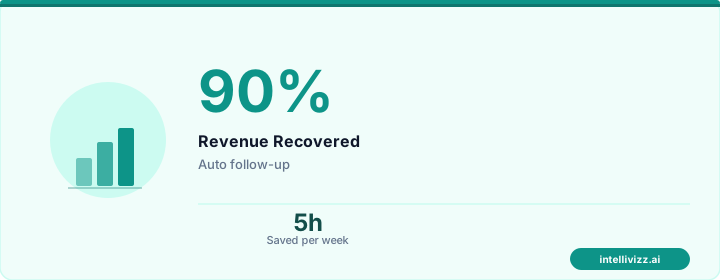
Automation fix: AI receptionist systems answer every call on the first ring, 24/7. They schedule appointments, answer FAQs, and triage urgent calls — converting missed opportunities into booked revenue. Practices implementing AI phone answering recover 80-90% of previously lost call revenue.
Drain #2: Patient No-Shows
No-shows and same-day cancellations waste provider time, staff preparation, and room utilization. With average no-show rates of 18-25% across specialties, this is the second-largest revenue drain.
Annual impact: $120,000-$300,000 per provider
Automation fix: Multi-channel automated reminders (SMS, email, voice) sent at strategic intervals reduce no-shows by 30-45%. Adding automated waitlist backfill — where the system texts waitlisted patients when a slot opens — recovers an additional 20-30% of cancelled appointment revenue.
Drain #3: Undercoding and Missed Charges
Physicians consistently undercode their services. Studies show that 20-30% of E&M visits are coded at a lower level than the documentation supports, and 15% of billable services are never captured at all (minor procedures, extended counseling, care coordination).
Annual impact: $50,000-$120,000 per provider
Automation fix: AI-powered coding assistance analyzes visit documentation and suggests appropriate codes, flagging potential undercoding. Automated charge capture systems ensure every billable service — from flu shots to ECGs — is recorded and submitted.
🏥 Patients expect instant responses — automation delivers
The data speaks for itself
Drain #4: Claim Denials and Delayed Payments
The average medical practice has a claim denial rate of 5-10%, and 60% of denied claims are never reworked. Even among reworked claims, resolution takes 30-60 days, tying up cash flow.
Annual impact: $40,000-$100,000
Automation fix: Automated eligibility verification before appointments catches insurance issues before they become denials. Real-time claim scrubbing identifies errors before submission. Automated denial management workflows flag, prioritize, and track rework of denied claims, increasing recovery rates from 40% to 85%.
Drain #5: Slow Patient Collections
Patient responsibility now averages 30-35% of medical bills, up from 10% a decade ago. Yet most practices collect only 50-70% of patient balances, with the rest written off after ineffective paper statement cycles.
Annual impact: $60,000-$150,000
Automation fix: Automated payment systems send digital statements, offer payment plans, process credit card payments, and follow up with escalating reminder sequences. Practices using automated patient billing see collection rates improve from 55% to 85%, with average time-to-payment dropping from 45 days to 12 days.
Drain #6: Inactive Patient Attrition
The average practice loses 10-15% of its active patient panel annually — not because patients are dissatisfied, but because they simply fall out of the recall cycle. Without proactive outreach, these patients drift to competitors or just stop seeking preventive care.
Annual impact: $80,000-$200,000 (based on lifetime value of lost patients)
Automation fix: Automated patient recall campaigns identify patients overdue for visits and reach out via their preferred channel. AI follow-up systems can personalize outreach based on the patient's health conditions, insurance status, and communication preferences, achieving reactivation rates of 25-40%.
Drain #7: Referral Leakage
When your practice refers patients to specialists, 25-40% never complete the referral. The patient either forgets, can't navigate the scheduling process, or chooses a different specialist. This represents lost continuity-of-care revenue and weakened referral relationships.
Annual impact: $30,000-$80,000
Automation fix: Automated referral tracking systems monitor whether patients complete specialist visits and trigger reminder sequences for those who haven't. Referral program automation closes the loop, ensuring your practice captures the downstream revenue from specialist follow-ups and return visits.
Total Revenue Leakage: The Full Picture
| Leakage Source | Low Estimate | High Estimate |
|---|---|---|
| Missed calls | $150,000 | $400,000 |
| No-shows | $120,000 | $300,000 |
| Undercoding | $50,000 | $120,000 |
| Claim denials | $40,000 | $100,000 |
| Slow collections | $60,000 | $150,000 |
| Patient attrition | $80,000 | $200,000 |
| Referral leakage | $30,000 | $80,000 |
| Total | $530,000 | $1,350,000 |
For a practice with $2-3 million in annual revenue, plugging even half of these leaks adds $265,000-$675,000 to the bottom line. The automation tools to address all seven drains typically cost $2,000-$5,000/month combined — delivering 10-20x ROI.
Where to Start
Don't try to fix everything at once. Prioritize by impact and ease of implementation:
- Week 1: Implement AI phone answering to stop the largest leak immediately
- Week 2-3: Set up automated appointment reminders and waitlist management
- Month 2: Deploy automated patient billing and payment collection
- Month 3: Add patient recall campaigns and referral tracking
- Ongoing: Implement coding optimization and denial management
Each step builds on the previous, creating a comprehensive workflow automation system that plugs revenue leaks systematically. Most practices see positive ROI within 30 days of implementing step one.
Building a Revenue Integrity Team
Plugging revenue leaks is not a one-person job. Sustainable revenue integrity requires a cross-functional team that meets regularly, shares data transparently, and holds each department accountable for specific financial metrics. Here is how to structure that team for maximum impact.
Cross-Departmental Stakeholder Roles
Your revenue integrity team should include representatives from front desk operations, clinical coding, billing and collections, and practice leadership. The front desk owns insurance verification accuracy and copay collection rates. Coders are accountable for charge capture completeness and documentation query turnaround time. Billing staff track denial rates, days in accounts receivable, and appeal success percentages. Leadership provides strategic direction and removes organizational barriers. Each member brings visibility into a different segment of the revenue cycle, eliminating the blind spots where leakage hides.
Monthly Revenue Auditing Cadence
Establish a monthly audit rhythm that examines a randomized sample of encounters from each provider. Review at least 20 charts per provider, checking for under-coding, missed charges, modifier errors, and documentation gaps. Track results on a rolling dashboard so trends become visible — a single month's data is noise, but six months reveals patterns. Tie audit findings directly to targeted education sessions, so providers understand the financial impact of documentation habits and can correct course quickly.
Automating your payment follow-up process through medical practice payment automation frees your team to focus on higher-value audit and recovery work rather than manual collection calls.
Benchmarking Against Specialty Averages
Without external benchmarks, internal improvements lack context. Compare your practice's denial rate, collection ratio, days in A/R, and cost-to-collect against published specialty benchmarks from MGMA or HFMA. If your denial rate is 12 percent but the specialty average is 6 percent, you know the problem is solvable because peers have solved it. Use benchmark gaps to prioritize initiatives — focus first on the metric where your practice deviates most from the median, since that represents the largest recoverable revenue opportunity.
For more on optimizing financial operations, explore our guide on automated patient billing reminders or learn about payment automation strategies.
Ready to modernize your practice? Explore our healthcare automation solutions, or read our guide to Insurance Claim Denial Follow-Up Automation: Stop....