
How Much Revenue Do Medical Practices Lose from Missed Calls? The Data Is Alarming
The Missed Call Revenue Gap
Every time a medical practice phone rings and no one answers, money disappears. Not metaphorically — literally. Research shows the average medical practice misses 30% of incoming calls, and 75% of those callers will not call back. They'll call the next provider on their search results instead.
For a practice receiving 80-120 calls per day, that means 24-36 missed calls daily. If even 40% of those are new patient inquiries or appointment requests, the revenue implications are staggering.

📞 62% of business calls go unanswered — don't be one of them
From manual processes to automated excellence
Revenue Per Missed Call by Specialty
The financial impact varies dramatically by specialty because patient lifetime value differs. Here's what the data shows:
| Specialty | Avg Revenue per New Patient (Year 1) | Missed Calls/Day | Est. Annual Lost Revenue |
|---|---|---|---|
| Orthopedics | $2,800-$4,500 | 8-12 | $380,000-$650,000 |
| Dermatology | $1,200-$2,000 | 10-15 | $250,000-$420,000 |
| Primary Care | $800-$1,500 | 12-18 | $200,000-$380,000 |
| Dental (General) | $1,000-$1,800 | 8-12 | $170,000-$310,000 |
| Pediatrics | $600-$1,200 | 15-20 | $190,000-$350,000 |
| Optometry | $400-$900 | 6-10 | $80,000-$160,000 |
These figures account for the conversion funnel: not every missed call would have become a patient, but enough would to represent a massive revenue gap.
The Hidden Costs Beyond Direct Revenue
Direct appointment revenue is just the visible tip of the iceberg. Missed calls create cascading financial damage:
Referral Revenue Loss
A missed call from an existing patient seeking a referral doesn't just lose that one interaction — it loses the downstream revenue from the specialist they would have referred to you, and the referral credit from the specialist's office.
Reputation Damage
Patients who can't reach your office leave negative reviews at 3x the rate of patients with access complaints about any other issue. Each negative review costs an estimated 30 potential patients, creating a compounding revenue drain.
Staff Burnout and Turnover
When phone volume overwhelms front desk staff, burnout follows. Replacing a medical receptionist costs $3,500-$7,000 in recruiting and training. Practices with chronic phone coverage gaps experience 40% higher front desk turnover.
Inefficient Callbacks
Staff who do attempt callbacks reach voicemail 60-70% of the time, spending 3-5 minutes per attempt on calls that produce no result. At $18-$22/hour, a full-time employee spending 2 hours daily on unsuccessful callbacks costs $9,000-$11,000 annually in pure waste.
When Missed Calls Happen: The Data Pattern
Missed calls aren't random. They follow predictable patterns that practices can address:
- Monday mornings (8-10 AM) — 40% higher call volume than average as patients call about weekend symptoms
- Lunch hour (12-1 PM) — Staff breaks reduce coverage; patients call during their own lunch breaks
- After 4 PM — Late-day calls catch practices winding down; these callers are often working parents who couldn't call earlier
- Hold abandonment — 62% of callers hang up after 60 seconds on hold; the medical industry average hold time is 2 minutes 17 seconds
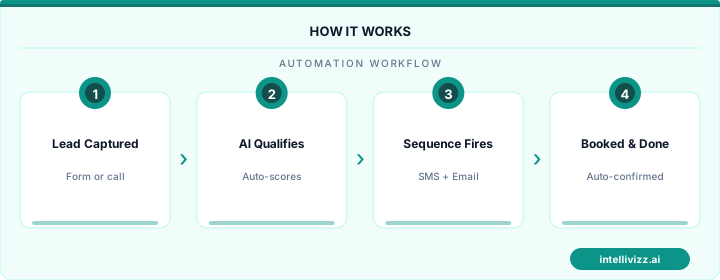
📞 62% of business calls go unanswered — don't be one of them
See how automation transforms industry operations
The Math: What One Missed Call Actually Costs
Let's trace the full revenue impact of a single missed call from a potential new patient at a family medicine practice:
- Initial visit revenue: $250 (new patient E&M code)
- Follow-up visits Year 1: $600 (average 4 visits at $150)
- Lab and diagnostics: $300 (annual bloodwork, screenings)
- Prescriptions managed: $150 (management fees for chronic conditions)
- Referral value: $200 (estimated kickback value from specialist referrals)
- Patient lifetime value (5 years): $6,500
When you multiply that by the 15-25% of missed calls that represent new patient opportunities, each missed call carries an expected value of $975-$1,625. At 30 missed calls per day, the daily expected loss is $29,250-$48,750.
Solutions That Actually Work
AI Phone Answering
An AI phone answering service eliminates missed calls entirely by answering every call on the first ring, 24/7. Unlike voicemail or traditional answering services, AI can schedule appointments, answer common questions, and triage urgent needs — converting calls into revenue instead of lost opportunities.
Missed Call Text-Back
For practices not ready for full AI, an automated text-back system sends an immediate SMS to any caller who reaches voicemail: "Sorry we missed your call. Reply here to schedule an appointment or we'll call you back within 15 minutes." This recovers 25-35% of otherwise lost calls.
Smart Call Routing
Distributing calls across multiple staff members based on availability, rather than sending all calls to one front desk phone, reduces hold times by 40-60% and missed calls by 25-30%.
Calculating Your Practice's Missed Call Revenue Loss
Here's a simple formula to estimate your annual loss:
(Daily call volume × Miss rate × New patient %) × Avg first-year patient revenue × 260 business days
For a practice with 100 daily calls, 30% miss rate, 20% new patient inquiries, and $1,200 average first-year revenue:
100 × 0.30 × 0.20 × $1,200 × 260 = $1,872,000 in potential annual lost revenue
Even at a conservative 10% conversion rate of those inquiries, that's $187,200 — well over the cost of any phone coverage solution. Practices that track their missed call costs are consistently shocked by the numbers.
Frequently Asked Questions
How do I measure my practice's actual missed call rate?
Most modern phone systems include analytics showing total calls, answered calls, abandoned calls, and voicemail drops. If yours doesn't, services like CallRail or Smith.ai offer call tracking that integrates with your existing phone number.
Is the missed call problem worse for small practices?
Yes. Solo and small group practices with 1-2 front desk staff miss 35-45% of calls compared to 20-25% for larger practices with dedicated phone teams. The impact per missed call is the same, but the rate is higher.
Can't I just hire more front desk staff?
You can, but at $38,000-$48,000 per FTE (salary plus benefits), you're paying roughly $3,200-$4,000/month for a human who still misses calls during bathroom breaks, sick days, lunch, and after hours. AI front desk solutions cost 80-90% less and never miss a call.
Building a Zero-Missed-Call Culture
Reducing missed calls is not just a technology problem — it requires organizational commitment to answering every ring. A zero-missed-call culture aligns staffing, technology, and accountability systems around a single measurable goal. Here is how to build that culture from the ground up.
Staffing Coverage Gap Analysis
Pull your call volume data by hour for the past 90 days and overlay it against your staffing schedule. Most practices discover predictable coverage gaps — the lunch hour, Monday mornings, Friday afternoons, and the 4:30-5:00 PM window when staff begin closing procedures but patients are leaving work and ready to call. Quantify the revenue impact of each gap by multiplying missed calls during that window by your average new-patient value. Use this analysis to justify staggered lunch breaks, part-time staff during peak hours, or automated overflow solutions for specific time windows rather than across the entire day.
Overflow Routing Architecture
Design a multi-tier routing system that activates progressively as hold times increase. Tier one routes to available front-desk staff. If all lines are occupied for more than 30 seconds, tier two routes to a back-office team member trained in basic scheduling. If tier two is unavailable, tier three routes to a virtual receptionist or AI-powered answering system that can schedule appointments, answer common questions, and capture callback information. Each tier should be invisible to the caller — no "please hold while we transfer you" messages that invite hang-ups. The goal is zero rings going unanswered, regardless of internal staffing conditions.
Deploying an after-hours answering service extends your overflow architecture beyond business hours, ensuring that the 40 percent of calls occurring before 8 AM or after 5 PM receive the same professional handling as mid-day calls.
Call Abandonment Rate Monitoring Dashboards
Install a real-time dashboard visible to front-desk staff that displays current call abandonment rate, average hold time, and number of calls in queue. When the abandonment rate exceeds your target — five percent is a strong benchmark — the dashboard changes color, creating an immediate visual signal that more phone coverage is needed. Review abandonment data weekly with your team, celebrating improvements and investigating spikes. Tie call performance to team recognition programs, not punitive measures, because staff who feel empowered to solve the problem outperform those who feel monitored.
For more on capturing patient calls, explore our guide on understanding the cost of missed calls or learn about after-hours answering solutions.
The Staffing Economics Behind Chronic Call Abandonment
Understanding why medical practices miss calls requires examining the staffing economics that create chronic phone coverage gaps — a workforce management problem that raw revenue-loss statistics obscure. The root cause is not technology failure but labor market dynamics that make adequate phone staffing economically irrational under traditional hiring models.
Full-time equivalent (FTE) calculations reveal the staffing gap clearly. A medical practice operating 50 hours per week with an average call volume of 15 calls per hour needs continuous phone coverage. A single FTE provides approximately 1,700 productive hours per year after subtracting PTO, sick days, lunch breaks, bathroom breaks, and administrative tasks. Covering 2,600 annual operating hours therefore requires a minimum of 1.53 FTEs dedicated solely to phone answering — before accounting for peak-hour surges that routinely double or triple the average call rate. Most practices staff 1.0 FTE for phones and wonder why 30% of calls go unanswered.
Overtime labor costs compound the problem. When the primary receptionist calls in sick or takes vacation, the practice faces a choice: pull a medical assistant from clinical duties (reducing provider productivity and billable encounters) or authorize overtime for another front-desk employee. At time-and-a-half rates, overtime phone coverage costs $28-35 per hour for a position that pays $18-23 at straight time. Practices averaging just 10 overtime hours per week spend an additional $14,500-$18,200 per year on phone coverage that still leaves evenings, weekends, and holidays completely unattended.
Receptionist turnover rates in medical practices run 30-45% annually — roughly double the overall healthcare worker turnover rate. Each departure triggers a replacement cycle costing $3,500-$6,000 in job posting fees, interview time, background checks, and training hours. During the 3-6 week vacancy-and-ramp period, call answering rates plummet as remaining staff absorb the workload. A practice that loses two receptionists per year spends $7,000-$12,000 on replacement costs while experiencing 6-12 weeks of degraded phone performance — exactly the windows when missed-call revenue losses spike.
Temp agency markup percentages for medical receptionist placements run 40-65% above the equivalent hourly wage, meaning a $20/hour receptionist costs the practice $28-33/hour through a staffing agency. Temp workers also lack familiarity with the practice's scheduling templates, insurance verification procedures, and provider preferences, resulting in longer call handling times and higher error rates that generate downstream rework for permanent staff.
Bilingual staff premiums add another cost layer for practices in diverse metropolitan areas. Spanish-English bilingual receptionists command a 10-15% wage premium, and practices needing Mandarin, Vietnamese, Korean, or Arabic coverage often pay 20-30% above baseline because the labor pool is significantly smaller. Practices that cannot afford bilingual staff miss or mishandle calls from limited-English-proficiency patients, creating both revenue loss and potential OCR compliance exposure under Title VI language access requirements.
Virtual assistant hourly rates from medical-specific services like HelloRache, MyOutDesk, or Nexa range from $8-18 per hour depending on training level and language capabilities. While substantially cheaper than domestic hires, virtual assistants introduce latency issues (offshore time zones), HIPAA training gaps, and patient trust concerns when callers detect an unfamiliar accent or background noise. Workforce management software platforms like Deputy, When I Work, or QGenda can optimize shift scheduling to align staffing with call volume patterns, but they cannot solve the fundamental economic constraint: adequate phone coverage at 2024 labor rates costs $65,000-$95,000 annually for a practice that the phones generate $250,000-$500,000 in bookable revenue — a ratio that makes AI-powered answering systems economically inevitable.
Ready to modernize your practice? Explore our healthcare automation solutions, or read our guide to AI Receptionist for Medical Offices: Cut Missed Calls....