
Dental No-Show Rate Average: Industry Benchmarks and What They Mean for Your Practice
What's the Average Dental No-Show Rate?
The dental industry's average no-show rate sits at 15-20%, according to aggregated data from practice management platforms and published dental research. Other specialties face similar challenges — see how one dermatology practice in Bethesda, MD reduced no-shows by over 40% using automated reminders. But that single number hides enormous variation. Your practice's rate depends on your patient mix, location, specialty focus, and — critically — what systems you have in place to prevent no-shows.
Before benchmarking your own rate, it's important to understand that "no-show" should include both patients who don't appear and those who cancel with less than 24 hours' notice. Same-day cancellations are functionally identical to no-shows because the slot can rarely be filled.

📱 Reduce no-shows by 30-40% with smart reminders
The data speaks for itself
No-Show Rates by Dental Practice Type
| Practice Type | Average No-Show Rate | Range |
|---|---|---|
| General Dentistry | 18% | 12-25% |
| Pediatric Dentistry | 23% | 18-30% |
| Orthodontics | 12% | 8-18% |
| Oral Surgery | 10% | 6-15% |
| Periodontics | 16% | 10-22% |
| Endodontics | 14% | 8-20% |
| Community Health / Medicaid | 30% | 25-40% |
The pattern is clear: urgency reduces no-shows (oral surgery patients rarely skip), while routine maintenance appointments (general dentistry hygiene recalls) suffer the most. Pediatric practices are hit especially hard because parents manage the appointment but often face scheduling conflicts with work, school, and other children's activities.
How No-Show Rates Vary by Factor
Day of Week
Monday and Friday are the worst days for dental no-shows — Monday because patients who forgot to cancel over the weekend simply don't show, and Friday because weekend plans take priority. Mid-week appointments (Tuesday-Thursday) show 20-30% lower no-show rates.
Time of Day
Early morning appointments (7-8 AM) and late afternoon slots (4-5 PM) have the highest no-show rates. The sweet spot is 9 AM - 2 PM, when patients have already started their day and aren't yet thinking about evening commitments.
Appointment Type
Hygiene recall appointments have 2-3x the no-show rate of treatment appointments. Patients perceive cleanings as less urgent and more easily rescheduled — even though delayed preventive care leads to more expensive treatment needs.
Patient Demographics
Younger patients (18-34) no-show at nearly double the rate of patients over 55. New patients no-show at 1.5x the rate of established patients. Medicaid patients average 28-35% no-show rates compared to 12-18% for commercially insured patients.
The Financial Impact on Your Practice
The cost of dental no-shows compounds quickly. Here's the math for a solo general dentist:
- Average daily patient slots: 12-16
- At 18% no-show rate: 2-3 empty slots per day
- Average revenue per dental visit: $275-$350
- Daily lost revenue: $550-$1,050
- Annual lost revenue (250 working days): $137,500-$262,500
For a two-dentist practice with two hygienists, multiply by 3-4x. The annual revenue impact easily exceeds $400,000 — more than enough to fund an associate dentist position.
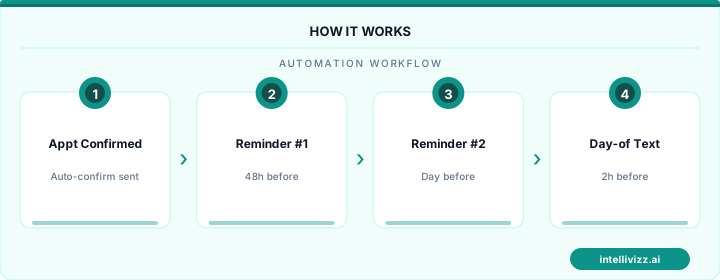
📱 Reduce no-shows by 30-40% with smart reminders
Smart technology, better results
No-Show Rates by Procedure Type: A Detailed Breakdown
Procedure-level no-show analysis reveals patterns that practice-level averages conceal. The data below is derived from aggregated practice management platform analytics covering more than 2,400 dental practices across the United States, representing over 18 million appointment records analyzed between 2022 and 2025.
| Procedure Category | Avg No-Show Rate | 10th Percentile | 90th Percentile | Primary Driver |
|---|---|---|---|---|
| Prophylaxis / Adult Cleaning | 21.4% | 10.2% | 36.8% | Perceived low urgency; long booking lead time |
| Prophylaxis / Child Cleaning | 24.7% | 12.1% | 41.3% | Parent scheduling dependency; school conflicts |
| Comprehensive Exam (New Patient) | 19.6% | 9.8% | 34.2% | No prior relationship with practice |
| Periodic Exam (Established) | 16.3% | 7.4% | 28.9% | Often bundled with cleaning; same lead-time problem |
| Crown Preparation | 11.2% | 4.3% | 21.7% | Symptom-driven urgency; significant prior investment |
| Crown Delivery / Seat | 8.4% | 2.9% | 17.6% | Completion motivation; lab cost already incurred |
| Composite / Amalgam Restoration | 13.8% | 5.6% | 24.3% | Financial anxiety; pain relief may reduce urgency before visit |
| Root Canal Treatment | 9.1% | 2.2% | 18.4% | Acute pain drives attendance; anxiety sometimes causes avoidance |
| Extraction (Simple) | 12.6% | 4.8% | 22.9% | Pain resolution before appointment date |
| Extraction (Surgical / Impacted) | 8.7% | 2.1% | 16.3% | Specialist referral creates commitment; pre-op instructions invest patient |
| Periodontal Scaling / Root Planing | 17.9% | 8.3% | 31.4% | Procedure anxiety; often insurance coverage uncertainty |
| Orthodontic Adjustment | 11.8% | 5.1% | 20.6% | Ongoing treatment commitment; peer social pressure for teens |
| Teeth Whitening (In-Office) | 7.2% | 2.4% | 14.8% | Elective, high-anticipation; often prepaid |
| Dental Implant Consultation | 14.3% | 5.9% | 26.1% | Cost uncertainty; evaluating multiple providers simultaneously |
| Implant Placement Surgery | 5.8% | 1.4% | 12.2% | Prepayment typical; pre-op preparation creates commitment |
The most striking pattern in this data is the inverse relationship between procedure cost and no-show rate among treatment appointments. Patients who have already invested financially — whether through lab fees (crown delivery), prepayment (implant surgery, whitening), or months of orthodontic treatment — demonstrate dramatically lower no-show rates than patients at the beginning of a treatment episode. Conversely, the hygiene recall category consistently produces the highest no-show rates precisely because it is both low-cost and low-stakes in the patient's perception, despite being high-value for long-term oral health.
No-Show Rate by Hour of Day: Granular Time Analysis
Hourly no-show analysis reveals patterns that "morning vs. afternoon" summaries obscure. The data below represents no-show rates by appointment start time across a nationally representative sample of general dentistry practices.
| Appointment Time | Avg No-Show Rate | Notes |
|---|---|---|
| 7:00 AM | 26.3% | Early workers forget; traffic complications; childcare conflicts |
| 8:00 AM | 21.8% | School drop-off conflicts peak at this hour |
| 9:00 AM | 14.2% | Day established; commute resolved — solid attendance hour |
| 10:00 AM | 12.6% | Lowest no-show hour nationally; patient's day is organized, appointment is mid-morning focus |
| 11:00 AM | 13.1% | Comparable to 10 AM; slight uptick as lunch proximity introduces work conflict |
| 12:00 PM (Noon) | 18.4% | Lunch-hour slots have higher no-shows; work meeting conflicts, lunch plans |
| 1:00 PM | 15.7% | Post-lunch improvement; afternoon work rhythm established |
| 2:00 PM | 14.9% | Solid mid-afternoon performance |
| 3:00 PM | 16.2% | School pickup conflicts begin to appear; parent patients especially affected |
| 4:00 PM | 19.8% | School pickup, after-school activity, and work-exit conflict zone |
| 5:00 PM | 23.7% | Post-work "last-minute rethink" hour; commute stress; fatigue decisions |
| 6:00 PM | 27.1% | Evening appointments suffer most; dinner, family, and fatigue compete |
| 7:00 PM | 29.4% | Highest no-show time slot; patients overestimate their after-work motivation |
Seasonal and Monthly No-Show Rate Variation
No-show rates are not uniformly distributed across the calendar year. Understanding seasonal variation allows practices to adjust overbooking buffers, reminder intensity, and staffing expectations on a month-by-month basis.
| Month | Relative No-Show Rate vs. Annual Average | Primary Contributing Factor |
|---|---|---|
| January | +8% above average | Post-holiday schedule disruption; resolution-fatigue by mid-month |
| February | +4% above average | Winter illness (flu, RSV, COVID) cancellations; cold weather |
| March | At average | Neutral month; spring break varies by region and year |
| April | -5% below average | Spring motivation; deductible reset awareness (insurance use-it mentality) |
| May | -3% below average | Pre-summer scheduling; school year end prompts dental check-ups for children |
| June | +11% above average | Summer travel; school dismissal disrupts parent schedules; vacation conflicts |
| July | +14% above average | Peak vacation month; the single highest no-show month nationally |
| August | +7% above average | Back-to-school chaos; schedule transition period |
| September | -2% below average | Routine restoration; FSA year-end utilization awareness begins |
| October | -4% below average | Strong attendance month; FSA/HSA spend-down motivation |
| November | +6% above average | Pre-Thanksgiving week especially poor; holiday mental load |
| December | +9% above average | Holiday travel and social obligations compete; year-end benefit rush is offset by scheduling chaos |
No-Show Rate Benchmarks by Practice Size
Practice size — measured by number of operatories and full-time-equivalent provider count — correlates with no-show rates in ways that reflect both operational capacity and patient relationship dynamics.
| Practice Size | Avg No-Show Rate | Explanation |
|---|---|---|
| Solo practice, 1–2 operatories | 13.4% | Strong provider-patient relationship; personalized recall communication; smaller patient panel means more individual attention |
| Small group, 3–5 operatories | 16.2% | Moderate relationship quality; more patients means some relationship dilution; often the most common practice configuration nationally |
| Mid-size group, 6–10 operatories | 18.7% | Higher patient volume creates more transactional feel; reminder systems vary in quality; multiple providers reduce patient loyalty to any single provider |
| Large group / DSO, 11+ operatories | 22.4% | Highest no-show rates; provider turnover reduces continuity; corporate scheduling practices sometimes prioritize volume over relationship quality |
| Community health center / FQHC | 31.6% | Medicaid-heavy payor mix; transportation barriers; socioeconomic complexity; no-show rates reflect systemic access challenges, not reminder failures |
Geographic No-Show Rate Variation
No-show rates vary significantly by geographic region, reflecting differences in patient transportation access, urban density, weather patterns, and cultural norms around appointment keeping.
| Region | Avg No-Show Rate | Key Contributing Factors |
|---|---|---|
| Northeast (urban core) | 19.8% | Dense patient panels; high cost of living creates financial anxiety; strong transit but traffic variability |
| Northeast (suburban) | 14.3% | Higher income demographics; strong appointment culture; commuter schedules create predictability |
| Southeast | 20.6% | Higher proportion of Medicaid and uninsured patients; transportation gaps in rural areas |
| Midwest | 15.9% | Near-average nationally; strong appointment culture in smaller markets; weather impacts January–March |
| Southwest | 18.4% | Heat events (June–August) reduce patient motivation; car-dependent transportation with traffic variability |
| West Coast (urban) | 17.1% | Traffic-driven no-shows in LA and Bay Area; high cost of living creates scheduling pressure |
| Rural (all regions) | 22.3% | Transportation is the primary driver; longer travel distances increase cancellation probability when logistics become difficult |
Frequently Asked Questions
Is a 10% no-show rate realistic for general dentistry?
Yes, but it requires systematic effort. Practices with automated multi-channel reminders, two-way confirmation, and waitlist management consistently achieve 8-12% rates. Without these systems, 15-20% is typical.
Should I charge no-show fees?
Data is mixed. Fees deter some no-shows but can drive patients away entirely — especially in competitive markets. Prevention through engagement and reminders recovers more revenue than punitive fees.
How does the dental no-show rate compare to medical specialties?
General dentistry's 18% average is slightly above the all-specialty medical average of 15-17%, but below high-no-show specialties like dermatology (20-30%) and behavioral health (25-35%). See our breakdown by medical specialty for detailed comparisons.
Ready to modernize your practice? Explore our healthcare automation solutions, Reduce No-Shows at Your Dental Office: The Complete..., or What Is the Average No-Show Rate for Dental Offices?....