
Reduce No-Shows at Your Dental Office: The Complete Action Plan
Dental offices experience higher no-show rates than most healthcare specialties — averaging 15-20% for general dentistry and up to 25% for pediatric dentistry. The 6-month hygiene recall is the worst offender, with no-show rates reaching 30-40%. Here's a dental-specific action plan to cut your no-show rate in half.
Understanding Dental-Specific No-Show Patterns
Dental no-shows are concentrated in predictable areas: hygiene recalls booked 6 months out, Monday morning and Friday afternoon appointments, new patient appointments (2-3x higher no-show rate), pediatric appointments dependent on parent schedules, and longer procedures that create anxiety. For detailed data, see our analysis of dental office no-show benchmarks.
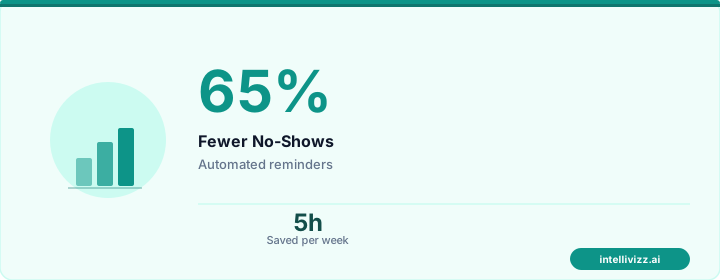
📱 Reduce no-shows by 30-40% with smart reminders
From manual processes to automated excellence
The Dental No-Show Reduction Plan
Tier 1: Automated Reminders (Week 1)
Implement a 4-touchpoint reminder sequence optimized for dental: booking confirmation with what-to-expect information, 7-day email reminder for appointments booked more than 2 weeks out, 48-hour text reminder with 1-tap confirm/reschedule, and morning-of text with parking and office directions.
For hygiene recalls specifically, add a 2-week pre-due outreach: "Your 6-month cleaning is coming up! Schedule now for the best availability: [link]."
Tier 2: Easy Rescheduling (Week 2)
Include a rescheduling link in every reminder. Patients who can reschedule with 2 taps are far less likely to no-show than those who need to call and wait on hold. For dental specifically, allow patients to reschedule to same-week availability to capture the visit before motivation wanes.
Tier 3: Waitlist Backfilling (Week 3-4)
Build your waitlist by asking every patient: "Would you like us to notify you if an earlier appointment opens?" When cancellations occur, automated backfill texts waitlisted patients immediately. Dental practices with active waitlists recover 50-65% of cancelled hygiene appointments.
Tier 4: New Patient Engagement (Week 4)
New patients are your highest-risk category. Within 24 hours of booking: welcome message with office photos and provider bios, what-to-expect guide (especially for anxious patients), digital intake forms to complete before arrival, and parking and location details. An AI receptionist can make these welcome calls automatically at scale.
Tier 5: Financial Policies (Month 2)
A clear cancellation/no-show policy, communicated at booking and in reminders, reduces no-shows by 10-15%: $25-$50 fee for no-shows without 24-hour notice, first offense is a warning, and the policy is communicated empathetically.
Expected Timeline and Results
- Week 1-2: 20-25% no-show reduction from automated reminders
- Week 3-4: Additional 10-15% from backfilling and new patient engagement
- Month 2-3: Additional 5-10% from financial policies and process refinement
- 90-day total: 35-50% reduction in no-shows
Ready to tackle no-shows at your dental practice? Book a free consultation for a customized reduction plan.
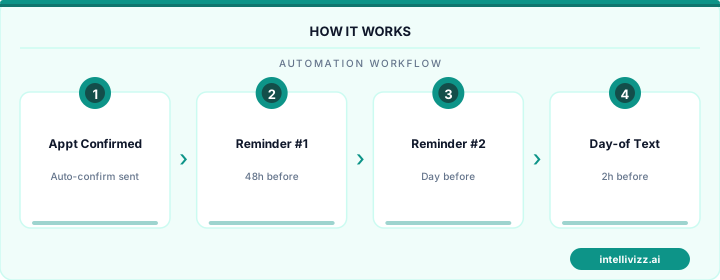
📱 Reduce no-shows by 30-40% with smart reminders
See how automation transforms industry operations
Procedure-Specific No-Show Patterns in Dental Practices
No-show rates in dental offices are not uniform across procedure types — and understanding this variation is essential for building an effective prevention strategy. Routine hygiene appointments (6-month cleanings and exams) have the highest no-show rates, averaging 12-18% across US dental practices, because patients perceive them as lower urgency and are more likely to cancel or simply not appear when scheduling conflicts arise. Restorative appointments (fillings, crowns, root canals) have slightly lower no-show rates (8-13%) because patients are motivated by pain or existing symptoms, but they carry much higher revenue stakes — a missed crown preparation appointment represents $800-$1,500 in lost revenue compared to $150-$250 for a missed hygiene visit.
Orthodontic adjustment appointments have the highest absolute no-show rates in practices that offer orthodontics (15-22%), primarily because patients perceive individual adjustments as low-consequence. Emergency appointments, ironically, have very low no-show rates (under 5%) because pain is a powerful motivator. Cosmetic procedures (whitening, veneers) fall in the middle at 9-14%, with a distinct pattern: patients who booked impulsively during a promotional period are far more likely to no-show than those who booked after a consultation.
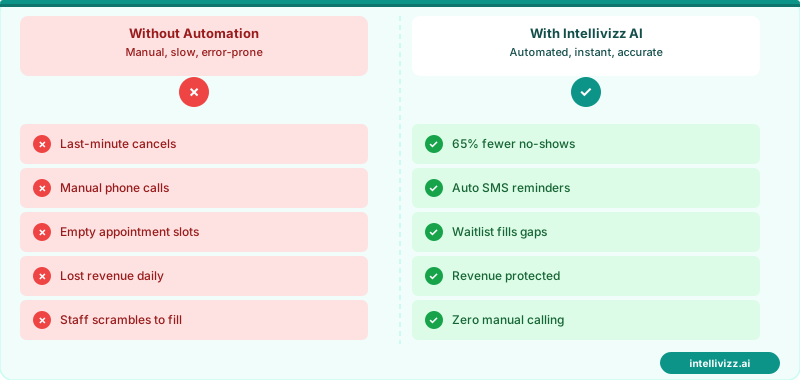
🦷 A missed crown prep costs $1,200 — automation costs $8
Dental practices using AI reminder sequences reduce no-shows by 55-70% within 90 days.
The Optimal Reminder Sequence for Dental Appointments
Research on appointment reminder effectiveness in dental settings points to a specific timing sequence that outperforms single-reminder approaches. A four-touch sequence — 7 days before, 48 hours before, 24 hours before, and a morning-of confirmation — produces the lowest no-show rates when combined with easy one-tap confirmation. Each touchpoint should be delivered through the patient's preferred channel (identified at intake), with SMS producing the highest confirmation rates (68% open rate within 5 minutes), followed by email (42%), and phone calls (varies by patient age, with older patients preferring calls).
The content of each reminder message matters as much as the timing. The 7-day reminder should emphasize what to bring (insurance card, list of current medications, completed new patient forms if applicable) and include a reschedule link prominently — making it easy to reschedule rather than simply not show up. The 48-hour reminder should include prep instructions specific to the procedure. A patient coming in for a crown preparation needs different information than a patient coming for a hygiene visit. The morning-of message should be brief, include the address and parking information, and confirm the exact appointment time.
| Procedure Type | Avg. No-Show Rate | Revenue at Risk/No-Show | Recommended Reminders |
|---|---|---|---|
| Hygiene / Cleaning | 12–18% | $150–$250 | 3-touch sequence |
| Filling / Restoration | 8–13% | $250–$600 | 4-touch sequence |
| Crown Preparation | 7–11% | $800–$1,500 | 4-touch + phone call |
| Orthodontic Adjustment | 15–22% | $100–$200 | 4-touch with gamification |
| Root Canal | 5–9% | $700–$1,400 | 4-touch + prep instructions |
Insurance Verification as a No-Show Prevention Strategy
One underappreciated driver of dental no-shows is insurance anxiety. Patients who are uncertain about their coverage — what their copay will be, whether a procedure is covered, whether they've met their deductible — are significantly more likely to cancel or no-show rather than face a surprise bill at the front desk. Practices that automate insurance verification before the appointment and communicate coverage details to patients in advance report 20-30% reductions in no-shows attributable to billing uncertainty.
The automated workflow looks like this: when an appointment is scheduled, the system triggers an insurance verification request to the payer using the patient's insurance details on file. Within 24-48 hours, the system receives a coverage response and automatically generates a patient-friendly cost estimate. This estimate is sent to the patient via their preferred channel at least 3 days before the appointment, giving them time to ask questions, update their insurance information, or make payment arrangements. Practices using this workflow also report fewer front-desk billing disputes and higher same-day treatment acceptance rates. Pair this with comprehensive AI dental office management for a fully automated patient journey from booking to payment.
Building a Culture of Appointment Commitment in Your Dental Practice
Beyond the technical elements of reminder automation, reducing no-shows in dental practices requires building a patient culture where appointment commitments are taken seriously. This cultural work begins at the scheduling call — the language used when booking affects patient psychology around the appointment. Confirmatory language ("We have you confirmed for Tuesday at 2 p.m." vs. "I'm putting you in for Tuesday at 2") signals that the appointment is a firm commitment. Explaining the value of the appointment at the time of booking ("This appointment will address the sensitivity you've been experiencing and should give you significant relief") increases the patient's perceived cost of missing it.
The confirmation process itself is a cultural touchpoint. Practices that require an active confirmation (the patient replies "YES" or clicks a confirmation button rather than simply receiving a passive reminder) report significantly lower no-show rates than those with passive reminder systems. Requiring a positive response to a confirmation request communicates that the practice takes the appointment seriously and expects the patient to do the same. It also provides early warning: patients who don't confirm by a certain threshold (e.g., 24 hours before the appointment) can be proactively contacted by staff, often recovering appointments that would otherwise no-show.
For procedures with very high revenue stakes (implants, full-mouth reconstructions, Invisalign starts), practices should consider implementing a courtesy deposit policy — collecting a nominal deposit at booking that is applied to the first appointment cost and forfeited only for same-day cancellations or no-shows without prior notice. When presented in the right context ("We reserve this time exclusively for you, and the deposit ensures we can prepare appropriately"), most patients respond positively. The practice benefits from both a reduced no-show rate and a psychological commitment device that makes patients more likely to keep high-stakes appointments.
The ROI Timeline for Dental No-Show Reduction
Dental practices implementing comprehensive no-show reduction automation should expect to see measurable results within 45-60 days of full deployment. The no-show rate improvement is typically gradual: a 3-4 percentage point reduction in the first month, with continued improvement as reminder sequences establish patterns and patients develop new appointment behavior norms. By month three, most practices have reached their plateau improvement -- typically a no-show rate 55-70% lower than their pre-automation baseline. At that point, the financial impact is fully realized: if a practice with 25 daily appointments and a 15% no-show rate reduces to 5%, they recover 2.5 appointments per day. At $200 average revenue per appointment and 250 working days per year, that represents $125,000 in annual recovered revenue from a system that costs $200-500 per month to operate. The math is clear, the technology is proven, and the implementation is straightforward -- the only decision remaining is when to start.
Ready to modernize your practice? Explore our healthcare automation solutions, Dental No-Show Rate Average: Industry Benchmarks and..., or Automated Patient Recall System for Dental Practices:....