
Optical Order Ready Notification Automation: Never Lose a Patient's Eyewear Sale
Uncollected eyewear orders are one of the most frustrating revenue leaks in optometry. Industry data from The Vision Council shows that 8-12% of completed optical orders are never picked up — representing thousands of dollars in lost revenue per year for a busy practice. The primary reason? Patients simply forget or don't know their order is ready. The order pickup visit is also the ideal moment to request a Google review from a satisfied patient.
Automated order-ready notifications solve this problem entirely. When an order arrives, the patient receives an instant text or email notification with pickup details. No staff phone calls, no sticky notes, no hoping the patient remembers.
The Cost of Uncollected Orders
For a practice dispensing 50 optical orders per week, a 10% uncollected rate means 5 orders per week sitting on the shelf — approximately 260 orders per year. At an average frame + lens value of $350-$500, that's $91,000-$130,000 in annual revenue at risk.
Even when orders are eventually collected, delays create problems: extended hold times tie up inventory space, staff spend hours making follow-up calls, and patient satisfaction drops when they feel forgotten.
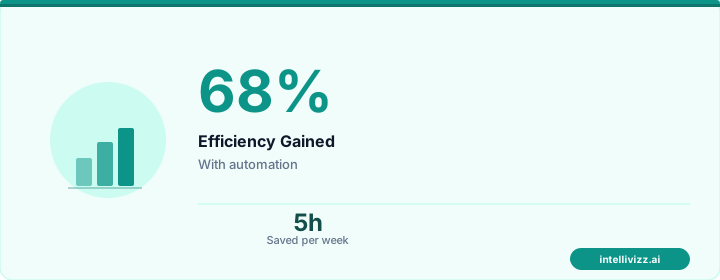
💡 Automation handles the routine — you handle the growth
See how automation transforms industry operations
How Automated Notifications Work
The automation workflow is straightforward:
- Order received at lab: When the frame and lenses arrive from the lab, staff marks the order as "Ready" in the practice management system.
- Instant notification: An automated SMS (and/or email) is sent to the patient: "Great news! Your eyewear order at [Practice Name] is ready for pickup. Visit us at [Address] during business hours. Questions? Reply here or call [phone]."
- Reminder at 48 hours: If the patient hasn't picked up within 48 hours, a gentle reminder fires: "Just a reminder — your eyewear is ready at [Practice]. We're holding it for you! Stop by anytime during our hours: [hours]."
- Final notice at 7 days: "Your eyewear order has been ready for pickup for a week. Please stop by [Practice] at your convenience, or reply here to schedule a pickup time."
- Staff alert at 14 days: If still uncollected, the system alerts staff for a personal phone call.
Integration With Optical Lab Management
The trigger for the automation comes from your practice management or optical lab tracking system. Common integration points:
- Eyefinity / VSP: API or status change webhook when order status updates to "Received"
- ABB Optical / Frames Data: Lab order tracking integration
- Manual trigger: Staff clicks a button in the dispensary workflow when physically receiving the order — this triggers the automated patient notification
For practices using an all-in-one automation platform like Intellivizz, the manual trigger approach is simplest: when staff updates the order status, the entire notification sequence fires automatically. Learn more about automating optometry patient communication in our AI receptionist for optometry guide.
Optimizing the Notification Messages
Key elements of high-performing optical notifications:
- Excitement: "Great news!" or "Your new glasses are here!" — make it a positive moment, not a transactional notice.
- Business hours: Include current hours to eliminate a potential barrier ("What time are they open?")
- Reply option: Let patients text back to schedule a pickup time, especially for contact lens orders that can be left at the front desk.
- Adjustment mention: "We'll make sure everything fits perfectly when you pick up" — reminds them that the visit is quick and includes a fitting.
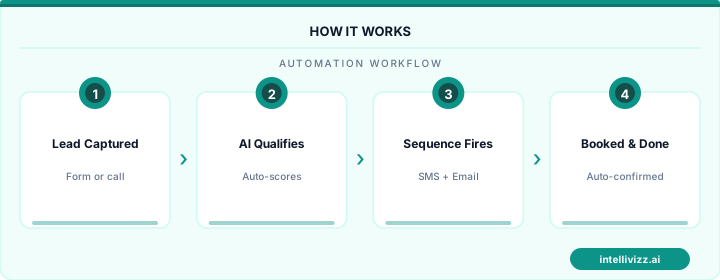
💡 Automation handles the routine — you handle the growth
From manual processes to automated excellence
Beyond Order-Ready: The Complete Optical Automation Stack
Order-ready notifications are just one component. A complete optical communication system also includes:
- Annual exam reminders: Automated recall at 11 months post-exam
- Contact lens reorder reminders: Triggered when the patient's supply is estimated to run low
- Insurance benefit reminders: "Your vision insurance benefit resets on [date]. Schedule your exam before it expires!"
- Post-purchase satisfaction check-in: 2 weeks after pickup: "How are your new glasses? Any adjustments needed?"
Measuring Impact
- Uncollected order rate: Before vs. after automation (target: reduce from 10% to under 4%)
- Average pickup time: Days from order-ready to pickup (target: under 3 days)
- Staff time saved: Hours per week previously spent making pickup calls
- Revenue recovered: Value of orders that would have gone uncollected without automated reminders
Automated order-ready notifications are one of the simplest and highest-ROI automations an optical practice can implement. The setup takes less than a day, the cost is minimal, and the revenue recovery starts immediately.
Reducing Order Abandonment Through Proactive Status Communication
Optical dispensing abandonment — a patient who ordered glasses or contacts but never returned to pick them up — is a significant and addressable revenue leak in optical retail and optometry practice settings. Industry estimates suggest that 8–15% of custom eyewear orders go unclaimed for more than 30 days after the practice notifies the patient of readiness. The financial impact is direct: a frame-and-lens order with an average retail value of $350–$600 that sits in a drawer for 60 days before being restocked or discarded represents lost revenue from both the dispensing itself and the missed interaction opportunity (lens upgrades, second pair sales, contact lens discussions). The root cause is almost never patient intent to abandon — it is friction: missed initial notifications, inconvenient pickup logistics, or a general drift of urgency once the initial excitement of ordering subsides.
Automated order-ready notification sequences address abandonment through persistence and channel diversification. Where a single phone call or voicemail may be missed or deprioritized by a busy patient, a structured sequence — initial SMS notification with pickup details, email confirmation with order specifics and office hours, follow-up SMS at 7 days if unclaimed, and a final courtesy call at 14 days — dramatically improves pickup rates. The follow-up contacts are not aggressive collection calls; they are patient-service-framed messages that emphasize the clinical dimension ("Your new prescription lenses are ready — we want to make sure you get the best vision correction possible") and offer specific logistics assistance (scheduling a pickup appointment for patients who prefer structure). Practices that implement this automated follow-up sequence see unclaimed order rates drop to 3–5% from the 10–15% baseline within 60–90 days.
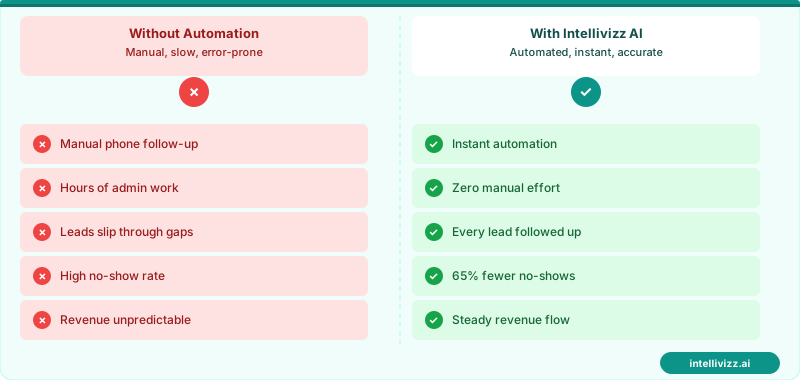
👓 Every Order Ready Deserves to Be Picked Up
Automated pickup sequences cut unclaimed order rates from 15% to under 5%
Dispensing Appointment Automation and Post-Pickup Satisfaction Sequence
Scheduled dispensing appointments — rather than walk-in pickup — represent a best-practice standard in high-volume optical dispensing for a specific reason: the dispensing interaction is a clinical touchpoint, not just a package pickup. A well-executed dispensing appointment includes a visual acuity check with the new prescription, frame adjustment and fitting verification, patient education on lens care and adaptation (particularly important for progressive lens first-time wearers and high-prescription patients), and a natural sales environment for second pair suggestions and contact lens follow-up. A patient who walks in unannounced to pick up their glasses may encounter a busy dispensary, receive a cursory fitting check, and leave without the education and relationship reinforcement that drives long-term patient loyalty and optical revenue. For a deeper dive into prescription tracking and revenue recovery, see our guide on contact lens reorder automation.
Automation supports scheduled dispensing by presenting an appointment booking option within the order-ready notification itself — a direct link to schedule a 20-minute dispensing appointment rather than just a notice that the order is available. For first-time progressive lens patients and patients ordering their first pair from the practice, the system flags the dispensing appointment as recommended rather than optional, with messaging that explains the clinical rationale. Post-pickup, an automated satisfaction check — sent 7–10 days after dispensing, once the patient has had time to adapt to the new prescription — captures early concerns (visual discomfort, frame fit issues, adaptation difficulties) before they escalate to a phone complaint or, worse, to a negative online review. Patients who report satisfaction receive a gentle review request; patients who report concerns are immediately routed to a follow-up call from a dispensing optician.
| Notification Stage | Channel | Timing | Key Message |
|---|---|---|---|
| Order ready — initial | SMS + email | Day order is received/completed | Ready for pickup + dispensing appt link |
| Follow-up if unclaimed | SMS | Day 7 | Reminder + office hours + pickup scheduling |
| Courtesy call | Phone | Day 14 | Personal outreach + logistics assistance |
| Post-pickup satisfaction | SMS + email | Day 7–10 post-pickup | Adaptation check + review request |
Optometry practices building an integrated patient communication system — connecting ordering, dispensing, recall, and contact lens supply automation — will find the framework in optometry patient recall automation directly applicable as the upstream scheduling system that feeds the dispensing and notification workflows described here.
Integrating Order Notifications with the Full Optical Revenue Cycle
Optical order-ready notification represents one point in a broader optical revenue cycle that extends from frame and lens selection through dispensing, follow-up, and eventual recall for updated prescription or new eyewear. Practices that treat the order notification as an isolated transaction — rather than as a touchpoint in an ongoing patient relationship — miss the full revenue potential of the dispensing interaction. The patient who comes in to pick up their glasses is standing in the optical dispensary at a moment of high engagement with their eyewear and visual experience. This is the optimal moment to introduce a second pair conversation, discuss the benefits of photochromic lenses for their lifestyle, present a sunwear option, or initiate a contact lens trial for a glasses-primary patient who has expressed interest in contacts.
Automated dispensing appointment confirmation sequences can prime these conversations before the patient arrives. A confirmation message sent the day before the dispensing appointment that includes a "what to expect at your dispensing visit" explainer — mentioning the fitting check, adaptation discussion, and the opportunity to explore other eyewear options — sets a patient expectation that makes the optical capture conversation feel like an expected part of the experience rather than a sales pitch. Practices that incorporate this pre-dispensing priming into their automated communication sequence report 15–25% higher same-visit optical conversion rates compared to practices where the dispensing interaction happens without prior context-setting, simply because the patient arrives with the correct frame of reference for what the appointment encompasses.
Ready to modernize your practice? Explore our healthcare automation solutions.