
Optometry Patient Recall Automation: Keep Patients Coming Back for Annual Eye Exams
The annual eye exam is the backbone of optometry practice revenue — yet recall rates for overdue patients average only 30-40% when managed manually. Practices lose 20-30% of their patient base each year to simple attrition: patients forget to schedule, life gets busy, and the annual exam drops off the priority list. Automated recall systems recover this revenue by systematically re-engaging overdue patients.
Why Optometry Recall Is Uniquely Challenging
Unlike specialties where patients return for ongoing symptoms, optometry patients feel fine — their vision hasn't changed noticeably, so they don't feel urgency. The 12-month gap between visits means patients have 365 days to forget about your practice. And unlike dental hygiene (6-month cycles), the annual cadence means one missed recall can turn into 2-3 years of absence.
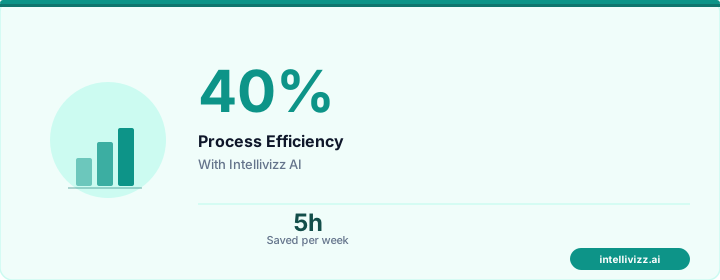
🏥 Patients expect instant responses — automation delivers
Smart technology, better results
The Automated Recall Sequence
11-Month Pre-Due Reminder
"Hi [Name], it's almost time for your annual eye exam at [Practice]. Your last visit was [date]. Schedule early for the best availability: [booking link]. Your vision insurance benefits reset [next month/in X weeks] — use them before they expire!"
12-Month Due Notification
"Your annual eye exam is due! Dr. [Name] at [Practice] recommends yearly exams to monitor your eye health and update your prescription. Book now: [link]. Same-day appointments available."
13-Month Overdue Follow-Up
"We noticed it's been over a year since your last eye exam. Regular exams catch conditions like glaucoma and macular degeneration early — when treatment is most effective. Schedule your exam: [link]."
15-Month Second Follow-Up
"It's been over 15 months since your last visit to [Practice]. Don't let your eye health slip — book a comprehensive exam today: [link]. We have evening and weekend appointments available."
18-Month Final Automated Outreach
"We haven't seen you in 18 months, [Name]. We want to make sure your eyes are healthy. As a returning patient, enjoy [incentive — free retinal screening, discount, etc.]. Schedule: [link] or call [phone]."
Specialty-Specific Recall Triggers
Contact Lens Patients
Contact lens wearers have a built-in recall trigger: their prescription expires after 1-2 years (depending on state law). Automated outreach 6-8 weeks before expiration drives both exam bookings and lens reorders: "Your contact lens prescription expires on [date]. Schedule your renewal exam to keep your supply uninterrupted: [link]."
Glaucoma and Chronic Conditions
Patients with glaucoma, diabetic retinopathy, or macular degeneration need more frequent monitoring (every 3-6 months). Automated recall ensures these critical follow-ups don't fall through the cracks — with escalation to the doctor if a patient misses a scheduled check.
Pediatric Vision
Children's vision changes rapidly. Annual recall for pediatric patients includes age-specific messaging to parents: "It's time for [Child's name]'s annual eye exam! Children's prescriptions can change quickly — staying current helps academic performance and comfort."
Optical Order Follow-Up
Patients who received glasses or contacts receive a satisfaction check at 2 weeks and a follow-up at 30 days. This builds the relationship and provides an opportunity to address any concerns before they become complaints.
Insurance Benefit Reminders
A unique opportunity for optometry: most vision insurance benefits (VSP, EyeMed, Davis Vision) reset annually. Automated reminders in Q4 drive a surge of year-end bookings: "Your [VSP/EyeMed] benefits expire December 31. You have $[amount] in unused frame allowance and a covered annual exam. Don't let your benefits go to waste — book now: [link]."
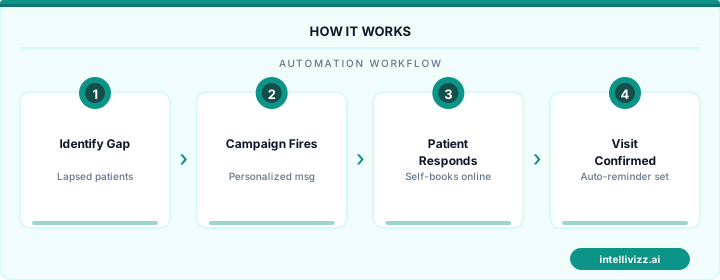
🏥 Patients expect instant responses — automation delivers
The data speaks for itself
Results and ROI
- Recall response rate: 50-65% of overdue patients schedule within 30 days of first outreach (vs. 30-40% with manual recall).
- Revenue per recalled patient: $200-$400 (exam + optical/contact lens revenue).
- Annual revenue impact: For a practice with 2,000 patients, recovering 200 additional overdue patients = $40,000-$80,000 in incremental annual revenue.
- Retention improvement: 15-20% reduction in annual patient attrition.
An AI receptionist for optometry handles the incoming calls generated by recall campaigns, ensuring patients who respond can book immediately rather than reaching voicemail.
Ready to recover overdue patients at your optometry practice? Book a free consultation to see automated recall in action for eye care.
Segmenting Recall by Clinical Need and Insurance Benefit Cycle
Uniform 12-month recall intervals are a practical default, but they are not optimal for patient outcomes or practice revenue. Optometry practices serving diverse patient populations — including pediatric patients with rapidly changing prescriptions, myopia management patients requiring 6-month progress visits, diabetic patients with annual dilated exam medical necessity, and contact lens wearers with annual supply cycles — have meaningfully different clinical recall needs. Automated recall segmentation applies the appropriate interval and message to each patient cohort rather than routing every patient through the same 12-month sequence.
Insurance benefit cycle alignment is equally important. A patient whose VSP or EyeMed benefits reset on January 1 should receive a benefit-expiration reminder in October — not a generic annual recall message in December. Benefits-aligned recall messaging converts at significantly higher rates because it creates genuine urgency: the patient understands that failing to schedule before year-end means forfeiting a benefit they have already paid for through payroll deduction. Automated systems that pull benefit data from VSP and EyeMed APIs can calculate each patient's individual benefit reset date and schedule the recall communication accordingly, rather than applying a practice-wide seasonal message that misses a large portion of the patient base whose benefits operate on non-calendar cycles.
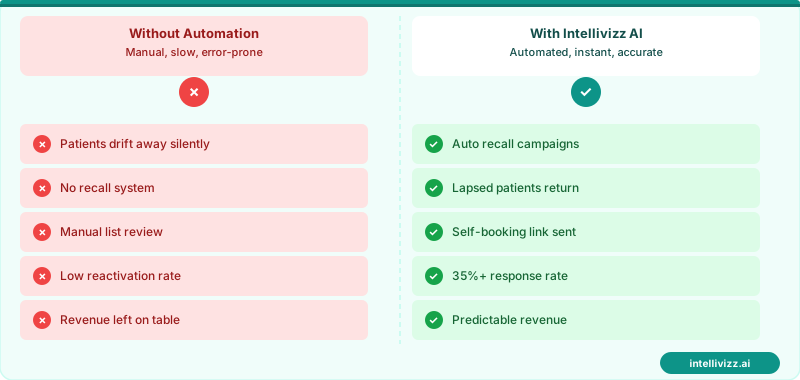
👁️ Recall the Right Patient at the Right Benefit Moment
Benefits-aligned recall drives 2–3x higher scheduling response rates
Multi-Channel Recall Sequences and Response Rate Benchmarks
Single-channel recall — a postcard or a single email — reliably underperforms in modern practice environments. Patients move through their communication channels differently depending on age, contact preference, and time of day. A comprehensive recall sequence deploys across email, SMS, and phone (voicemail drop or live call) over a structured timeline, with each contact serving a distinct function and building on the prior touchpoint.
A well-calibrated multi-channel recall sequence for a 12-month interval might operate as follows: an email at 11.5 months referencing the upcoming annual exam and current glasses or contact lens supply; an SMS at 12 months with a direct scheduling link; a second email at 12.5 months emphasizing insurance benefit timing; and a voicemail drop at 13 months from the doctor if the patient has not scheduled. This four-touch sequence consistently outperforms single-touch recall, with aggregate scheduling response rates in the 55–70% range versus 25–35% for single-channel email alone. Related: learn how contact lens reorder automation uses expiration alerts to drive repeat orders.
| Recall Channel | Avg. Open / Response Rate | Best For | Timing |
|---|---|---|---|
| 28–38% open, 8–12% schedule | Benefit expiration info, detail | 11.5–12 months | |
| SMS | 90%+ open, 15–22% click | Direct scheduling link | 12 months |
| Voicemail drop | 60–75% listen, 8–14% callback | Lapsed patients, high-value | 13+ months |
| Postcard | Variable, 4–7% response | No-email patients, elderly | 12 months |
Practices looking to extend recall automation into contact lens supply management will find the guide on optical order-ready notification workflows complementary — covering the post-dispensing touchpoints that maintain patient engagement between annual recall cycles and drive repeat optical revenue.
Measuring Recall Campaign ROI and Continuous Improvement
Optometry practices that treat recall automation as a set-and-forget system consistently underperform those that actively measure campaign performance and iterate on sequence design. The key performance metrics for recall automation — scheduling response rate by contact type, channel conversion rate by patient demographic, no-show rate on recall-generated appointments versus walk-in appointments, and revenue per recalled patient — are all directly calculable from scheduling and billing data if the practice management system is configured to tag appointment source correctly. Monthly review of these metrics allows the practice administrator or office manager to identify which elements of the recall sequence are driving bookings and which are underperforming against benchmarks.
Continuous improvement typically focuses on three variables: message content (clinical framing versus convenience framing versus benefit-urgency framing), send timing (day of week and time of day variations that affect SMS open rates and email response rates by patient cohort), and sequence length (testing whether a four-touch sequence meaningfully outperforms a three-touch sequence for specific patient segments, given the additional cost in platform credits and the risk of over-contact perception). Practices that run systematic A/B tests on recall messaging — even simple tests comparing two subject lines or two SMS message variants — accumulate compounding performance improvements over 12–18 months that substantially exceed the initial recall performance achieved at implementation.
The revenue impact of systematic recall automation over a 24–36 month implementation horizon is typically the most compelling argument for the investment. A practice with 800 active patients — those who have been seen within the past 24 months — and a baseline recall scheduling rate of 55% that improves to 72% through automation captures 136 additional annual exam appointments per year. At an average comprehensive exam revenue of $180–$280 per appointment (exam fee plus refraction and any medical billing), this represents $24,000–$38,000 in additional annual revenue from recall alone, before accounting for the optical and contact lens revenue generated by those additional appointments. The optical capture from recalled patients averages $280–$420 per appointment in dispensing revenue, meaning the true total revenue impact of the incremental 136 appointments is closer to $65,000–$100,000 annually — a return that typically exceeds the practice's total investment in recall automation technology by 15–25x.
Ready to modernize your practice? Explore our healthcare automation solutions, or read our guide to Annual Wellness Recall Automation: Keep Patients....