
Annual Wellness Recall Automation: Keep Patients Coming Back for Preventive Care
The Annual Wellness Visit Gap
Annual wellness visits are the foundation of preventive medicine and a significant revenue stream for primary care practices. Yet compliance rates are dismal: only 45-50% of commercially insured patients and 55-60% of Medicare patients complete their annual wellness visit within the recommended timeframe. The rest either visit late (adding to scheduling bottlenecks) or skip entirely. Understanding how to reduce appointment no-shows is key to improving these recall completion rates.
For a primary care practice with 3,000 active patients, 50% compliance means 1,500 annual wellness visits completed. At $200-$350 per visit (including lab work and screenings), that's $300,000-$525,000 in captured revenue — and an equal amount left uncaptured by the 1,500 patients who don't come in.
💡 Automation handles the routine — you handle the growth
From manual processes to automated excellence
Why Patients Skip Annual Wellness Visits
- "I'm not sick" (40%): The biggest barrier — patients who feel healthy don't see the urgency of a preventive visit
- Scheduling friction (25%): Patients intend to schedule but never get around to calling during office hours
- Insurance confusion (15%): Patients unsure whether their plan covers the visit or fear surprise charges
- Time and inconvenience (12%): Can't take time off work, childcare issues, transportation
- Provider relationship (8%): Patients without a strong relationship with their PCP are less motivated
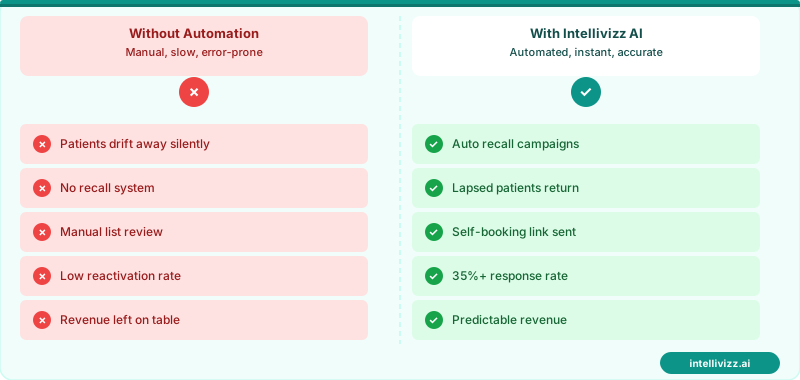
The Automated Recall Campaign
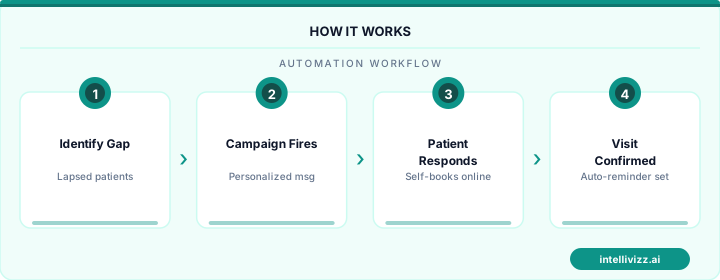
T-60 Days: Early Notification
"Hi [Name], your annual wellness visit with Dr. [Provider] is due in [Month]. These visits are fully covered by your insurance at no cost to you. Schedule now: [link]"
Key elements: mention the specific provider, emphasize "no cost," and include a direct scheduling link. This early message captures the 25% of patients who just need a nudge.
T-30 Days: Educational Message
Email with health-specific content: "Your annual wellness visit includes [screenings relevant to age/gender]. These screenings catch conditions early — when they're most treatable."
Include specific, age-appropriate screening information: mammography, colonoscopy, diabetes screening, cholesterol, blood pressure. Making the visit tangible increases scheduling by 15%.
T-14 Days: Urgency + Convenience
"Your annual wellness visit is due this month. We have openings on [specific dates]. Reply with your preferred time or book online: [link]"
Offering specific dates eliminates the "I need to figure out when I'm free" barrier.
T-0 (Due Date): Direct Message
"Today marks 12 months since your last wellness visit. Dr. [Provider] wants to make sure you stay on track with your preventive care. Schedule today: [link]"
T+30 Days: Overdue Follow-Up
"You're now 30 days overdue for your annual wellness visit. Delaying preventive screenings can mean missing conditions that are easier to treat when caught early. Let's get you scheduled: [link]"
T+60 Days: Personal Outreach
System flags the patient for a personal call from the care team: "We noticed you haven't been in for your annual visit. Is there anything preventing you from scheduling? We'd like to help."
Segmenting by Risk
Not all patients have equal urgency for annual wellness visits. Segment your recall by:
- Chronic conditions: Patients with diabetes, hypertension, or heart disease get more frequent and more urgent recall messaging
- Age-based screenings: Patients approaching screening milestones (50 → colonoscopy, 40 → mammography) get targeted messaging about the specific screening
- Previous compliance: Patients who've been compliant in past years get lighter touch; chronic skippers get more aggressive sequences
- Insurance type: Medicare AWV messaging differs from commercial wellness visit messaging
💡 Automation handles the routine — you handle the growth
See how automation transforms industry operations
Medicare Annual Wellness Visit (AWV) Specifics
The Medicare AWV is particularly valuable — reimbursing $175-$250 with no patient cost-sharing. Yet only 55% of eligible Medicare patients utilize it. Automated recall specifically for AWV should emphasize:
- No copay, no deductible, no cost to the patient
- Specific preventive screenings included
- Health risk assessment and personalized prevention plan
- Fall risk assessment and advance care planning (for qualifying patients)
Integration with Patient Recall Systems
Annual wellness recall should be one campaign within a broader patient recall system that also manages:
- Chronic disease management follow-ups (quarterly A1C, etc.)
- Vaccination schedules (flu, shingles, pneumonia)
- Age-based screening recalls (mammography, colonoscopy, bone density)
- Post-hospitalization follow-ups
Financial Impact
Moving annual wellness compliance from 50% to 75% for a 3,000-patient practice:
- Additional visits: 750 per year
- Revenue per visit: $200-$350
- Additional annual revenue: $150,000-$262,500
- Downstream revenue (labs, referrals, treatments discovered during wellness visits): additional $50,000-$100,000
- Automation cost: $300-$800/month
- ROI: 15-25x
Beyond revenue, improved wellness compliance enhances quality metrics that are increasingly tied to value-based payment models — affecting reimbursement rates across all services, not just the wellness visit itself.
Customizing Recall Messages by Preventive Care Type and Insurance Coverage
Annual wellness recall is not a uniform communication exercise — the clinical context, insurance coverage structure, and patient motivation for each type of annual preventive visit varies significantly. A patient being recalled for an annual physical responds to different messaging than one due for an annual mammogram, colonoscopy screening, or diabetes management visit. Generic "time for your annual visit" reminders perform significantly below recall messages that are specific to the care type, name the preventive service due, explain the clinical rationale in accessible terms, and reference the patient's insurance coverage for the visit. This specificity signals that the practice has reviewed the patient's record and is communicating based on their individual care needs — rather than sending a bulk calendar reminder to everyone on the list.
Insurance coverage context is particularly motivating for preventive recall compliance. Most commercial insurance plans, Medicare, and Medicaid cover annual wellness visits at zero patient cost — no co-pay, no deductible application. Patients who are unaware of this coverage often decline to schedule based on a general assumption that the visit will result in a bill. Recall messages that explicitly state "Your [plan name] covers your Annual Wellness Visit at no cost to you" consistently outperform cost-neutral recall messages that do not reference the coverage. For Medicare patients, the Medicare Annual Wellness Visit (AWV) recall message should specifically name the AWV, distinguish it from a physical exam (patients often believe they already had their annual visit after a sick care appointment), and reference the cognitive and health risk assessment components that provide clinical value beyond a standard check-in.
🩺 "Your Annual Wellness Visit Is Covered at No Cost." — Four Words That Drive Scheduling.
Insurance-specific recall messaging converts 2–3x better than generic annual reminders
Tracking Recall Campaign Performance and Closing the Quality Gap
Annual wellness recall automation creates a measurable performance data layer that manual recall systems cannot produce. Every recall outreach — by patient, by care type, by channel, by timing — generates a response signal: scheduled, no response, opted out, or responded but did not schedule. Aggregating these signals across the full patient population enables practice administrators and quality managers to calculate care gap closure rates: what percentage of patients due for mammography screening, colorectal cancer screening, diabetes A1c checks, or hypertension management visits actually completed the visit following the recall sequence. This data is directly useful for value-based care performance reporting, HEDIS measure compliance, and quality incentive program participation.
Performance tracking also enables continuous recall sequence optimization. A practice that discovers its diabetes management recall emails have a 15% scheduling rate while its mammography recall SMS messages achieve 32% can investigate the difference and apply the higher-performing elements of the mammography sequence to the diabetes recall. A practice whose recall sequence generates strong scheduling rates but poor actual completion rates (patients schedule but cancel or no-show) can identify that the problem is downstream of recall — in reminder sequencing and barrier identification — and address it separately. This analytical capability transforms annual wellness recall from a compliance checkbox into a continuously improving quality improvement program.
| Preventive Care Type | Avg. Care Gap Rate | Recall Message Angle | Expected Scheduling Lift |
|---|---|---|---|
| Annual wellness visit (Medicare AWV) | 35–50% | No-cost + cognitive assessment | 25–35% gap closure |
| Mammography screening | 25–40% | Schedule specificity + urgency | 20–30% gap closure |
| Colorectal cancer screening | 40–55% | Options (FIT, colonoscopy) + coverage | 15–25% gap closure |
| Diabetes A1c check | 30–45% | Personalized clinical context | 20–28% gap closure |
Practices implementing annual wellness recall as part of a broader preventive care automation strategy will find the patient engagement framework in patient appointment reminder automation directly applicable — particularly the multi-channel reminder sequencing that maintains scheduling momentum after the initial recall contact generates a booked appointment.
Integrating Wellness Recall with Population Health Management Goals
For primary care practices participating in value-based care arrangements — Accountable Care Organizations, Medicare Shared Savings Program, commercial ACO contracts — annual wellness recall automation is not just a revenue tool; it is a direct contributor to the population health metrics that determine shared savings distributions and quality bonus payments. Care gap closure rates for preventive services (mammography, colorectal cancer screening, A1c testing for diabetic patients, blood pressure monitoring for hypertensive patients) are among the most heavily weighted quality metrics in most value-based care contracts. A practice that achieves 75% mammography screening compliance in its attributed patient population outperforms one at 55% compliance in ways that translate directly to thousands or tens of thousands of dollars in quality incentive payments, depending on contract structure and patient panel size.
Population health-aligned annual wellness recall automation operates at the practice level — not just sending individual patient reminders, but managing the practice's care gap closure rate as a portfolio metric. The system tracks, for each quality measure, the current compliance rate across the attributed patient panel, the target rate required to achieve maximum quality incentive payment, and the number of patients who need to complete the measure by the end of the measurement period to close the gap. This population-level view allows the practice manager to prioritize recall resources appropriately: if mammography compliance is at 68% (target 75%) and colorectal screening is at 82% (target 80% already exceeded), the reminder sequencing should intensify efforts toward mammography recall in the current quarter while maintaining routine colorectal recall cadence. This strategic allocation of recall attention is only possible when automation provides the real-time population view that manual recall tracking cannot support.
Ready to modernize your practice? Explore our healthcare automation solutions, or read our guide to Optometry Patient Recall Automation: Keep Patients....
Relevant AI Automations
AI Review Management (HIPAA-Compliant)
All-in-one HIPAA-compliant review management: automated review requests, AI-powered responses, and review repurposing for web & social.
HIPAA-Compliant AI Voice Agent — 24/7 Patient Call Handling
HIPAA-compliant AI voice agent answers every patient call 24/7 — triages urgency, books appointments, and sends encrypted follow-ups
Website Live Chat → Patient Booking Funnel
AI-powered live chat on the practice website engages visitors, answers questions about services/insurance, collects cont