
What Is the Average No-Show Rate for Dental Offices? Industry Data and Benchmarks
Understanding your dental practice's no-show rate in context — how it compares to industry benchmarks and what factors drive it — is the first step toward reducing it. For a broader view across all medical specialties, see our patient no-show rate benchmarks by specialty. Here's a comprehensive look at the data.
The No-Show Reduction Playbook: Seven Proven Interventions
Reducing dental appointment no-shows is not a single-intervention problem — it is a systems problem that requires coordinated action across scheduling protocols, patient communication workflows, and front-desk procedures. Practices that achieve sub-10% no-show rates do not have a single secret weapon; they have implemented multiple reinforcing strategies that compound each other's effectiveness. This playbook covers each intervention in implementation-ready detail.
Intervention 1: Structured Multi-Touch Reminder Sequences
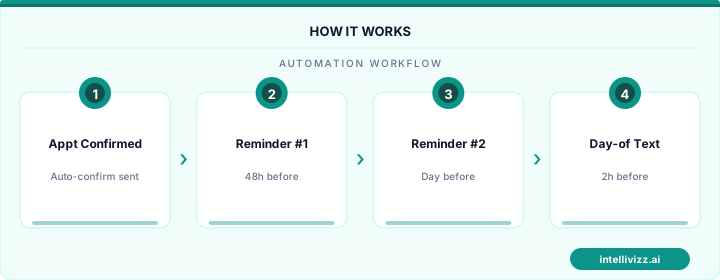
The single highest-impact intervention is a structured, multi-channel reminder sequence that begins well before the appointment date and requires patient acknowledgment at each touchpoint. Generic reminder blasts are not enough — the sequence must be designed to create progressive commitment.
Implementation checklist for multi-touch reminder sequences:
- ☐ Configure your practice management software (Dentrix, Eaglesoft, Open Dental, or Curve) to trigger automated reminders at 7 days, 48 hours, and 2 hours before each appointment
- ☐ Use SMS as the primary channel for the 48-hour and 2-hour reminders (open rates exceed 95% vs. 20-30% for email)
- ☐ Require explicit confirmation — "Reply C to confirm or R to reschedule" — on the 48-hour reminder, not just passive notification
- ☐ Route unconfirmed appointments to a front-desk follow-up worklist by 5 PM the day before, so staff can make personal calls that evening or the morning of
- ☐ Track confirmation rates by channel and by appointment type quarterly to identify gaps
- ☐ For hygiene recall patients booked 6+ months in advance, add a 30-day pre-appointment re-engagement message that reconnects them to their care plan: "Your cleaning is coming up next month — here's what we'll be checking for at your visit"
Patient communication templates:
7-Day Email Body: "Hi [First Name], you have a [procedure] scheduled with Dr. [Name] on [Day], [Date] at [Time]. We're looking forward to seeing you. [If applicable: Please remember to [preparation instruction].] If your schedule changes, please let us know at least 48 hours in advance so we can offer your spot to another patient who needs care. Reply to this email or call us at [number]."
48-Hour SMS: "Hi [First Name] — reminder that you have a [procedure] appointment at [Practice Name] on [Day] at [Time]. Reply C to confirm or R to reschedule. Questions? Call [number]."
2-Hour SMS: "See you in a couple hours, [First Name]! Your [procedure] with Dr. [Name] is at [Time] at [Address]. Reply HELP if you need anything."
Intervention 2: New Patient Pre-Visit Engagement Protocol
New patients no-show at significantly higher rates than established patients because they have no relationship with the practice and no accumulated sense of obligation or connection. A structured pre-visit engagement protocol — implemented in the window between booking and the first appointment — dramatically reduces first-visit no-shows.
New patient pre-visit engagement checklist:
- ☐ Send a personalized welcome email within 1 hour of booking, including a message from the dentist (not just administrative language), a photo of the front desk team, and a brief "what to bring" checklist
- ☐ Provide a digital intake form link that can be completed before the visit — patients who complete intake forms have significantly lower no-show rates because they have invested time in the appointment
- ☐ Make a personal welcome call within 24 hours of booking for new patient first visits — a 2-minute call from the front desk ("Hi [Name], this is [Staff] from [Practice] — I wanted to personally welcome you and make sure you have everything you need before your first visit") reduces first-visit no-shows by roughly half
- ☐ Send a "meet your dentist" email 3 days before the appointment featuring Dr. [Name]'s bio, areas of focus, and a patient quote — building personal connection before the chair
- ☐ Include a Google Maps link with parking instructions in the 48-hour reminder specifically for new patients
Intervention 3: Waitlist Automation and Cancellation Recovery
Every dental practice should operate a live waitlist — a list of patients who want an earlier appointment than what was available at booking. Without automation, waitlists are managed manually via sticky notes and phone tag, and most cancellation slots go unfilled. With automation, cancelled slots can be filled within minutes.
Automated waitlist implementation steps:
- Enable the waitlist feature in your practice management software and actively offer it to patients when booking: "The next opening with Dr. [Name] is [Date] — would you like to be on our waitlist for anything sooner?"
- When a cancellation or no-show occurs, configure the system to automatically send an SMS to the next 3–5 waitlisted patients: "Hi [Name], we have an opening tomorrow at [Time] with Dr. [Name] — first to reply YES gets the spot"
- Set a 15-minute response window; if no response, the system moves to the next waitlisted patient
- Track waitlist fill rate monthly — practices with well-managed waitlists fill 40–60% of cancelled slots, turning no-shows from pure revenue loss into a scheduling optimization problem
Intervention 4: Treatment Plan Pre-Authorization and Financial Clarity
A significant portion of dental no-shows — particularly for restorative and treatment appointments — are driven by financial anxiety. Patients who are unclear on what they will owe at the visit have a much higher likelihood of avoiding the appointment altogether rather than facing an unexpected bill. Removing financial uncertainty before the appointment reduces this avoidance behavior.
Pre-authorization and financial clarity checklist:
- ☐ Run insurance eligibility and benefits verification for every patient at least 3 days before their appointment, not on the day of
- ☐ Send a pre-visit financial summary email for any appointment where the patient will have an out-of-pocket balance: "Based on your insurance, your estimated cost for [procedure] is approximately $[amount]. We accept [payment methods] and offer [payment plan option] if helpful. Questions before your visit? Call us."
- ☐ For high-cost treatment appointments ($500+), call the patient personally to confirm they have received the cost estimate and to answer any questions — this call is also a no-show prevention touchpoint in disguise
- ☐ Offer a "no-surprise guarantee" framing: "If there's any difference between your estimate and actual cost of more than $50, we'll call you to discuss before processing payment"
Intervention 5: Strategic Overbooking for High-Risk Appointment Slots
Evidence-based overbooking — scheduling slightly more appointments than chair capacity in specific high-risk windows — is a legitimate and widely used tool in dental practice management. The goal is not to overbook uniformly, but to identify the specific slots and patient segments where no-show probability is high enough to justify a buffer appointment.
ROI calculation for strategic overbooking:
If your Monday morning hygiene block has a 28% no-show rate and you typically schedule 4 hygiene patients in that block, you can expect 1 no-show per Monday morning on average. Scheduling a 5th patient in a slot that can only accommodate 4 simultaneously — but staggering them so the 5th arrives at the midpoint of the block — means:
- If the expected no-show occurs: all 4 remaining slots are productive, no disruption
- If no one no-shows: the 5th patient waits briefly or is accommodated with a short delay, and you capture incremental production of approximately $250–$350
- Expected value per Monday morning: +$175–$245 of recovered or incremental production (weighted at 70% no-show probability)
Applied to the 52 Monday mornings per year, strategic overbooking in this single block generates $9,100–$12,740 in recovered annual production — before accounting for any other high-risk time slots.
Intervention 6: No-Show Follow-Up and Re-Booking Protocol
What happens after a no-show is as important as what happens before. Practices that have a structured same-day re-booking protocol recover a meaningful percentage of no-showed patients and prevent the appointment gap from becoming a care gap — which eventually leads to more complex treatment needs and lower patient lifetime value.
Same-day no-show re-booking workflow:
- ☐ Within 2 hours of a missed appointment, send a non-judgmental SMS: "Hi [Name] — we missed you today at [Time]. Life happens! We'd love to get you back on the schedule. Click here to rebook: [link]"
- ☐ If no response to the SMS within 24 hours, the front desk makes a personal call using empathetic language: "Hi [Name], this is [Staff] from [Practice] — we just wanted to make sure everything is okay and see if we can find a time that works better for you"
- ☐ Add the patient to a "needs rebooking" smart list in the practice management system so they are not forgotten — unscheduled patients who previously no-showed should be included in monthly reactivation outreach
- ☐ For patients with two or more no-shows in the past 12 months, flag the account for a required deposit at next booking ($50 hold, refunded at check-in) — communicate this policy clearly and compassionately
Intervention 7: Technology Platform Selection
The interventions above are most effectively implemented through a dedicated patient communication and recall platform rather than relying on the reminder features built into practice management software (which are often limited in channel flexibility and automation logic). Leading platforms as of 2026 include:
| Platform | Best For | Key Differentiator | Approx. Monthly Cost |
|---|---|---|---|
| Weave | All-in-one phone + messaging | Integrates phone system with patient record lookup — staff see patient info when call comes in | $400–$700/mo |
| Solutionreach | Multi-location practices | Automated recall campaigns with customizable branching logic | $350–$600/mo |
| Lighthouse 360 | Small to mid-size practices | Automated 6-month recall reactivation with insurance re-verification | $200–$400/mo |
| NexHealth | Tech-forward practices | Online scheduling with real-time availability sync + automated waitlist | $300–$500/mo |
| RevenueWell | Revenue recovery focus | Unscheduled treatment follow-up automation alongside reminder sequences | $250–$450/mo |
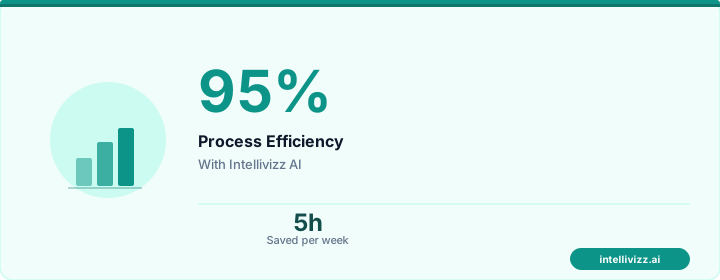
📱 Reduce no-shows by 30-40% with smart reminders
See how automation transforms industry operations
What Top-Performing Practices Do Differently
Practices with no-show rates below 10% share common characteristics:
- Multi-channel automated reminders: Text + email + phone call sequence at 7 days, 48 hours, and morning-of the appointment.
- Two-way communication: Patients can confirm, reschedule, or cancel via text reply — reducing friction.
- Same-day/next-day availability: Maintaining open slots for acute needs reduces far-out bookings that become no-shows.
- Waitlist automation: Cancelled slots are instantly offered to waitlisted patients, recovering 40-60% of cancellations.
- New patient engagement: Personal welcome calls within 24 hours of booking reduce first-visit no-shows by up to 50%.
For a complete playbook, read our guide on 12 evidence-based strategies to reduce appointment no-shows.
How to Calculate Your Practice's No-Show Rate
Pull 90 days of data from your practice management system and calculate: (Total No-Shows + Late Cancellations) / Total Scheduled Appointments × 100. Then break it down by: provider, day of week, time of day, appointment type, new vs. established patient, and insurance type. This segmented analysis reveals exactly where your no-show problem is concentrated — and where targeted intervention will have the biggest impact.
If your practice's no-show rate is above 15%, there's significant revenue to recover. Book a free consultation to see how automated patient engagement can bring your rate below the industry average.
📱 Reduce no-shows by 30-40% with smart reminders
From manual processes to automated excellence
Ready to modernize your practice? Explore our healthcare automation solutions, Dental No-Show Rate Average: Industry Benchmarks and..., or How Much Do No-Shows Cost Your Dental Practice? The....