
Patient No-Show Rate by Specialty: Benchmarks, Data, and What Drives the Differences
Patient no-show rates vary dramatically by specialty — from 5-8% in oncology to 30-40% in behavioral health. Understanding where your specialty falls and why helps you set realistic targets and choose the right reduction strategies. For dental practices specifically, see our deep-dive on the average dental no-show rate by appointment type. Patient appointment reminder automation is the highest-ROI tool for reducing no-shows across all specialties.
No-Show Rates by Specialty
Based on aggregated data from EHR platforms, health system studies, and practice management research:
| Specialty | Average No-Show Rate | Range |
|---|---|---|
| Oncology | 5-8% | 3-12% |
| Orthopedics | 8-12% | 5-18% |
| Cardiology | 10-14% | 7-20% |
| OB/GYN | 12-16% | 8-22% |
| General Surgery | 12-16% | 8-20% |
| Primary Care | 15-20% | 10-28% |
| General Dentistry | 15-20% | 10-30% |
| Ophthalmology/Optometry | 15-18% | 10-25% |
| Dermatology | 18-23% | 12-30% |
| Pediatrics | 20-25% | 15-35% |
| ENT | 18-22% | 12-28% |
| Podiatry | 18-22% | 12-28% |
| Physical Therapy | 15-20% | 10-28% |
| Chiropractic | 15-22% | 10-30% |
| Psychiatry/Behavioral Health | 25-35% | 18-45% |
| Community Health Centers | 25-35% | 20-45% |
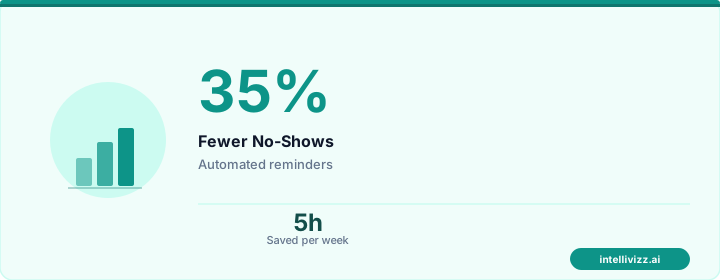
📱 Reduce no-shows by 30-40% with smart reminders
See how automation transforms industry operations
What Drives the Differences
Symptom Severity and Urgency
Oncology has the lowest no-show rate because patients are acutely aware of the consequences of missing treatment. Dermatology and primary care have higher rates because many conditions aren't perceived as urgent — patients figure they'll reschedule "next week" and never do.
Appointment Lead Time
Specialties with long wait times (dermatology: 4-6 weeks, psychiatry: 6-8 weeks) have higher no-show rates because the gap between booking and appointment allows life to intervene. Urgent care and same-day primary care slots have near-zero no-show rates.
Patient Demographics
Community health centers and Medicaid-heavy practices see higher rates due to transportation barriers, unstable housing, and competing life stressors. Practices serving affluent, privately insured populations typically see rates 5-10 percentage points lower.
Visit Frequency
High-frequency visit patterns (chiropractic: 2-3x/week, physical therapy: 2-3x/week) create appointment fatigue. The first few visits have normal no-show rates; rates increase as treatment progresses and urgency fades.
Stigma and Anxiety
Behavioral health no-show rates are the highest of any specialty, driven by stigma, appointment anxiety, and the nature of the conditions being treated. Patients may feel better on the day of the appointment and deprioritize, or anxiety about the session itself becomes a barrier.
Specialty-Specific Reduction Strategies
High-wait-time specialties (Dermatology, Psychiatry): More aggressive reminder sequences starting earlier, waitlist management, and pre-appointment engagement to maintain commitment over the wait period.
High-frequency specialties (Chiropractic, PT): Automated recurring appointment management, treatment plan progress tracking, and milestone motivation messages.
Pediatrics: Parent-focused communication, sibling co-scheduling, and school-calendar awareness in scheduling.
Behavioral health: Empathetic reminder messaging, telehealth alternatives offered in reminders, and warm-handoff from intake to first appointment.
Setting Your Target
Use the benchmarks above to set a realistic target for your specialty. A reasonable 90-day goal is reducing your current rate by 30-40%. Practices using comprehensive no-show reduction strategies typically achieve rates 40-55% below their specialty average within 6 months.
Ready to benchmark and reduce your practice's no-show rate? Book a free consultation for a specialty-specific analysis and reduction plan.
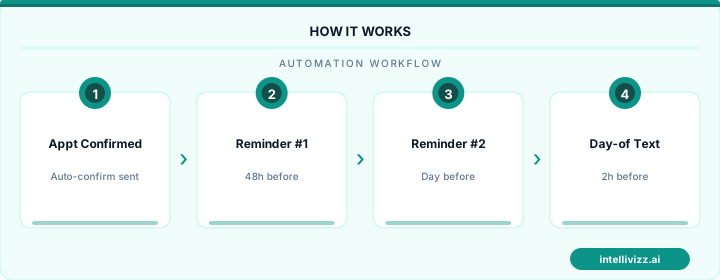
📱 Reduce no-shows by 30-40% with smart reminders
From manual processes to automated excellence
Regional Variation in No-Show Rates: Geography Matters
National average no-show rates by specialty provide useful benchmarks, but the variation by geography is significant and often overlooked. Urban practices in high-density markets (New York, DC, Chicago, Los Angeles) consistently report no-show rates 3-5 percentage points lower than national averages, primarily because patients have more transportation options (public transit reduces the "car broke down" cancellation reason) and more competition from nearby providers creates higher perceived stakes for missed appointments. Rural practices, conversely, often report no-show rates 4-8 points higher than national averages, driven by longer travel distances that create greater friction around attendance.
The DC metro area specifically presents a unique pattern: weekday no-show rates are slightly lower than national averages (reflecting the high federal employee population with reliable commutes), but Friday afternoon and Monday morning slots have no-show rates 40-60% higher than mid-week appointments — a pattern driven by federal government work-from-home schedules and the tendency of government workers to extend long weekends. Practices in the DC metro that deploy targeted reminder sequences for these high-risk slots see significantly better results than those using uniform reminder timing.
Medicaid patient populations across all geographies have no-show rates approximately 2x higher than commercially insured populations — a well-documented disparity driven by social determinants including transportation barriers, childcare constraints, work schedule inflexibility, and the cumulative burden of managing multiple health conditions. Practices serving mixed payer populations should configure different reminder sequences for Medicaid patients: more touchpoints, earlier final reminders (72 hours rather than 24 hours, to allow for transportation arrangement), and proactive transportation resources in the reminder content.
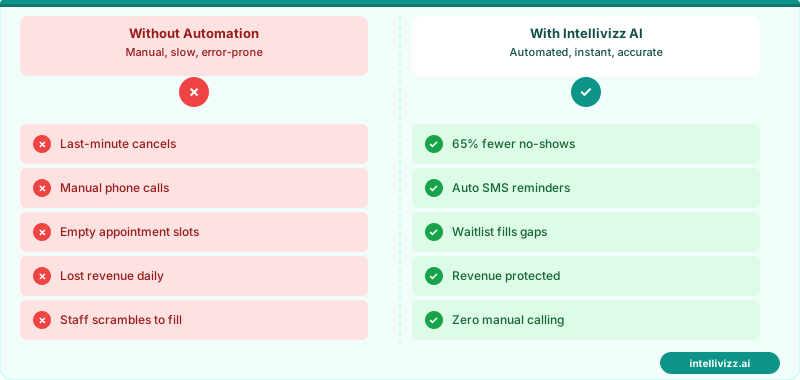
📊 No-show rates vary 3x across specialties — and geography adds another layer
Understanding your specific no-show drivers enables targeted automation that outperforms generic reminders.
Calculating the True Cost of No-Shows in Your Practice
Most practice administrators calculate no-show cost as simply the lost revenue from the missed appointment. But the true economic cost is significantly higher when you account for all factors. Direct revenue loss is only the starting point. Staff time spent attempting to confirm, fill, or follow up on no-show slots adds 15-25 minutes of administrative cost per no-show. The slot that goes unfilled after a no-show could have been offered to a waitlisted patient — the opportunity cost of that missed booking represents additional revenue loss. High no-show rates also affect quality metrics and payer contract performance in value-based care arrangements, which can reduce per-patient reimbursement rates across the entire practice panel.
A more complete no-show cost calculation for a primary care practice with 15% no-show rate and 25 appointments per day: direct revenue loss = 3.75 missed appointments × $220 average visit revenue = $825/day. At 250 working days per year, that's $206,250 in direct annual revenue loss. Adding staff time (3.75 × 20 minutes × $20/hour equivalent) = $25/day, or $6,250 annually. Opportunity cost from un-filled slots (assume 40% fill rate on recovered slots with 2-hour notice) = $198,000 recoverable. Total economic impact including opportunity cost: over $200,000 annually for a single primary care physician.
| Specialty | National Avg No-Show | DC Metro Avg | Annual Cost/Physician |
|---|---|---|---|
| Primary Care | 18–24% | 14–19% | $150,000–$300,000 |
| Psychiatry/Mental Health | 22–30% | 19–26% | $80,000–$180,000 |
| Dermatology | 12–18% | 10–15% | $100,000–$240,000 |
| Cardiology | 10–15% | 8–12% | $80,000–$200,000 |
| Orthopedics | 8–13% | 7–11% | $120,000–$280,000 |
Evidence-Based Interventions for High-Risk Appointments
Not all no-show risk is equal, and the most sophisticated practice management systems now stratify patients by no-show risk at the time of booking — allowing differentiated reminder intensities based on individual patient history. A patient who has never missed an appointment in 5 years of care needs only a single confirmation reminder. A patient who has missed 3 of their last 8 appointments warrants a 5-touch sequence with a staff phone call as one of the touchpoints. This risk-stratified approach is more cost-effective than blanket intensive reminders for all patients and produces better outcomes by concentrating attention where it matters most.
For the highest-risk patient segments, adding a small deposit or cancellation fee for new patient appointments has shown 15-25% reduction in no-shows in practices that implement it carefully. The deposit must be positioned as convenience (holding the appointment slot, applied toward the visit cost) rather than punitive — and must be accompanied by a generous, friction-free cancellation policy (cancel or reschedule at least 24 hours in advance for a full refund) so that it encourages early cancellation rather than no-shows. Combine this strategy with the appointment reminder automation best practices for a comprehensive no-show reduction system.
Technology Solutions for No-Show Prevention: Choosing the Right Platform
The market for appointment reminder and no-show prevention technology has matured significantly over the past five years. Practices now have access to purpose-built healthcare reminder platforms (Klara, Solutionreach, Luma Health, Relatient), EHR-native reminder modules (Epic's MyChart messaging, Athenahealth's patient engagement tools), and general-purpose automation platforms that can be configured for healthcare use. Each category has distinct advantages and trade-offs that should inform selection based on practice size, EHR infrastructure, and complexity of reminder needs.
Purpose-built platforms offer the fastest implementation, the most healthcare-specific features, and vendor support teams with deep healthcare domain knowledge. They typically cost $200–$800 per month for a single-physician practice and scale to $2,000–$5,000 for large multi-physician groups. EHR-native modules are attractive for practices already invested in a major EHR platform, as they eliminate integration complexity — but they often offer less customization and fewer channels than purpose-built platforms. General-purpose platforms (Zapier, Twilio, HubSpot) offer maximum flexibility but require technical setup resources and ongoing maintenance that most practices lack in-house.
Regardless of platform choice, the configuration of the reminder content and timing matters more than the technology itself. A practice using a basic SMS reminder platform with well-crafted messages and optimal timing will outperform a practice using a sophisticated purpose-built platform with generic, poorly-timed messages. Before investing in platform evaluation, establish clarity on your current no-show rate by specialty and appointment type, your patients' preferred communication channels, and the specific workflow improvements you want automation to produce. This clarity makes platform evaluation faster and ensures the chosen solution addresses actual needs rather than impressive feature lists.
Ready to modernize your practice? Explore our healthcare automation solutions, How to Reduce No-Shows in Your Medical Practice:..., or How Does AI Reduce No-Shows for Doctors? 7 Proven....