
Automated Patient Billing Reminders: Collect More, Chase Less, Keep Patients Happy
The Patient Collections Crisis
Patient financial responsibility has more than tripled over the past decade. With high-deductible health plans now covering 55% of commercially insured workers, the average patient owes $1,200-$2,500 out of pocket per year for medical care. Yet most practices still use the same collections approach from 1995: mail a paper statement, wait 30 days, mail another, wait 30 more days, send to collections.
This approach collects 55-65% of patient balances. The rest? Written off, sent to collections agencies (who take 25-40% of what they recover), or simply abandoned. For a practice with $500,000 in annual patient responsibility, that's $175,000-$225,000 in uncollected revenue.
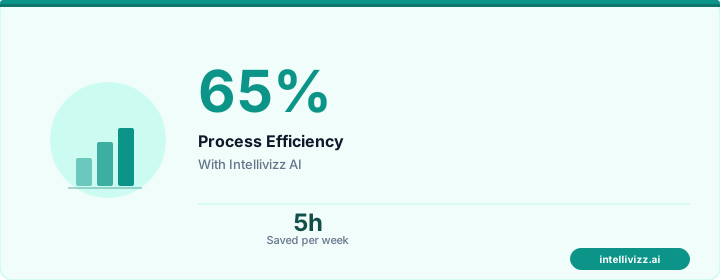
💰 Get paid faster with automated billing workflows
The data speaks for itself
Why Paper Statements Don't Work Anymore
The paper statement model fails for predictable reasons:
- Mail is slow — statements arrive 5-10 days after mailing, and patients pay an average of 18 days after receiving them. Total: 23-28 days for first payment attempt.
- Paper is ignorable — 30% of medical statements are thrown away unopened, mistaken for junk mail or insurance EOBs.
- Payment friction is high — writing a check, finding an envelope and stamp, and mailing it back is a multi-step process most people avoid.
- No escalation path — each statement looks identical to the last, creating no urgency.
- Cost per statement — at $0.85-$1.20 per statement (printing, postage, processing), a 3-statement cycle costs $2.55-$3.60 per patient before you've collected a dime.
The Automated Multi-Channel Approach
Automated billing reminders transform collections by meeting patients where they are — their phone — with frictionless payment options.
Day 1: Digital Statement
As soon as the claim adjudicates and patient responsibility is determined, an automated text and email are sent with the balance amount and a one-tap payment link. "Your balance with Dr. Smith's office is $185.00. Pay securely here: [link]." Average response: 35% pay within 48 hours.
Day 7: Friendly Reminder
A follow-up text: "Just a reminder — your $185.00 balance is due. Need a payment plan? Reply PLAN for options." This captures another 15-20% of balances and surfaces patients who need financial flexibility.
Day 14: Urgency Escalation
Email and text with slightly more direct language: "Your account has a past-due balance of $185.00. Please make a payment to keep your account current." Another 10-15% pay at this stage.
Day 30: Final Notice
Last automated outreach before manual intervention: "Your $185.00 balance requires immediate attention. Pay now to avoid additional collection activity." Captures 5-8% more.
Day 45+: Staff Review
Only the remaining 15-20% of balances require human attention. Staff focus their time on high-balance accounts where a conversation can negotiate payment plans — not chasing $35 copays.
Payment Plan Automation
One of the biggest drivers of uncollected balances isn't unwillingness to pay — it's inability to pay the full amount at once. Automated payment plans solve this by offering self-service installment options:
- Patient replies "PLAN" to a billing reminder
- System offers 3-6 month installment options (e.g., $185 → 3 payments of $61.67)
- Patient selects a plan and enters payment method
- Automated charges process monthly; patient receives receipts
- No staff time required for setup, billing, or tracking
Practices offering automated payment plans collect 92-95% of balances, compared to 55-65% with statement-only approaches. The key insight: patients who owe $500+ are 4x more likely to pay via installments than as a lump sum.
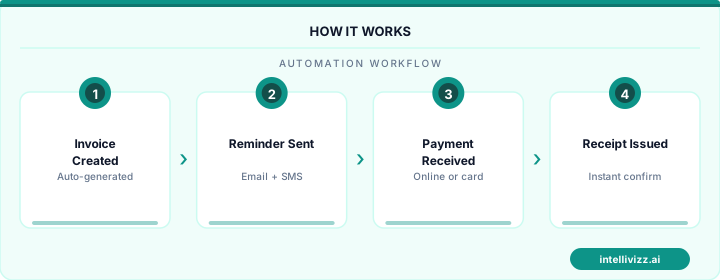
💰 Get paid faster with automated billing workflows
Smart technology, better results
Impact on Collections Performance
| Metric | Paper Statements | Automated Reminders |
|---|---|---|
| Collection rate | 55-65% | 82-90% |
| Average time to payment | 42 days | 11 days |
| Staff hours per 100 accounts | 15-20 hours | 2-4 hours |
| Cost per dollar collected | $0.08-$0.12 | $0.02-$0.04 |
| Patient satisfaction with billing | 62% | 84% |
HIPAA Considerations
Automated billing communications must comply with HIPAA's minimum necessary standard. Best practices include: Related: learn how copay collection automation captures patient payments before they walk out the door.
- Texts include the amount and practice name but no clinical details
- Payment links authenticate the patient before showing balance details
- Email statements are sent as secure links, not PDF attachments
- Patients can opt out of text/email and receive paper only
- All communication platforms execute BAAs and maintain encryption
Practices already using HIPAA-compliant AI systems for phone handling can often extend the same compliance framework to billing communications, simplifying the vendor management process.
Integrating with Practice Management
The most effective billing automation connects directly to your practice management system to trigger reminders based on real-time claim status. This prevents embarrassing scenarios like sending a bill for a claim that was just paid by insurance, or reminding a patient about a balance that was adjusted off.
Look for platforms that offer bidirectional integration: the PMS triggers reminders when balances are due, and the payment platform posts payments back to the PMS automatically, keeping ledgers current without manual posting.
Combined with broader payment automation including copay collection, insurance billing optimization, and write-off management, automated billing reminders become one piece of a comprehensive revenue leakage prevention strategy.
Frequently Asked Questions
Do patients find automated billing texts annoying?
Patient satisfaction with text-based billing actually exceeds paper statements by 20+ points. Patients appreciate the convenience and transparency. The key is keeping messages brief, professional, and always including an easy payment option.
What about patients without smartphones?
Automated systems should include email and paper statement fallbacks. For patients who only accept paper, the automation still saves time by generating and mailing statements automatically without staff intervention.
How do I handle disputes through automated systems?
Include a "Questions? Reply HELP" option in every message. Disputes are routed to staff for personal attention, but the automation handles the 80% of balances that don't require human involvement.
Payment Communication Psychology
The words you use in billing reminders matter as much as the timing. Small changes in message framing, send timing, and tone escalation can dramatically shift patient payment behavior without increasing collection costs. Here is the science behind effective payment communication.
Message Framing That Increases Response Rates
Loss-aversion framing outperforms neutral language by 18-23 percent in healthcare payment contexts. Instead of "You have a balance of 150 dollars," try "Avoid a late fee by paying your 150 dollar balance before March 15th." Similarly, anchoring the message to a specific benefit — "Pay today and keep your account in good standing for your next visit" — ties the payment to continued access to care. Always include the exact balance and a one-tap payment link; every additional step between reading the message and completing payment reduces conversion by approximately 12 percent.
Optimal Send-Time Algorithms
Payment reminders sent between 10 AM and 12 PM on Tuesdays and Thursdays generate the highest response rates across most patient demographics. However, the ideal time varies by age group — patients under 35 respond better to evening messages (6-8 PM) when they are reviewing personal finances, while patients over 55 engage more with morning communications. Track open rates and payment completion rates by send time for your specific patient population, then let your automation platform optimize delivery windows based on individual patient behavior patterns over time.
Integrating send-time optimization with medical practice payment automation ensures every reminder reaches the patient when they are most likely to take action, maximizing collection efficiency.
Escalation Tone Sequencing
Design a deliberate tone progression across your reminder sequence. Message one should be warm and informational — a friendly heads-up. Message two adds gentle urgency with a specific deadline. Message three introduces consequences without being threatening — mention that accounts beyond 90 days may be referred to collections, and offer a payment plan as an alternative. Never use accusatory language or ALL CAPS, which damage the patient relationship and can trigger complaints. The goal is firm clarity, not intimidation, because patients who feel respected are three times more likely to pay than those who feel threatened.
For more on optimizing collections, explore our guide on copay collection automation or learn about comprehensive payment automation strategies.
Ready to modernize your practice? Explore our healthcare automation solutions.