
School Payment Automation: Modernizing Tuition and Fee Collection for Private and Independent Schools
The Tuition Collection Challenge Facing Private and Independent Schools
Private and independent schools face a billing challenge that is structurally unlike any other industry: they must collect tuition from families who are simultaneously their most important customers, their primary community advocates, and the parents of the children the school serves. Every tuition collection interaction carries relational weight that a gym membership billing system or a SaaS subscription renewal simply doesn't.
The numbers are significant. Industry surveys consistently find that 5–15% of families at independent schools are late on tuition payments in any given month. For a school with 400 families paying an average of $18,000 per year ($1,500/month), a 10% late rate means 40 families carrying overdue balances totaling $60,000+ in any given billing cycle. Managing those 40 families manually — sending reminders, tracking responses, escalating where appropriate, working with finance directors on exception cases — consumes dozens of administrative hours per month that could be applied to the school's educational mission.
School payment automation solves this challenge without replacing the human judgment and relational sensitivity that school billing requires. The automation handles the routine — reminders, receipts, payment plan management, scheduling follow-up sequences — while flagging the exceptions that genuinely need a human conversation: families facing unexpected hardship, disputes about charges, or accounts approaching the threshold where enrollment status must be addressed.
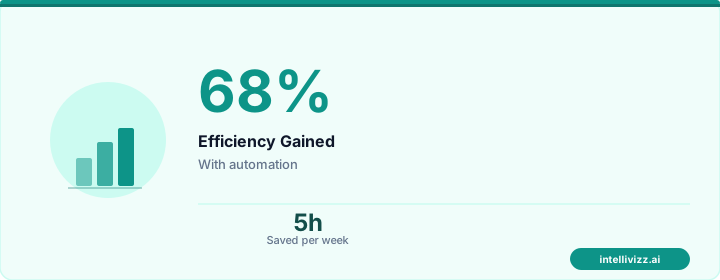
📋 10% late-payment rate = $60,000+ in overdue balances per billing cycle
For a 400-family school, automated reminders and dunning sequences can recover the equivalent of multiple staff hours per week — and strengthen parent trust in the process.
Payment Plan Setup and Management Automation
Most private schools offer multiple payment plan options: full annual payment (often with a discount), semi-annual, quarterly, monthly, or 10/11-month school-year plans. Manually managing which family is on which plan, tracking when each installment is due, and chasing exceptions is among the most time-consuming administrative functions in a school's business office.
Digital Plan Enrollment
Payment plan automation begins with the enrollment process. Rather than paper forms or individual email exchanges with the business office, families complete an online plan selection form — integrated with the school's student information system (SIS) and billing platform — that captures their preferred payment schedule, payment method (ACH, credit card, or check), and authorization for recurring charges. The setup is completed once per academic year, with automatic re-enrollment prompts at the beginning of each new year.
Digital plan enrollment reduces enrollment errors (misread plan codes, missed signatures, wrong amounts authorized) and eliminates the data entry burden on business office staff. The plan data flows directly from the enrollment form into the billing system, creating the payment schedule automatically and triggering a confirmation to the family with their full payment calendar for the year.
Automated Payment Processing and Receipts
For families on ACH or credit card plans, payments process automatically on the scheduled dates without staff intervention. Each successful payment triggers an automatic receipt email to the family's confirmed email addresses — a small but meaningful communication that families appreciate and that reduces inquiries to the business office about whether payments were received.
Payment data is posted automatically to the student's account in the SIS and billing platform, maintaining real-time balance accuracy without manual posting. For schools using platforms like FACTS Management, Blackbaud Tuition Management, or TADS, native integrations handle this posting automatically. For schools with custom billing setups, webhook-based integrations post payment confirmations within minutes of processing. This directly complements the broader enrollment workflow automation detailed in how to automate the school enrollment process.
Multi-Channel Payment Reminders: Email, SMS, and App Notifications
The most effective tuition reminder systems operate across multiple channels with intelligent sequencing — not sending the same message on every channel simultaneously (which feels like spam) but deploying different channels at different points in the pre-due and post-due sequence based on response patterns.
Pre-Due Reminder Sequence
5 days before due date: Email — "your tuition payment is coming up" reminder with one-click payment option
1 day before due date: SMS — brief, warm reminder: "Hi [Parent Name], a friendly reminder that [Child's] tuition of $[amount] is due tomorrow. Pay here: [link]"
Due date: Push notification (if parent app is installed) — same-day reminder with payment link
The pre-due sequence dramatically reduces the number of families who miss payment dates simply because the date slipped their memory. For families on automatic payment plans, pre-due reminders also serve as advance notice of the upcoming charge — reducing the number of unexpected-charge inquiries and payment disputes.
Post-Due Escalation Sequence
When a payment is not received on the due date, the automation transitions to a post-due sequence. The design of this sequence requires careful calibration — firm enough to generate action, sensitive enough not to damage the relationship with a family that is a genuine community partner.
Late Payment Escalation: Friendly to Firm to Administrative
The late payment escalation framework used by well-designed school billing automation mirrors the natural progression of how a thoughtful business office director would handle the situation — starting with generous assumptions (oversight, technical issue) and moving toward firmer communication only as time passes and the balance grows.
Stage 1: Friendly (Days 1–7 Past Due)
The Day 1 message assumes a technical issue or simple oversight: "Hi [Parent Name], it looks like we may not have received your [Month] tuition payment yet — could be a processing delay or a card issue. Easy to resolve: [payment link] or [contact info] for any questions. No action needed if this crossed in the mail!"
This framing — "no action needed if this crossed in the mail" — gives parents who have already paid (but whose payment is processing) a way to disregard the reminder without embarrassment. It normalizes the possibility of a technical issue rather than immediately signaling suspicion of intentional non-payment.
Days 3 and 7 bring progressively clearer reminders, but still in a warm tone. The Day 7 message adds a gentle offer: "If you're experiencing any unexpected financial pressure this month, please don't hesitate to reach out — we have options, and we'd rather talk than have an outstanding balance create stress."
Stage 2: Firm (Days 8–21 Past Due)
By Day 14, the tone becomes more direct. The message acknowledges the ongoing balance, clearly states the amount and original due date, notes any applicable late fees (if the school's policy includes them), and provides clear next steps. The communication remains respectful but removes the tentative language of the early sequence.
For families on manual payment plans (check, cash), the Day 14 message includes a request for communication: "If you have already sent your payment or need to discuss your account, please contact our business office directly at [contact]. We want to work with every family to resolve outstanding balances promptly."
The Day 21 message escalates further — the tone is now clearly administrative rather than friendly, and the message includes a specific deadline for response before the account moves to administrative review. This message is almost always effective at generating a response: even families who have been avoiding the situation will typically respond to a message with a clear deadline and consequence.
Stage 3: Administrative Review (Day 22+)
At the administrative review stage, the automation flags the account for direct handling by the finance director or head of school, generates a formal account statement, and suspends further automated outreach in favor of personal contact. The automation has done its job — surfacing the delinquent account with a full history of all automated contacts, responses, and unresponded messages — so staff can have an informed conversation with the family without needing to reconstruct the billing history from scratch.
For families who have reached administrative review multiple times, the system maintains a complete interaction log that informs enrollment renewal decisions, financial aid conversations, and in extreme cases, unenrollment notice processes. This documentation is invaluable — it demonstrates to families, boards, and legal counsel that the school followed a consistent, documented process before taking any formal action.
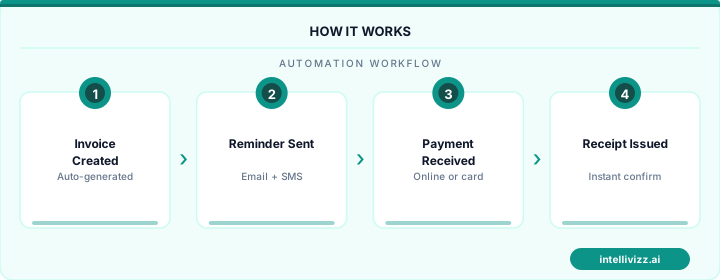
🎯 3-stage escalation: friendly → firm → administrative review
Well-calibrated escalation sequences preserve family relationships while dramatically reducing delinquency rates — typically cutting late-payment rates from 10–12% down to 3–5%.
Financial Aid and Scholarship Disbursement Automation
Financial aid administration involves a parallel set of communication and workflow challenges. Families receiving aid need timely notification of their award amounts, disbursement schedules, and the net tuition amounts they owe. Internally, the business office needs to ensure that aid disbursements are applied accurately to accounts, that re-application deadlines are communicated, and that families whose aid status changes mid-year are handled appropriately.
Automation handles financial aid disbursement by integrating with the school's aid management process:
- Award notification letters generated automatically from aid decision data and sent via email with clear breakdown of award amount, disbursement timing, and net balance
- Disbursement postings made automatically to student accounts when aid is applied, with receipt confirmation to the family
- Re-application reminders sent at configurable intervals before the following year's deadline, with links to the application portal
- Mid-year aid change notifications (for families whose circumstances change and whose aid is adjusted) generated automatically with the revised payment schedule
For schools participating in third-party aid management programs (FACTS Grant and Aid, School and Student Services, Clarity), automation workflows can integrate with those platforms to synchronize aid data and eliminate duplicate data entry between systems. See also how these systems connect to the broader enrollment pipeline in school enrollment funnel automation.
Incidental Fee Collection: Field Trips, Lunch Accounts, and Uniforms
Beyond tuition, private schools collect dozens of different incidental fees throughout the year — field trip deposits, lunch account replenishment, uniform orders, technology fees, athletics participation fees, activity fees, and more. Each of these represents a small collection challenge that multiplies across the full school population into a significant administrative burden. You may also want to explore our guide on how to reduce late tuition payments for a prevention-first approach.
Automating incidental fee collection means:
- Fee invoices generated and sent automatically when a student is enrolled in an activity or when a fee trigger occurs (low lunch balance alert, field trip registration, uniform order)
- Online payment collection for each fee type, with payment confirmation posted to the student's account
- Consolidated billing statements that show all outstanding charges — tuition and incidental fees — in a single view, reducing the cognitive burden on families managing multiple charge types
- Low-balance alerts for prepaid accounts (lunch, copy cards, elective materials) that trigger automatic notifications before accounts run dry
The operational benefit of automating incidental fee collection is disproportionate to the dollar amounts involved. A $25 field trip deposit that has to be tracked and chased manually for 85 students costs far more in staff time than the $25 represents. Automating the collection of these fees frees business office staff for the high-judgment work — exception handling, financial aid conversations, delinquency management — that requires human expertise.
Parent Communication Around Billing: Transparency Builds Trust
The most underappreciated aspect of school billing automation is its role in building parent trust through transparency. Parents who receive clear, consistent, proactive communication about their billing — rather than discovering charges retroactively or receiving first contact only when there's a problem — report significantly higher satisfaction with the school's administrative experience.
Key communication practices that automation enables at scale:
- Annual billing calendar email: Sent each August with every payment date, amount, and method for the coming school year — so families can plan their household budgets in advance
- Enrollment confirmation billing summary: When re-enrollment contracts are signed, an automatic confirmation summarizing the following year's tuition, payment plan, and financial aid (if applicable) creates a clear record of the family's financial commitment
- Automatic receipts for every payment: Every successful payment generates an immediate receipt — removing the need for families to contact the business office to confirm payments were received
- Proactive late fee waiver communication: For families who are occasionally late but generally reliable, an automated note explaining late fee waiver processes and how to request one maintains goodwill while still enforcing the school's policies
For schools in the DMV region, these communication systems complement the broader tuition billing best practices covered in resources like tuition payment automation for private schools in the DMV and school communication automation in Maryland.
Integration with SIS and Billing Platforms
School payment automation is most effective when integrated directly with the school's existing software stack. The major platforms in the independent school market offer varying degrees of native automation and third-party integration capability:
| Platform | Type | Key Automation Features |
|---|---|---|
| FACTS Management | Tuition management + SIS | Payment plan management, automated reminders, delinquency reporting |
| Blackbaud Tuition Management | Tuition management | Online billing portal, automatic invoicing, integration with Blackbaud SIS |
| TADS | Tuition + enrollment + aid | Integrated aid and billing, family portal, payment plan flexibility |
| Veracross | Full SIS + billing | Native billing module, parent portal, configurable reminder workflows |
| Ravenna Solutions | Enrollment + billing | Enrollment-to-billing pipeline, digital contracts, automated invoicing |
| Magnus Health / SchoolDoc | Health forms + billing | Health form compliance fees, lab result billing, insurance verification |
For schools whose existing platforms provide limited automation, supplementary tools — CRM-based automation, SMS platforms, or dedicated dunning software — can layer on top of the SIS to provide reminder sequences and multi-channel outreach capabilities the core platform lacks. The financial return on school payment automation is measurable and rapid. A school that reduces its average late-payment rate from 12% to 5% — a realistic outcome with structured reminder automation — recovers $105,000 in annual cash flow on a 400-family student body. Against a typical automation platform cost of $5,000–$15,000 per year, the ROI is clear within the first semester of operation.
Financial Aid Integration and Tuition Accounting Workflows
School payment automation reaches its full potential when integrated with the financial aid ecosystem — a domain of accounting complexity that generic payment processing platforms handle poorly. The interplay between tuition charges, financial aid credits, and family payment obligations creates reconciliation challenges that demand purpose-built automation.
Merit scholarship disbursement follows a calendar that rarely aligns with tuition due dates. A student awarded a $12,000 annual merit scholarship may have the award split across fall and spring terms, but the disbursement timing depends on enrollment verification, satisfactory academic progress checks, and donor-restriction compliance. Automated payment systems must hold tuition invoices in a pending state until scholarship credits post, then generate a net-balance statement showing the family's remaining obligation. Schools that send full-tuition invoices before scholarship credits post generate unnecessary anxiety calls to the business office and erode trust in the payment system.
Need-based aid reconciliation introduces additional complexity because aid amounts frequently change mid-year. A family that experiences job loss, divorce, or medical emergency may receive a mid-year aid adjustment that retroactively changes their payment obligation. Automated systems must recalculate the remaining balance, adjust the payment plan installments, generate a revised payment schedule, and issue refunds for any overpayments — all without manual intervention from the business office staff. Schools processing 50-100 mid-year aid adjustments annually save 200-400 staff hours by automating the recalculation-and-notification workflow.
Sibling discount calculation is a deceptively complex pricing problem. A school offering 10% off the second child and 20% off the third child must determine which child is "first" when all three attend simultaneously — typically the oldest, but some schools use the highest-grade-level student. When the oldest child graduates mid-year or transfers, the discount structure recalculates for the remaining children. Automated tuition billing must maintain a family-level enrollment record, track sibling relationships, apply the correct discount tier as enrollment changes, and generate adjusted invoices within the same billing cycle.
Payment plan hardship modification workflows handle families who fall behind on installments due to financial difficulty. Rather than sending the account to collections — which damages the school-family relationship and rarely recovers the full amount — automated systems can offer pre-approved modification options: extending the payment period by 2-3 months, reducing installment amounts with a balloon payment in the final month, or temporarily suspending payments with interest accrual. These modifications require electronic signature capture, updated amortization schedules, and compliance documentation showing the school offered reasonable accommodation before pursuing collection action.
Tuition refund policy automation applies the school's withdrawal-refund schedule without manual calculation errors. Most schools follow a declining-refund model: 90% refund in the first two weeks, 75% through week four, 50% through the semester midpoint, and 0% thereafter. Automated systems must calculate the refund based on the official withdrawal date, apply it against any outstanding balance, offset financial aid that must be returned to the funding source, and generate the net refund or net balance-due amount. When financial aid is involved, the school must perform a Return of Title IV Funds calculation (for federally funded programs) that determines how much aid the student "earned" based on the percentage of the enrollment period completed.
1098-T generation and filing — required for schools receiving tuition payments — must be automated to meet IRS deadlines. The form reports qualified tuition and related expenses, scholarships and grants, and adjustments for prior years. Schools must generate individualized 1098-T forms for every student who made payments or received scholarships, make them available electronically by January 31, and file them with the IRS by the end of February. Endowment draw-down tracking intersects with tuition accounting when scholarship funds are sourced from endowed gifts with specific spending-rate restrictions; automated systems must track the corpus balance, calculate the allowable annual draw based on the spending policy (typically 4-5% of a 12-quarter rolling average), and flag when scholarship commitments exceed the allowable draw amount.
Ready to modernize your school's operations? Explore our education automation solutions, Tuition Reminder System for Private Schools: Designing..., or Failed Tuition Payment Recovery: Automating ACH....
Relevant AI Automations
AI Review Management
All-in-one review management: automated review requests, AI-powered responses, and review repurposing for web & social — 3 engines in 1.
Missed Call Text-Back
Instantly respond to missed calls from prospective parents with AI-powered SMS, capturing enrollment leads 24/7
AI Voice Agent - Inbound
AI answers calls 24/7, handles FAQs about programs, tuition, availability, and books tours