
Tuition Payment Automation for DMV Private Schools: Reduce Late Payments and Improve Cash Flow
The Tuition Collection Challenge in the DMV
The DC-Maryland-Virginia metro area hosts some of the nation's most expensive private schools, with tuition ranging from $15,000 to $50,000+ annually. Despite serving affluent families, 15-25% of tuition payments arrive late in any given month, creating cash flow disruptions that affect budgeting, payroll, and operations.
The irony: most late-paying families can afford the tuition. They're busy professionals — government officials, consultants, executives, attorneys — who simply forget or deprioritize the payment amidst dozens of other financial obligations. The solution isn't more aggressive collection; it's easier, more automated payment processes.
💰 Get paid faster with automated billing workflows
Smart technology, better results
Automated Payment Infrastructure
Auto-Pay Enrollment
The single most impactful change: making auto-pay the default payment method during enrollment. Schools that default to auto-pay (with opt-out) see 70-80% enrollment in automatic payments, compared to 25-35% for opt-in programs.
- ACH direct debit (lower processing fees than credit card)
- Credit/debit card recurring charges (higher fees but preferred by some families)
- Flexible date selection (1st or 15th of month) to align with family pay cycles
Payment Plan Automation
DMV families often prefer monthly payments over lump-sum tuition. Automated payment plans handle:
- 10-month, 11-month, or 12-month payment schedule options
- Automatic proration when students enroll mid-year
- Failed payment retry logic (try again in 3 days, then 7 days)
- Automatic late fee assessment with grace period
- Payment plan adjustment requests (extend terms, modify amounts)
Reminder Sequences
For families not on auto-pay, automated reminders reduce late payments dramatically:
- T-7 days: "Your tuition payment of $[amount] is due on [date]. Pay online: [link]"
- T-1 day: "Tuition payment reminder — due tomorrow. One-click payment: [link]"
- Due date: "Your tuition payment is due today. Pay now to avoid late fees: [link]"
- T+3 days: "Your tuition payment is past due. A late fee of $[amount] will be applied on [date]. Pay now: [link]"
- T+7 days: "Important: your account is past due. Please contact our business office to discuss: [phone] or pay online: [link]"
Financial Aid and Scholarship Integration
DMV schools with financial aid programs face additional complexity. Automated systems handle:
- Net tuition calculation after aid awards
- Separate billing for tuition vs. fees (when aid covers tuition but not activity fees)
- Mid-year aid adjustments (family circumstances change)
- Confidential communication — aid-related billing details visible only to the business office and the family
Incidental and Fee Billing
Beyond tuition, schools bill for lunch programs, after-school care, field trips, uniforms, and technology fees. Automated billing:
- Consolidates all charges into a single monthly statement
- Allows families to pay all charges at once or individually
- Automatically applies pre-paid balances (lunch account, extended care deposits)
- Generates real-time spending reports for families
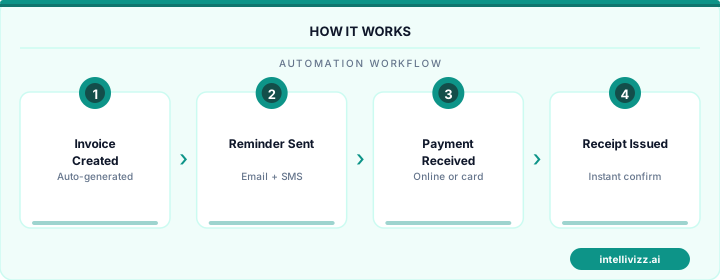
💰 Get paid faster with automated billing workflows
The data speaks for itself
Impact on School Finances
| Metric | Manual Process | Automated |
|---|---|---|
| Late payment rate | 15-25% | 5-8% |
| Average days past due | 22 days | 6 days |
| Bad debt write-offs | 2-4% of tuition revenue | 0.5-1% |
| Staff hours on collections | 20-30 hrs/month | 3-5 hrs/month |
| Family satisfaction with billing | 60-65% | 85-90% |
For a DMV school with $5M in annual tuition revenue, reducing late payments from 20% to 7% improves cash flow by $650,000 — capital that can be deployed for programs, facilities, and financial aid rather than sitting in accounts receivable.
Schools combining payment automation with re-enrollment automation and parent communication tools create a seamless financial experience that reduces friction at every touchpoint.
The Financial Complexity of DMV Private School Tuition
Private school tuition in the DC-Maryland-Virginia metro area ranges from $18,000 to $55,000+ annually — among the highest in the United States. At these price points, families expect both a premium educational experience and premium financial service: clear billing, flexible payment arrangements, transparent communication about fees, and responsive handling of billing questions. Schools that deliver subpar financial administration at these tuition levels risk the reputation damage that drives enrollment attrition, even when the educational product is excellent.
The complexity of DMV private school financial administration is compounded by the variety of payment structures schools offer. Annual payment discounts (typically 3-5% for full upfront payment), semester billing, 10-month payment plans, and 12-month plans each require different billing schedules and payment tracking. Add tuition assistance awards, sibling discounts, financial aid adjustments, extended payment agreements for families facing temporary hardship, and late payment protocols — and the financial administration burden for a school with 300 families can consume 40-60 hours per week of administrative staff time.
Tuition payment automation reduces this burden dramatically by systematizing the most time-consuming elements: payment plan generation, automatic payment processing, delinquency follow-up, and financial aid communication. The result is a financial operation that runs more smoothly, generates fewer exceptions that require manual intervention, and delivers a better experience to families — all with reduced administrative labor.
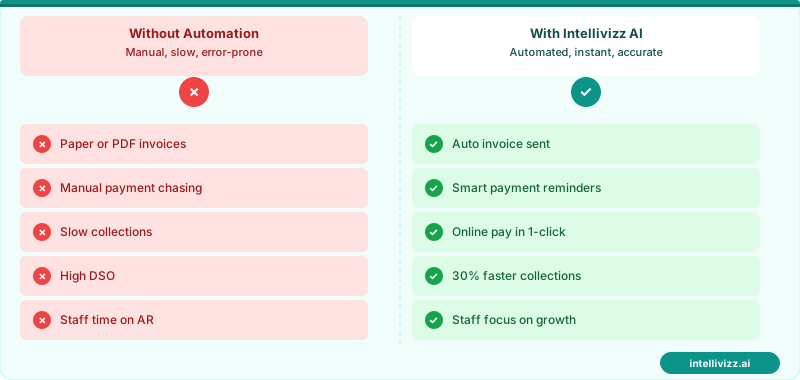
🎓 $55K/year tuition — families expect premium financial service to match
DMV private schools with payment automation reduce billing disputes by 60% and late payments by 45%.
Automated Delinquency Management: Balancing Firmness and Relationship Preservation
Tuition delinquency management in private schools is uniquely delicate. Unlike commercial collections, schools are managing a continuing relationship with families whose children are enrolled. Aggressive or tone-deaf collection communications can damage the relationship, generate negative word-of-mouth in the tight-knit private school community, and potentially trigger enrollment withdrawals that cost far more than the delinquent tuition. The goal of automated delinquency management is to recover revenue while preserving the relationship — a balance that requires careful message sequencing and escalation protocols.
Effective automated delinquency sequences begin with a neutral, informational tone: "We noticed your payment scheduled for [Date] has not yet processed — please check your payment method on file." This avoids assumption of bad faith and gives families an easy out (technical payment failure is common). If the first reminder is unresolved, the second message increases specificity about consequences (late fees that may apply, enrollment hold policies) while maintaining a helpful tone. Only after multiple unanswered automated contacts should the sequence escalate to a personal call from the Business Manager or Head of Finance — at which point the automated system has already documented the full contact history, enabling a productive and informed human conversation.
| Days Past Due | Automated Action | Tone | Escalation |
|---|---|---|---|
| 1 day | Email: payment not received | Neutral, informational | None |
| 5 days | Email + SMS: gentle reminder | Helpful, solution-focused | None |
| 10 days | Email: late fee notice | Firm, policy-based | Flag for finance staff |
| 15 days | Staff call triggered | Personal, empathetic | Business manager |
| 30+ days | Enrollment hold protocol | Formal, documented | Head of School |
Financial Aid Communication and Renewal Automation
Financial aid administration is among the most labor-intensive aspects of private school financial management. Application collection, document verification, award calculation, communication of awards, and re-application for the following year all require significant staff time and careful coordination. For schools with financial aid programs serving 20-40% of enrolled families (common in DMV private schools with explicit equity missions), automation of aid communication is particularly valuable. Related: learn how to reduce late tuition payments at your school with proactive reminder sequences.
Award notification sequences can be automated with personalized, individual award details pulled from the financial aid management system. Re-application reminders ensure that aid-receiving families submit renewal applications on time, preserving enrollment for families who depend on aid continuation. Document collection automation (securely requesting tax returns, financial statements, and employer letters with status tracking and deadline reminders) reduces the administrative burden on both families and staff. Schools using financial aid communication automation report 40-55% reduction in late or incomplete financial aid applications, which directly reduces the manual follow-up burden on the business office. For the complementary communication strategy, see the guide on school communication automation in Maryland.
Online Payment Portal Design for DMV Private Schools
The family-facing payment portal is the most important interface in tuition payment automation — it must be intuitive, mobile-friendly, and clearly informative to avoid generating support calls that negate the efficiency gains from automation. DMV private school families are technologically sophisticated and will quickly abandon a clunky portal in favor of calling the business office, which defeats the purpose of automation. Investing in portal UX design quality pays dividends in adoption rates and reduced support volume.
Essential features for a DMV private school payment portal: account balance display with a clear breakdown of tuition, fees, and financial aid applied; payment history for the current academic year; the ability to update payment method (credit card, bank account, or both) without staff assistance; automatic payment schedule display (showing upcoming payment dates and amounts for families on installment plans); and a secure document upload function for financial aid supporting documents. Families should be able to accomplish any routine financial transaction without contacting the business office.
Security features are non-negotiable for a portal handling transactions of $18,000–$55,000 per year. PCI-DSS compliance for credit card transactions, bank-grade encryption for account information, multi-factor authentication for portal access, and fraud detection for unusual payment patterns must be standard features of any portal deployed for DMV private schools. Families entrusting a school with annual payments in the tens of thousands expect the same security standards they receive from their bank or financial institution. Schools that cannot demonstrate portal security compliance will face rightful family reluctance to use automated payment systems.
Ready to modernize your school's operations? Explore our education automation solutions, or read our guide to Tuition Reminder System for Private Schools: Designing....